


Crypto exchange Bitget is tightening controls on transactions linked to 16 crypto platforms and entities, including HTX and EXMO, following recent U.S. and European regulatory actions. The restrictions are being introduced in three stages on August 7, August 13 and August 23. Bitget said transactions connected directly or indirectly to the listed entities could face review, rejection or account restrictions. In serious cases, accounts could also be terminated if the activity breaches the exchange’s terms.
The first set of restrictions took effect on August 7 and covered Aban Tether Exchange and Shelbit General Trading LLC. A second group was added on August 13, including A7 Africa, A7 Nigeria and PilotFinance Ltd.
The largest group will be affected on August 23. It includes HTX, formerly known as Huobi, EXMO Ltd, Rapira, Aifory Pro, ABCeX, WhiteBird, NoOnecrypto INC., Tradex, Monease Ltd, BitPapa and Exnode/Exnode Pay, which is registered as Arvix.
Bitget’s policy is significant because the restrictions are not limited to direct transactions. The exchange said activity involving the listed entities could also be reviewed when the connection is indirect. This means that users may need to pay closer attention to where their funds originate, where they are being sent and whether a third party or intermediary is involved.
The first two rounds of restrictions are connected to action by the U.S. Treasury’s Office of Foreign Assets Control, or OFAC. On August 7, U.S. authorities announced sanctions against Shelbit and Aban Tether, alleging that the entities processed cryptocurrency transactions linked to attempts to evade Iran-related sanctions. Authorities also cited transfers connected to Iran’s Islamic Revolutionary Guard Corps.
The August 23 restrictions have a different basis. They are linked to the European Union’s 21st package of sanctions against Russia, adopted in July. The package identified Huobi Global SA, the legal entity associated with HTX, as well as EXMO and other crypto-related platforms.
I have been in communication with Binance. This matter concerns only Binance’s UK and EU users. HTX does not conduct business in the UK or EU, and settlement negotiations with UK and EU regulators are already in progress. Any users affected in the course of these negotiations are…
— H.E. Justin Sun 👨🚀 🌞 (@justinsuntron) August 14, 2026
The measures have already triggered a response from HTX. Justin Sun said on X that he had been in contact with Binance after the exchange announced similar restrictions. Sun said the issue concerned Binance users in the UK and EU and argued that HTX does not operate in those regions. He added that discussions with regulators were continuing.
The UK has taken a broader position on the matter. Its sanctions authorities have said that the designation of Huobi Global also covers the HTX exchange because Huobi Global owns the platform. HTX has indicated that discussions with UK and EU regulators are still underway.
HTX is aware of the recent developments regarding the UK sanctions designations. The HTX exchange is committed to full compliance with all applicable laws and to cooperation with law-enforcement agencies worldwide.
The UK’s designation arrived today without prior notice or any…
— HTX (@HTX_Global) May 26, 2026
Bitget’s decision comes shortly after Binance announced comparable restrictions using the same August 7, August 13 and August 23 timeline. Binance also named several of the same platforms, including HTX and EXMO.
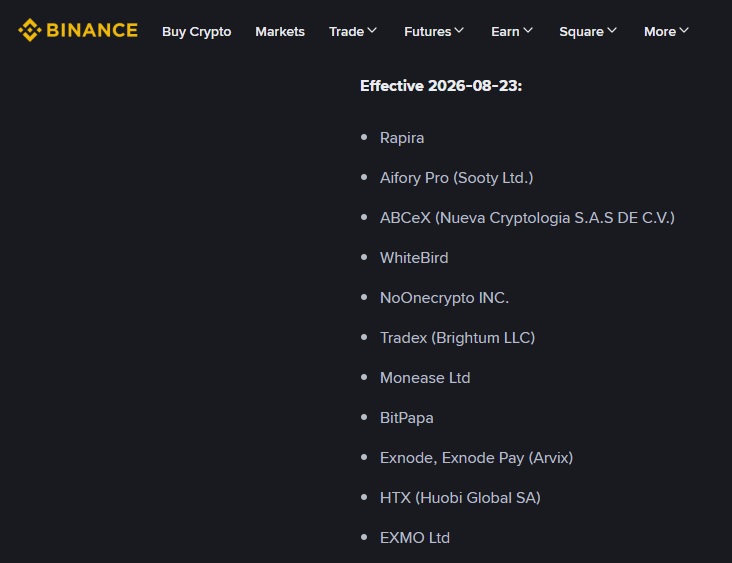
Source: binance.com
The parallel actions by major exchanges show how sanctions are increasingly affecting the way crypto platforms monitor transactions. Instead of focusing only on users dealing directly with a sanctioned or restricted entity, exchanges are paying greater attention to the wider movement of funds and possible indirect connections.
For crypto users, the message is becoming clearer. Simply checking the final destination of a transaction may no longer be enough. The source of funds, wallet history and intermediaries involved in a transfer can also become relevant when exchanges carry out compliance checks.
As regulatory scrutiny increases in both the U.S. and Europe, centralised exchanges are likely to keep strengthening these controls. For users, maintaining clear records and understanding the counterparties involved in transactions could become an increasingly important part of managing crypto assets.
Stay informed with the latest trends in Web3, blockchain innovation, and cybersecurity updates at 3verseTV
You need to login in order to Like















Leave a comment