



European regulators are looking into Binance’s use of the “reverse solicitation” exemption under the EU’s Markets in Crypto-Assets Regulation (MiCA) to serve customers without a MiCA licence.
The European Securities and Markets Authority, along with regulators in France, Germany, and Greece, are investigating whether Binance allowed new customers in some European countries without the required licence. Authorities have asked Binance for information and warned that any violations could lead to enforcement actions, such as fines.
FT: EU Regulators Scrutinize Binance’s Use of MiCA Exemption
Binance, the world’s largest crypto exchange, is under scrutiny from EU regulators over its use of MiCA’s “reverse solicitation” exemption to continue serving some European customers after failing to secure a license,… pic.twitter.com/CNhOVb5Fji
— Wu Blockchain (@WuBlockchain) October 1, 2026
Article 61 of MiCA includes a reverse solicitation rule that lets companies outside the EU offer services without a licence, but only in specific situations. This exemption applies when an EU customer contacts the company on their own, without any advertising or promotion from the firm. ESMA has emphasized that this rule should be interpreted strictly and not used to get around MiCA licensing requirements.
This investigation is happening as EU regulators get ready to enforce MiCA more actively. Reverse solicitation is one of ESMA’s main priorities for 2027, along with topics like outsourcing, operational resilience, liquidity, and making sure crypto firms have enough infrastructure in the EU.
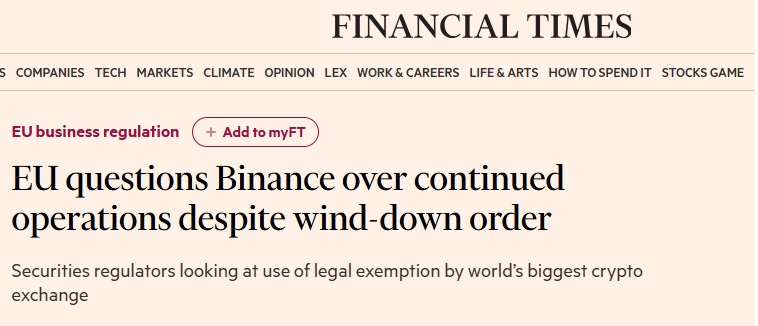
Source: ft.com
Binance first tried to get a MiCA licence in Greece but withdrew its application in June. After that, reports say the exchange shifted its focus to operating from the United Arab Emirates. Even without a MiCA licence, regulators are checking if Binance has still been serving European customers through other methods.
Binance has said it follows the rules in the places where it operates. The company also says it is working to get MiCA authorization and sees the framework as an important step to offering regulated services across Europe.
In France, Binance stopped offering crypto trading after it did not get a MiCA licence. French users could still withdraw their crypto assets.
This investigation could be a key test of how European authorities interpret the reverse solicitation rule. If regulators take a stricter view, overseas crypto companies might face more limits when serving EU customers without MiCA authorisation.
MiCA was created to set up a common set of rules for crypto-assets across the EU. These rules cover things like crypto service providers, stablecoins, investor protection, and market conduct.
For international exchanges, obtaining authorisation in the EU can therefore provide a clearer regulatory route to serving customers across the bloc. At the same time, the reverse solicitation provision has provided a limited pathway for certain services where the customer initiates the relationship.
The Binance case may help show where regulators set the boundary between real customer-initiated activity and an exchange actively seeking customers in Europe.
This investigation is happening as major crypto companies face more regulatory scrutiny. Binance is also under investigation in the United States for an alleged violation of Iran-related sanctions, but that issue is separate from the European MiCA case.
At this stage, EU regulators are asking Binance for information and checking if its activities meet the conditions of the reverse solicitation exemption. Any enforcement steps will depend on what the investigation finds and the relevant rules.
Stay informed with the latest trends in Web3, blockchain innovation, and cybersecurity updates at 3verseTV
You need to login in order to Like
















Leave a comment