



The concept of Bitcoin started as a mailing list discussion which evolved into the power source that established the cryptocurrency industry.
The brief guide follows Bitcoin’s development from its first experiments to its current status as an institutional market while explaining What is Bitcoin? – The Birth of Digital Money and answering questions about Bitcoin’s creator and creation date and explaining the significance of its design and major events in cryptocurrency history.
What is Bitcoin? – The Birth of Digital Money
The basic definition of Bitcoin describes it as digital money which exists as software-based tokens protected by encryption and maintained on a public database system known as the blockchain. The value transfer process of Bitcoin operates directly between users without requiring any central authority to act as an intermediary.
The combination of decentralized operation and transparent system and algorithmically controlled supply cap at 21 million coins makes Bitcoin a scarce digital asset that functions as a global transferable asset while resisting censorship. (Wikipedia)
Who created Bitcoin and when?
Satoshi Nakamoto established Bitcoin to the world via his 2008 white paper titled “Bitcoin: A Peer-to-Peer Electronic Cash System.”
The Bitcoin network launched operations in January 2009 when the first block known as the “genesis block” happened to be the first successful mining achievement. The world has never been able to discover Satoshi Nakamoto’s identity since this person amalgamated innovative skills with legendary status. (Bitcoin)
The 3 design features of Bitcoin instituted its unique attributes and made it resistant to failure through the following mechanisms:
- The ledger operates independently from any central authority that would control it. The decentralized network of thousands of independent nodes verifies and stores the chain which makes both censorship and single-point failures nearly impossible to achieve.
- Users can execute transactions independently from intermediaries because they maintain direct network connections with each other.
- The Bitcoin protocol sets a fixed supply of 21 million units which creates scarcity because fiat currencies do not have such a restriction. The unique combination of features made Bitcoin both a technological advancement and a financial opportunity that attracted numerous investors. (Bitcoin)
How Bitcoin solved problems in traditional financial systems
Digital payment systems before Bitcoin required third parties to verify transactions and stop users from spending the same digital token twice.
The system of Bitcoin achieved its breakthrough through the combination of cryptographic signatures with proof-of-work consensus (mining) and public ledger technology which enabled nodes to verify transaction history independently without needing central authority oversight for double-spend prevention.
The system design reduced dependence on international banking networks while enabling free market development and providing users with the ability to verify monetary supply. (Bitcoin)
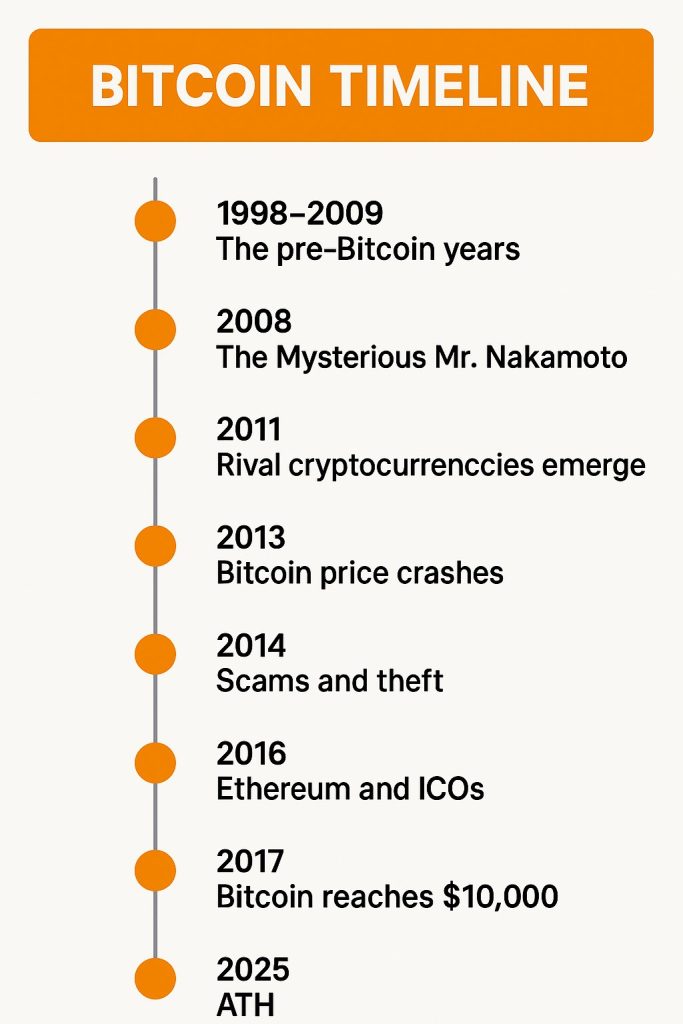
Timeline highlights (keywords included)
1998 – 2009 The Pre-Bitcoin years
The development of cryptographic cash began in the 1990s when Wei Dai created b-money and Nick Szabo designed bit gold to solve the digital scarcity and trustless settlement problems that Bitcoin would later solve. Satoshi used the fundamental ideas which early thinkers Wei Dai and Nick Szabo created through their conceptual work during the 1990s.
2008 – The Mysterious Mr. Nakamoto
Satoshi published his white paper during October 2008 which established the protocol. The network became operational two months after the white paper release and the first transactions occurred in 2009 thus beginning a new monetary system. (Bitcoin)
2010 – The first retail payment (Pizza Day)
Laszlo Hanyecz made history in May 2010 when he used 10,000 BTC to buy two pizzas which became the first recorded Bitcoin transaction for real-world goods and now marks “Bitcoin Pizza Day” on May 22 each year. The exchange between Hanyecz and the pizza delivery person demonstrated the extreme price volatility of Bitcoin during its early days while showing its basic functionality. (Bitcoin Wiki)
2011 – Rival cryptocurrencies emerge
The developers who recognized Bitcoin’s potential started creating alternative cryptocurrencies (altcoins) which modified various design elements including privacy features and transaction speed and consensus algorithms. The competitive environment between cryptocurrencies led to experimental development which expanded the entire crypto market.
2013 – Bitcoin price crashes
The price of Bitcoin surged dramatically in 2013 before it dropped sharply which demonstrated that new markets tend to be unstable while they learn about price formation systems. The market experienced extreme price fluctuations because of multiple exchange problems and regulatory news reports. (Wikipedia)
2014 – Scams and theft
The collapse of Mt. Gox in 2014 as the leading Bitcoin exchange became a major incident because it lost hundreds of thousands of bitcoins which demonstrated the need for better security measures and regulatory control in the industry. The incident forced the industry to establish new standards for exchange operations. (Wikipedia)
2016 – Ethereum and ICOs
Ethereum introduced programmable smart contracts which enabled decentralized applications and caused the ICO boom that let projects fundraise through token distribution. The time period allowed cryptocurrency to advance past monetary functions for developing programmable financial systems and experimental governance systems.
2017 – Bitcoin reaches $10,000 and continues to grow
The cryptocurrency market faced its very significant year in 2017. The first time Bitcoin reached $10,000 happened in November 2017 before it exceeded $20,000 in December 2017 which generated widespread media attention that brought in new investors and institutional investors. (CoinDesk)
Institutional adoption
During the past few years corporations together with funds started including Bitcoin in their financial records and introduced cryptocurrency-based investment options.
The combination of corporate treasury investments in Bitcoin and the launch of spot and futures ETFs led to increased institutional investment in Bitcoin while making it a standard investment option for institutional investors.
Major corporate entities made public announcements about their large Bitcoin holdings which demonstrated a new approach that institutions would use to handle this asset. (Cointelegraph)
ATH (All-Time High)
The price of Bitcoin reached new historical peaks because of changing market conditions and macroeconomic factors. The cryptocurrency price reached $125,000 in October 2025 because of ETF investment growth and institutional funding which established a new peak in its unpredictable price history. (Reuters)
Why Bitcoin mattered — early adoption and milestones
The creation of Bitcoin established a working economic system based on cryptographic principles. The early users of Bitcoin including hobbyist miners and privacy advocates and libertarian-leaning technologists and later entrepreneurs developed the necessary infrastructure of wallets and exchanges and payment processors which enabled code to become monetary value.
The first merchant transactions and exchange market development and whitepaper releases for alternative protocols and institutional investment entry established Bitcoin as a valuable asset worth billions of dollars.
Risks and lessons learned
The path to success was difficult because the protocol encountered hacking incidents and scams and faced regulatory resistance and market volatility which demonstrated that technical problems do not eliminate human and institutional complexities regarding custody and governance and compliance.
The industry developed professional standards which included enhanced security measures and regulated custody solutions and improved legal frameworks but ongoing obstacles persist.
The road ahead — Bitcoin and beyond
The introduction of Bitcoin established a new financial category which combines programmable decentralized operations. The Bitcoin ecosystem now encompasses stablecoins and smart-contract platforms and decentralized exchanges and multiple experimental systems for tokenized assets and governance models.
Bitcoin entered history books because it showed the world decentralized digital assets which operate through technological and social systems.
Quick stats (snapshot)
- The Bitcoin protocol has a fixed total supply of 21 million BTC units according to Wikipedia.
- The first actual Bitcoin transaction took place when 10,000 BTC bought two pizzas on May 22, 2010, as documented by Bitcoin Wiki.
- The cryptocurrency exchange Mt. Gox experienced a major failure in 2014 which led to the disappearance of hundreds of thousands of BTC according to Wikipedia.
- Bitcoin achieved $10,000 in November 2017 before it set multiple new records which exceeded $125,000 in October 2025 according to CoinDesk.
In a nutshell,
The history of Bitcoin keeps advancing through the current time period. Bitcoin evolved from its 2008 white paper debut into a trillion-dollar global asset class through a major economic transformation that occurred during the twenty-first century.
The ability to predict Bitcoin development requires knowledge of its historical accomplishments and challenges and significant events from the past.
References
- Bitcoin: A Peer-to-Peer Electronic Cash System – Original White Paper by Satoshi Nakamoto (2008)
https://bitcoin.org/bitcoin.pdf - Bitcoin (BTC) Overview and Historical Data – CoinMarketCap
https://coinmarketcap.com/currencies/bitcoin/ - The Genesis Block (Block 0) – Bitcoin Wiki
https://en.bitcoin.it/wiki/Genesis_block - Bitcoin Pizza Day: The First Real-World Bitcoin Transaction (10,000 BTC) – Bitcoin Magazine
https://bitcoinmagazine.com/culture/bitcoin-pizza-day-history - Gox Collapse: Timeline and Lessons – Reuters Special Report
https://www.reuters.com/article/us-bitcoin-mtgox-collapse-idUSBREA1Q04Y20140227 - Bitcoin Price History (2013–2017) – CoinDesk Bitcoin Price Index
https://www.coindesk.com/price/bitcoin/ - Ethereum and the ICO Boom – Ethereum Foundation https://ethereum.org/en/history/
- Institutional Adoption and Corporate Treasury Strategies – Bloomberg Crypto Reports
https://www.bloomberg.com/crypto - Bitcoin All-Time High (ATH) Reached $125,000 in October 2025 – Cointelegraph Markets Update
https://cointelegraph.com/news/bitcoin-price-today - Pre-Bitcoin Digital Cash: Wei Dai’s b-money and Nick Szabo’s bit gold – Nakamoto Institute Archive
https://nakamotoinstitute.org/
Image Reference:
“Bitcoin Timeline – Key Milestones from 1998 to 2025,” custom infographic created by ChatGPT (OpenAI Image Generator, 2025).
© 2025. Used with permission from OpenAI’s DALL·E image generation tool.
You need to login in order to Like

















Leave a comment