


Key Takeaways
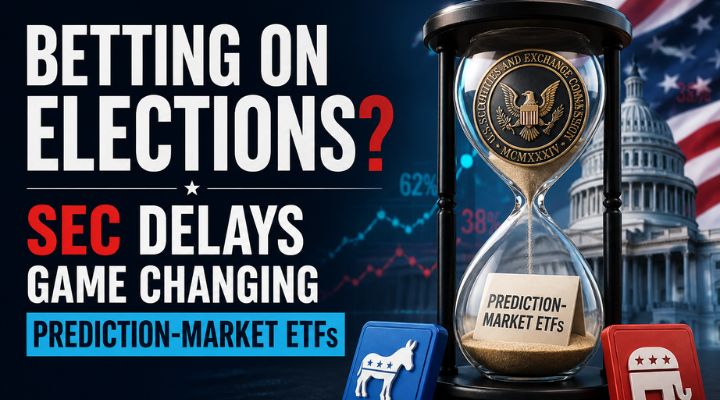
- The U.S. Securities and Exchange Commission has shown increasing caution regarding this rapidly expanding industry by delaying the clearance of prediction-market ETFs.
- Through regulated funds, asset managers such as Roundhill Investments, GraniteShares, and Bitwise Asset Management want to enable investors to trade real-world outcomes.
- These ETFs make access easy and stock-like by tracking event probabilities through derivatives. Regulators, however, are concerned about insider trading, manipulation, and the moral dangers associated with placing bets on delicate situations.
- Additionally, filings warn of “catastrophic losses” for which there is no redress once they expire. Experts compare this tendency to early cryptocurrency ETFs that experienced delays before success and broader adoption, and despite these obstacles, they see tremendous long-term potential.
Market Boom or Regulatory Doom, Are Prediction ETFs Facing Their Gloom?
The movement to integrate prediction markets into traditional investment has temporarily stalled. The first exchange-traded funds (ETFs) linked to actual events, such as elections, economic trends, and commodity prices, have been postponed by the U.S. Securities and Exchange Commission (SEC).
The action suggests that regulators are becoming more cautious about a rapidly expanding but contentious market.
Earlier this year, applications to launch over two dozen prediction-market ETFs were submitted by asset managers such as Roundhill Investments, GraniteShares, and Bitwise Asset Management. These products are designed to enable ordinary investors to trade on events such as the outcome of the U.S. election, the likelihood of a recession, layoffs in the tech industry, and even whether or not oil prices would surpass specific benchmarks.
The ETFs, which were originally scheduled to start this week, are currently undergoing a thorough evaluation. People with knowledge of the procedure claim that the SEC has asked for additional information about the structure, risk disclosures, and market integrity protections of these products.
The development emphasizes the difficulty of integrating prediction markets with conventional investment vehicles, even if such delays are not uncommon for new financial instruments.
The concept of prediction markets is not new. By enabling users to wager on binary outcomes, such as whether a political candidate will win or if inflation will exceed a particular threshold, platforms like Kalshi and Polymarket have acquired popularity. Usually, these contracts pay out a certain sum if the forecast is accurate and nothing if it is not.
Accurate Bets, Rising Threats
After these platforms correctly predicted significant political events, including as Donald Trump’s victory in the 2024 U.S. presidential election, interest in them skyrocketed. The demand for easier ways to engage in these markets has increased due to this success, and ETFs may be able to meet this need.
Regulators are still wary, though. The potential of market manipulation, insider trading, and the moral ramifications of placing bets on delicate events like elections or international wars are among the main issues that the SEC is examining. Legislators have also questioned if these markets would encourage bad behavior or the dissemination of false information.
The underlying event-based contracts are also overseen by the Commodity Futures Trading Commission (CFTC). Instead of outlawing prediction markets, the CFTC has indicated that it is willing to regulate them.
Final Thought
Quick Gain Track or Sudden Crack,Can Prediction ETFs Survive a Market Attack?
Derivatives are used in proposed prediction-market ETFs to monitor actual events, giving investors exposure without having to place bets. Trading is as easy as purchasing stocks because of this structure.
But there are a lot of risks. SEC documents warn of “catastrophic losses” with no recourse when contracts expire, particularly if results are contested. Despite this, analysts believe there is a lot of long-term potential, pointing out that even cryptocurrency ETFs had setbacks before they were successful.
You need to login in order to Like
















Leave a comment