


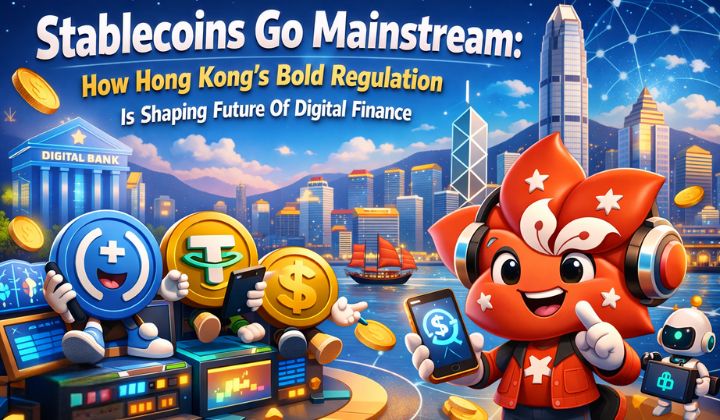
The word “stablecoin” is no longer limited to tech jargon in today’s quickly changing financial scene. It is now a structural component of digital finance.
The global stablecoin market value is worth more than $320 billion as of mid-March 2026. This is a significant milestone. Let’s understand what a stablecoin is all about and how is it going to change the future of digital finance.
What Is Stablecoin?
To understand the significance of these regulations, we must first understand the asset itself. A stablecoin is a digital currency that is intended to keep its value constant.
A stablecoin is “pegged” to a stable asset, usually the US dollar, unlike Bitcoin, which is known for its sharp price fluctuations.
It’s akin to electronic money. A reliable supplier usually keeps one actual dollar in a safe reserve for each stablecoin that is issued. This combines the stability of traditional money with the speed of the internet to guarantee that your digital coin will always be worth $1.
HKMA’s March 2026 Milestone: Regulated Stablecoin Issuance
The Stablecoins Ordinance of Hong Kong, which went into force in August 2025, is revolutionary, so to say. To guarantee that these digital assets are just as secure as the funds in your bank account, the Hong Kong Monetary Authority (HKMA) has implemented a stringent licensing system, and Hong Kong is creating a link between traditional banking and digital future by working with reputable institutions that issue notes.
Four Ways The New Rules Safeguard Your Investments
Stablecoins are used by large banks and organisations for quick international transactions. However, the new rules provide important safeguards for regular retail investors:
- Guaranteed Redemption: You are legally entitled to exchange your approved stablecoin for actual currency at “par value” (one-for-one) within one working day.
- Asset Protection: Licensed issuers are required to maintain all their reserves in liquid, high-quality assets. Your investment is protected even if the business undergoes financial stress because these funds are legally distinct from the company’s own finances.
- Vetted Products: In Hong Kong, only stablecoins from authorised organisations may be sold to the public. As a result, a “safe zone” is created that eliminates dangerous or unbacked digital tokens.
- Minimum Capital Required: Hong Kong has framed strict rules for companies wanting to issue stablecoins. The purpose behind the rules is to build trust and keep the system stable. As per the new rules, a company will secure a licence only if its owners have put in at least HK$25 million (about US$3.2 million) of their own money. This shows that the company is serious about its business. These rules also help keep out small or risky startups. They allow only strong and well-funded companies to enter the market. As a result, only those with real commitment and financial strength will be able to operate. This type of arrangement is also commonly termed as ‘skin in the game’.
Stablecoins: The $320B Reality & Hong Kong’s Regulatory Edge
Stablecoins are more than just a trading instrument. They are becoming an essential component of how we pay for services, store value in a digital world, and transfer money across borders.
By passing these laws, Hong Kong is not only safeguarding investors but also extending an invitation to the rest of the world to join it in a new era of safe, open, and effective finance.
The worldwide stablecoin market has reached a stage of institutional maturity today, in mid-March 2026, with a total market capitalization of over $320 billion.
Business-to-business (B2B) transactions, which currently make up over 60% of the worldwide stablecoin payment volume amounting to $226 billion annually, are rapidly driving this expansion.
Circle’s USD Coin (USDC) has shown incredible progress in early 2026, with its market cap climbing to $78.7 billion and monthly transfer volumes on the Ethereum network topping $1.7 trillion, while Tether (USDT) continues to hold a sizable lead with a market cap of over $184 billion.
Asia continues to be the main driver of this activity, accounting for 60% of the $245 billion in global stablecoin payment volumes. Singapore, Hong Kong, and Japan account for the majority of this regional supremacy.
These assets are now essential to the tokenization of real-world assets and are being used more by AI agents for autonomous machine-to-machine payments, going beyond simple trade.
Issuers must maintain 100% backing of outstanding tokens with superior, segregated reserve assets under the extremely strict HKMA framework.
By striking a balance between quick innovation and strong investor protection, Hong Kong hopes to become a leading worldwide hub for digital assets.
Stablecoin Market Overview: Valuation, Volume & Key Players
With a total market capitalization of more than $320 billion, the global stablecoin market has reached a level of institutional maturity. This amounts to about 15% of the whole market for digital assets.
With transaction volumes on public blockchains reaching a staggering $33 trillion in 2025, trading continues to be the key motivator. The share of real-world utility is increasing, especially in B2B payments and remittances, even though speculative trading still makes up a sizable fraction of this activity.
- Tether (USDT): With a market capitalisation of about $183.6 billion, it dominates the liquidity scene.
- USD Coin (USDC): With a market capitalisation of more than $75 billion, it is positioned as the main option for regulated institutional settlement.
- PayPal USD (PYUSD): Currently valued at about $1.54 billion, it keeps growing its consumer payment footprint.
- Emerging Assets: The desire for high-liquidity, yield-bearing assets is demonstrated by the quick rise of new fiat-backed stablecoins, like USD1, to a $5 billion market cap in early 2026.
Real-world Utility: Stablecoins As New Global Financial Rail
Stablecoins are no longer portrayed as a “trader’s tool” but rather as a “financial rail.” A few important applications are gaining traction outside of Asian markets:
- Real-world Asset (RWA) Settlement: Stablecoins act as the “cash leg,” meaning they are the actual money used to pay and complete a transaction when buying or selling tokenized assets like bonds, treasuries, or real estate.
- Enterprise Treasury: These assets are used by multinational firms for real-time intercompany loans, “just-in-time” finance, and eliminating the 5% friction charges associated with conventional cross-border banking.
- Humanitarian Aid: In war-torn areas, to bypass the destroyed local financial infrastructure, organisations such as the UN use stablecoins to distribute humanitarian aid instantly and transparently.
- Automated Payments: Stablecoins are the chosen currency for making machine-to-machine transactions.
Why Hong Kong’s Stablecoin Framework Is A Game-changer Now?
The significance of Hong Kong’s current strategy is very well understood. Stablecoins are no longer limited to speculative trade and have a global market value of more than $320 billion.
They are increasingly utilised for real-time cross-border B2B settlements, which avoid the delays of conventional correspondent banking, and serve as the main “cash leg” for the tokenization of real-world assets.
Hong Kong provides a “regulated sandbox” for innovation by offering a well-defined and legally binding framework. In a secure and predictable setting, it enables Chinese and foreign businesses to investigate the advantages of programmable money, such as automatic payments between AI agents or transparent distribution of humanitarian relief.
Hong Kong’s stablecoin laws offer the model for a contemporary, digital-first global financial hub at a time when digital sovereignty and financial stability are crucial.
The safety and clarity that the Hong Kong Stablecoins Ordinance offers to regular users is its most important influence, even if many conversations about stablecoin regulation centre on institutional actors and market stability. The new structure turns stablecoins from risky digital assets into safe financial products for individual investors.
Also Read: AI-enabled Fraud: Real Cases, Scammer Tactics & Smart Prevention Tips
How Hong Kong’s Stablecoin Rules Protect & Empower Retail Investors
Hong Kong is introducing strong rules to make stablecoins safer and more reliable for everyday investors. These measures aim to protect users, ensure easy withdrawals, and bring more transparency to the digital asset market:
Safe Redemption: Eliminating Liquidity Traps
The statutory right to redemption is the biggest immediate advantage for a retail investor. One digital dollar must always be convertible into one physical dollar under the new regulations, which require licensed issuers to honour redemption requests at par value.
These requests also need to be completed within a single workday. This removes the “liquidity traps” that frequently occur in uncontrolled markets, when customers are unable to take their money out when the market is under stress.
Regulated Reserve Segregation: Protecting User Assets
The “black box” of stablecoin reserves is no longer a concern for regular investors. As decided by the HKMA, all licensed stablecoins must be fully backed by liquid and high-quality assets that are kept besides the issuer’s own company money.
Even if the issuing business faces financial difficulties, the pool of assets underpinning the stablecoins will remain safe and available to consumers because these reserves are protected from the claims of creditors.
Restricted Availability Of Retail Stablecoins
The Ordinance mandates that only stablecoins issued by HKMA-licensed businesses may be made available to Hong Kong’s retail investors to combat fraud and scams.
The typical individual won’t unintentionally encounter dangerous, unbacked, or algorithmic stablecoins that lack adequate control thanks to this “closed loop” method.
The regulator has established a “safe zone” for public involvement in the digital economy by limiting retail access to just the most thoroughly examined and reliable products.
Mandatory Audits & Operational Transparency
A comprehensive whitepaper must be published by each licensed issuer, and their reserves must be independently attested and audited on a regular basis.
By taking these steps, Hong Kong is guaranteeing that the advantages of digital finance, such as quicker payments and round-the-clock accessibility, are provided without sacrificing the essential safeguards that each retail investor is entitled to.
The Way Forward
As per J.P. Morgan’s projections, the stablecoin market will grow around $500–$750 billion by 2028. The driving factors behind this growth will be crypto trading, institutional adoption, and demand in emerging markets as a hedge against currency volatility.
At the same time, the bank is not overly optimistic about this growth. It states that the market is unlikely to reach trillions. It also notes that stablecoins are unlikely to replace fiat money for everyday transactions soon. J.P. Morgan has stressed the need for clear regulations to prevent undesirable uses.
The United States and Hong Kong are taking important but slightly different approaches regarding regulation of stablecoins, but it is noteworthy that the global stablecoin market is entering a new phase of regulation.
The Western world has proposed the GENIUS Act, which represents a major step toward creating a clear legal framework for stablecoins. It focuses on transparency, maintenance of strong reserves and protection of consumers while aiming to bring stability and trust to one of the fastest-growing parts of the crypto industry.
At the same time, Hong Kong is emerging as a leading regulatory hub in Asia. Through the Hong Kong Monetary Authority (HKMA), the region has introduced strict licensing rules, full reserve backing requirements, fast redemption rights and strong measures for investor protection.
Unlike earlier unregulated markets, Hong Kong is building a “safe zone” where only credible and well-funded players will be able to operate.
The US approach is still evolving through legislation, but Hong Kong has moved faster in implementation. Both these frameworks show that Western as well as Asian market are working towards making stablecoins safe, transparent and widely functional in the financial system.
Stablecoin regulations are likely to become more standardised across countries in the days to come. Governments may work together to create common rules for reserves, audits and international usage. Stablecoins could soon play a major role in global payments, trade and digital finance under strong regulatory supervision.
In future, the success of stablecoins will depend not just on technology, but also on trust. Trust will be built through clear, consistent and well-enforced regulations similar to those now emerging in the US and Hong Kong.
Stay informed with the latest trends in Web3, blockchain innovation, and cybersecurity updates at 3verseTV
You need to login in order to Like















Leave a comment