


Key Takeaways
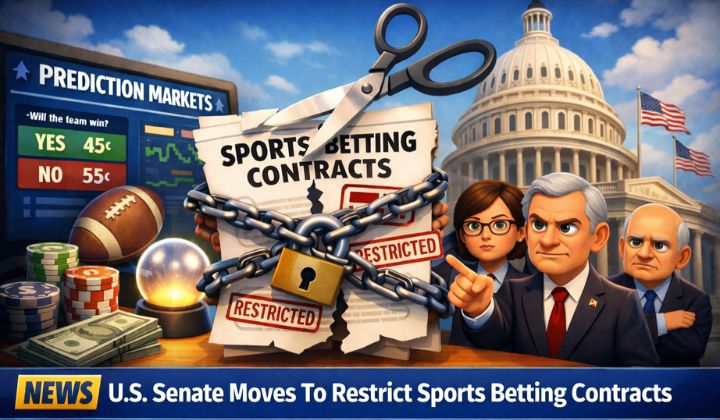
- A bipartisan bill directed by Adam Schiff and John Curtis targets sports betting on prediction platforms.
- The Commodity Futures Trading Commission may lose control as states push back on jurisdiction. Platforms like Polymarket and Kalshi face serious legal and business risks.
- Sports contracts, the industry’s main revenue source, are under direct threat. States intensify crackdowns with lawsuits, bans, and criminal charges.
- $20B valuations now hang on regulatory outcomes. A federal ban could force a shift to low-engagement, non-sports markets.
Could this Senate move mark the beginning of the end for sports-based prediction trading? More than $13 billion in monthly trade volume is at risk due to a new bipartisan Senate bill that is expected to rock the rapidly expanding prediction market sector.
A significant change in the way internet betting markets function is being signalled by U.S. lawmakers’ current efforts to outlaw sports-related contracts on federally regulated platforms.
The initiative is being led by Senators John Curtis and Adam Schiff. John Curtis is a Republican U.S. Senator from Utah, focused on youth protection and financial regulation.
Adam Schiff is a Democratic U.S. Senator from California, known for consumer protection and oversight of financial platforms.
Their proposed law would make it illegal for Commodity Futures Trading Commission-regulated platforms to provide contracts linked to sporting events and casino-style games. Important players like Polymarket and Kalshi are specifically targeted by this action.
Lawmakers claim that these platforms make it difficult to distinguish between gambling and financial trade. They contend that despite millions of participants, prediction markets now evade stringent state-level gaming regulations. Adam Schiff criticised regulators for allowing a “backdoor” system that reduces consumer protections and evades taxes.
States should regulate sports betting with measures like age checks and addiction restrictions in place, according to John Curtis, who warns of growing juvenile exposure.
A Billion-dollar Industry Caught In A Legal Crossfire
The bill represents the Senate’s first significant bipartisan effort to restrict prediction markets. In contrast to other initiatives, this law focuses on sports contracts, the industry’s main source of income. According to industry data, sports-related events account for a sizable amount of trading activity on these platforms, the plan directly jeopardises their business models.
Tensions between federal and state authorities are on the rise at the same time. Event-based contracts are under the sole control of the Commodity Futures Trading Commission. Several jurisdictions contend, however, that these products are governed by gaming laws rather than banking regulations.
Around the nation, legal disputes are already taking place. Citing unlicensed gambling operations, states including Nevada, Arizona, and Michigan have taken action against prediction services. While some have pursued lawsuits and criminal charges, others have issued cease-and-desist orders.
$20B Valuations Hang By A Thread
The sector is still growing quickly in spite of regulatory restrictions. According to reports, platforms like Polymarket and Kalshi are looking into further fundraising rounds that may raise their valuations to $20 billion. However, sports betting activity plays a major role in these estimates.
Companies would have to reconsider their approaches and shift their focus to non-sports areas like politics, weather, and economic events if there were a federal ban. This change might drastically lower overall trade volume and user interest.
An increasing consensus in Washington is highlighted by the proposed law. Prediction market sports betting is now viewed by both Democrats and Republicans as an urgent regulatory need. The industry is confronted with growing uncertainty as momentum grows.
Conclusion
“One bill, one decision, and an entire industry could change forever.” The prediction market sector is at an important point due to the proposed Senate law. Legislators are enforcing stricter regulations on sports-based contracts, which forces platforms to reconsider their fundamental tactics.
Businesses like Polymarket and Kalshi are currently under increasing legal pressure in addition to having less operating flexibility. A federal ban might force a shift in the market toward lower-engagement alternative event categories. The conflict between the Commodity Futures Trading Commission and state authorities is also getting worse at the same time
You need to login in order to Like
















Leave a comment