

The Rise Of AI NFTs
Since their meteoric rise to popularity in 2020, NFTs have revolutionized one industry after another. Massive advances in artificial intelligence (AI) are now paving the way for this technology to be extended to the Web3 realm. AI NFTs are one of the first products of this synergy.
What is an AI NFT?
Artificial intelligence (AI) is broadly defined as a computer’s ability to simulate human intelligence and perform complex tasks like decision-making, problem-solving, and learning. In the last decade, this and other related technologies have grown at an exponential rate, becoming intertwined with many aspects of our daily lives. While AI-generated NFT art has emerged as a major category in the NFT market, some project teams have taken this a step further and begun incorporating AI models within NFTs.
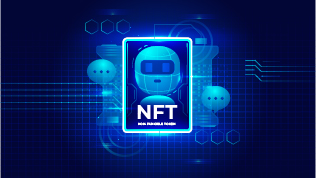
A tokenized asset with a Generative Pre-trained Transformer 3 (GPT-3) AI model coded into its smart contract is one design of an AI NFT. A GPT-3 is a deep learning-based language model that is used to generate human-like text. AI NFTs can be animated in addition to being able to interact with people through user inputs. This makes them more dynamic than more “traditional” NFTs, which typically take the form of an image or audio file.
Difference between AI NFTs and regular NFTs
NFTs are one-of-a-kind, indivisible, unchangeable, and digitally scarce. They can also serve as proof of ownership of the underlying asset, making its authenticity and provenance easily verifiable at any time.
However, most popular NFTs today are static images that cannot evolve or interact with the user. For example, CryptoPunks is a popular NFT collection, but there are only a few ways to interact with these digital collectibles.
AI NFTs, on the other hand, can generate new content and dynamic experiences on their own thanks to their learning abilities. The greater the exposure of these digital assets to a specific environment or user, the more data they can pull and generate.
The main difference between AI NFTs and regular NFTs is that AI NFTs are powered by artificial intelligence. This means that they can learn and evolve over time, which makes them more dynamic and interactive than regular NFTs.
Here are some other key differences between AI NFTs and regular NFTs:
- AI NFTs can generate new content: This means that they can create new images, videos, or music, which can be used in a variety of ways. For example, an AI NFT could be used to create a personalized video game experience or to generate new marketing materials for a business.
- AI NFTs can interact with users: This means that they can respond to user input, such as questions or commands. This makes AI NFTs more engaging and immersive than regular NFTs.
- AI NFTs can be used to create decentralized applications: This means that they can be used to build applications that are not controlled by any central authority. This could have a number of applications, such as in the areas of gaming, finance, and healthcare.
- AI NFTs are still in their early stages of development: but they have the potential to revolutionize the way we interact with digital content. As AI technology continues to advance, AI NFTs are likely to become more sophisticated and widespread.
Here are some examples of AI NFTs:
- Axie Infinity is a game that allows players to collect, breed, and battle digital pets called Axies. Axies are AI-powered, which means that they can learn and evolve over time.
- Sorare is a fantasy football game that allows players to collect and trade digital trading cards of real-world football players. The cards are AI-powered, which means that they can be used to create personalized game experiences.
- Art Blocks is a platform that allows artists to create and sell AI-generated art. The art is created using a variety of AI algorithms, which gives it a unique and unpredictable look.
- These are just a few examples of the many ways that AI is being used to create NFTs. As AI technology continues to advance, we can expect to see even more innovative and creative AI NFTs in the future.
You need to login in order to Like