


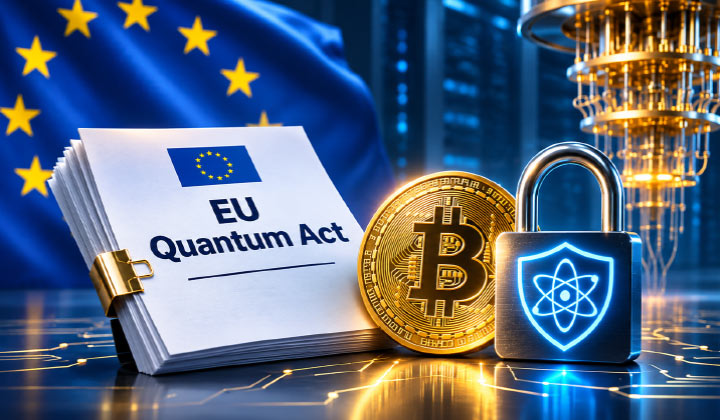
- The European Commission has proposed a Quantum Act to strengthen Europe’s quantum technology industry and prepare digital infrastructure for future cybersecurity risks.
- The proposal gives special attention to post-quantum cryptography, which could help protect crypto wallets, blockchain transactions and digital assets against future quantum computer attacks.
- The Act also proposes a Sovereign Tech Equity Fund to support important technologies, including quantum computing, AI and cybersecurity.
The European Commission has set out proposals for a Quantum Act which will seek to boost Europe’s quantum capabilities and ensure digital infrastructure is prepared for future security challenges.
The Act focuses on quantum innovation, business and the acceleration of migration to post-quantum cryptography. This is key for the cryptocurrency sector as there is potential that advanced quantum computers may one day be able to compromise current cryptographical technology and so impact on blockchain wallet and transaction security.
EU Wants Faster Shift Towards Quantum-resistant Security
The Quantum Act will seek to boost innovation, assist business exploitation of innovative developments and ensure key supply chains are secure. As part of seven action points within the Act, there is an action point dedicated to post-quantum cryptography (PQC). This involves the creation of novel cryptography which is able to resist attack by both current and future quantum computers.
We want to bring quantum from the lab to the market.
That’s why we’ve proposed the Quantum Act.
It will help Europe:
✅convert its scientific leadership into industrial leadership
✅accelerate the deployment and uptake of quantum tech
✅reinforce the EU’s preparedness for a quantum-safe future.And it lays the foundations for a new Sovereign Tech Equity Fund to invest in technologies critical to Europe’s sovereignty and security.
https://t.co/ubBPvdGO0i
— European Commission (@EU_Commission) November 25, 2026
Many areas of today’s world including finance, digital identification and blockchain are reliant on technology which utilises cryptography. An advanced quantum computer may in future be able to crack some current forms of digital encryption.
Cryptocurrencies are especially susceptible to this. Bitcoin relies on Elliptic Curve Digital Signature Algorithm (ECDSA) and Schnorr signatures, and Ethereum utilises ECDSA for external wallets. In theory, if there was a sufficiently developed and resilient quantum computer then it could run Shor’s algorithm and utilise this to calculate private keys from public keys.
Private keys are key as these enable individuals to manage and control their cryptocurrency. Therefore, there is potential that if an individual’s private key was compromised then their digital property could also be accessed.
Nevertheless, at present there is no known quantum computer which is capable of in any significant manner cracking the signature systems which are in operation on Bitcoin and Ethereum.
To avoid such a situation arising in the future, the European Commission is seeking to prompt both governments and businesses to start to get ready for this potential reality.
Public Procurement Could Support Quantum-safe Technology
Procurement by public bodies will also be used as a method to help drive the take-up of quantum safe security, under the proposed legislation.
Digital public procurement which falls under the scope of the EU’s second Network and Information Security Directive (NIS2) will need to take account of post-quantum cryptography needs.
Whether or not such needs apply will depend on a number of things such as the significance of a system, the level of sensitivity of data it deals with, the expense of transitioning to new cryptography and the potential consequences of a security incident.
Whilst the Act does not require all digital systems to be instantly updated, it does permit public bodies to draw up transition strategies where appropriate post-quantum cryptography solutions are not currently available.
Such strategies would need to be drawn up from six months after the Act comes into force. Member states will also be required to assess the preparedness of their respective countries for transition.
This follows on from the EU’s post-quantum security strategy, published in June 2025. This sets out a target to make key systems quantum-safe by 2030 and to subsequently apply this to further systems by 2035.
Again, this demonstrates that for cryptocurrency firms, exchanges and blockchain innovators, quantum-safe security is becoming an ever more significant consideration for the future.
EU Plans Sovereign Tech Equity Fund To Support Innovation
In addition to the Quantum Act, the European Commission has also proposed establishing the foundations for a Sovereign Tech Equity Fund (STEF). This fund will seek to invest equity in firms specializing in technology which is seen to be key to Europe’s technological sovereignty and economic security.
Potential sectors for investment include artificial intelligence, quantum, cybersecurity and semiconductor technology. Contributions to the fund may come from the European Commission, European Investment Bank, member states and private investors.
Whilst decisions still need to be made about the precise nature, finance and establishment of the fund, no specific sum of money has yet been announced for it. It is hoped that the fund will enable European technology firms to source finance so that they can continue to innovate, build infrastructure and remain globally competitive.
For the crypto sector, the Quantum Act is significant as it ensures that post-quantum security is included within mainstream European technology strategy. Nevertheless, individual blockchain innovators will still need to continue to devise solutions for updating their blockchain and related areas such as wallet and transaction signing functionality.
In fact, Ethereum has already begun to investigate post-quantum security and as part of its recent research efforts, has analysed options for transitioning to quantum-safe cryptography.
At present, the Quantum Act is just a proposal. It needs to be reviewed and then agreed by both the European Parliament and the Council of the European Union before it can become law.
Were it to be enacted, it may prompt both the private and public sectors to start to get ready for a future in which quantum computers are developed to a stage at which they can actually pose a risk to current security. For the crypto industry, this highlights that, even though we are not yet at such a stage, getting ready for future quantum-related challenges is becoming an increasingly key consideration.
Stay informed with the latest trends in Web3, blockchain innovation, and cybersecurity updates at 3verseTV
You need to login in order to Like

















Leave a comment