


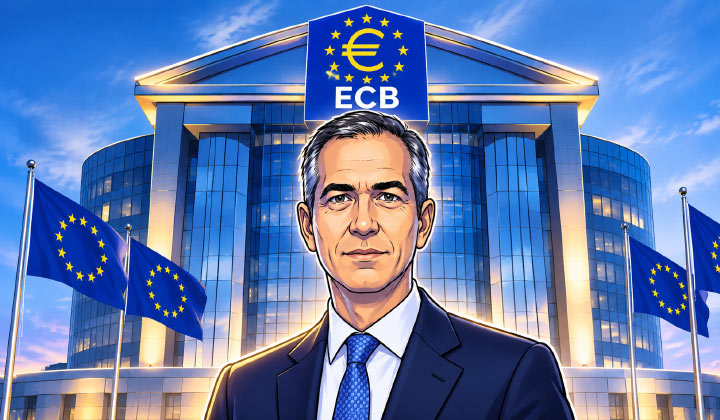
- Pablo Hernández de Cos, head of the Bank for International Settlements (BIS), has reportedly secured support from a majority of eurozone governments to become the next European Central Bank (ECB) president.
- He is expected to replace Christine Lagarde when her term ends on February 7, subject to formal approval.
- His appointment could influence Europe’s approach to stablecoins and digital currencies, as he has raised concerns about stablecoins while supporting the development of a digital euro.
Pablo Hernández de Cos, general manager of the Bank for International Settlements is poised to be the next European Central Bank (ECB) president. He appears to have won the endorsement of the majority of eurozone states following the Netherlands’ decision to end its support for Klaas Knot, another presidential contender.
The euro area member states have agreed to recommend Pablo Hernández de Cos as President of the @ecb, and Laurence Boone and Markus Brunnermeier as members of the ECB Executive Board.
I will propose that the European Council launches consultations with the @Europarl_EN and the Governing Council of the ECB.
This will pave the way for the formal appointment of the new ECB leadership by the #EUCO in December.
— António Costa (@eucopresident) November 26, 2026
Provided he is officially recognized that Hernández de Cos will assume the role from Christine Lagarde from 7th February. His presidency may go some way to influencing Europe’s strategy for digital finance including its stance towards stablecoins, tokenized accounts and a planned digital Euro.
Netherlands Withdrawal Strengthens His Chances
Following the Dutch government’s decision to end its support for Klaas Knot the former Governor of the Dutch central bank Hernández de Cos appears to have won the endorsement of most eurozone states, according to the Financial Times.
Pablo Hernández de Cos to be next ECB President https://t.co/IFpr3CDPQK
— Financial Times (@FT) November 26, 2026
Formerly the central bank governor for Spain, Hernández de Cos is now head of the BIS. This is a global body which collaborates with central banks worldwide. Should he gain official recognition, he will succeed Christine Lagarde upon the expiry of her current term on 7th February.
Despite not yet having received official endorsement, Hernández de Cos is well placed to become ECB president at a time when digital finance is becoming an increasingly significant area for European policymakers.
Hernández De Cos Has Concerns About Stablecoins
Hernández de Cos has voiced strong opinions on stablecoins. At the Jackson Hole Economic Symposium in August, he cast doubt on whether existing stablecoins were fit for purpose as a mass medium of exchange. Rather, he advocated the use of tokenized accounts for both day-to-day and major financial transactions.
Furthermore, he has highlighted that the increasing popularity of dollar-pegged stablecoins, beyond the United States, may pose issues for other nations. He believes that if stablecoins were to gain mass appeal then this could undermine a country’s monetary independence and further complicate central banks’ monetary policy control.
There is also potential for conventional banking to be affected. Should individuals and companies begin to transfer funds out a bank’s accounts and into stablecoins, banks may experience increased funding costs. This in turn may affect a bank’s lending and financial services provision.
However, Hernández de Cos has recognized that there may be niche applications for stablecoins. Primarily though, he is concerned by their potential for mass use.
Digital Euro May Be A Key Area Of Interest
Whilst Hernández de Cos has voiced concerns about stablecoins, he has been more positive about the prospects for central bank digital currencies (CBDCs), and in particular a digital version of the euro.
A digital euro could stimulate innovation in the payments sector and help to safeguard Europe’s monetary independence, he stated in a 2023 speech. The ECB is already developing a digital euro. It intends to run a test phase in 2027 and possibly introduce one in 2029, again dependent on relevant legislation being enacted.
A digital euro would constitute a form of digital central bank money. It would be created by the European Central Bank and would act as an additional payment method, but still be underpinned by the central bank.
If Hernández de Cos does become ECB president, his attitude towards digital currency may affect the way in which Europe progresses its digital payment system. His inclination towards tokenized accounts and CBDCs, rather than popular private stablecoins, may also affect Europe’s response to evolving financial matters.
Within the cryptocurrency sector, interest will be keenly focused on Hernández de Cos’ likely presidency as European authorities continue to consider the best way to integrate privately-created digital money alongside state-issued digital money.
Stay informed with the latest trends in Web3, blockchain innovation, and cybersecurity updates at 3verseTV
You need to login in order to Like

















Leave a comment