



- The US Commodity Futures Trading Commission (CFTC) has allowed regulated derivatives platforms to count Bitcoin, Ether and certain payment stablecoins towards their operating financial reserves.
- Bitcoin and Ether will receive a 20% haircut, while qualifying payment stablecoins will receive a 2% haircut.
- Companies must continue maintaining separate cash or highly liquid asset reserves to meet their existing liquidity requirements.
CFTC Gives Clarity On Crypto Reserves
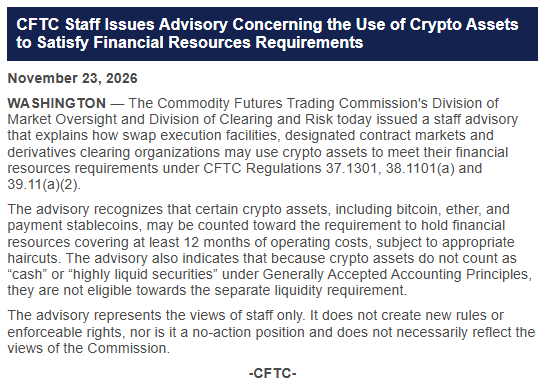
The US Commodity Futures Trading Commission (CFTC) has advised that authorized derivatives exchanges and clearing houses can accept Bitcoin, Ether and acceptable payment stablecoins as forms of capital. This was published on November 23.
Pleased to see @CFTC staff continue to provide important clarity around crypto assets in US derivatives markets through today’s staff advisory. More below:
— Mike Selig (@ChairmanSelig) November 23, 2026
Capital is required to ensure that companies can continue to trade despite adverse market conditions. Currently, companies are required to have enough capital to meet expenditure for a period of 12 months.
Companies can accept Bitcoin, Ether and acceptable payment stablecoins as capital. But they need to ‘haircut’, or discount, these digital assets to allow for potential volatility and other factors.
Bitcoin And Ether Face A 20% Haircut
A 20% haircut will be applied to Bitcoin and Ether. Acceptable payment stablecoins will be discounted by just 2%. If a derivatives exchange owned $100 million of Bitcoin then, following application of the haircut, $80 million of this amount would be recognized as capital. For acceptable payment stablecoins, $98 million of each $100 million would be recognized.
Generally, other non-tradeable cryptocurrencies which are not acceptable payment stablecoins will incur a 100% haircut. As a result, these will not be recognized as capital.
Furthermore, the regulator has highlighted that there is a risk that firms’ capital could be further impacted if the value of their crypto assets falls at a time when the company itself incurs losses. This may therefore affect a firm’s capacity to continue trading.
Cash Reserve Requirements Remain Unchanged
Despite the above, firms are still required to continue to keep cash or very liquid capital as back-up. Authorized contract markets and derivatives clearing houses are required to have access to liquid capital to meet trading expenditure for a period of at least six months.
Swap execution facilities are required to have liquid capital to meet trading expenditure, or expected termination costs, for a period of at least three months, whichever is greater.
Source: cftc.gov
However, the CFTC has confirmed that Bitcoin, Ether and payment stablecoins are not regarded as cash or liquid capital for the purposes of regulation.
This most recent advice continues a trend for the CFTC to seek to integrate digital assets within conventional financial areas. Previously, it has provided advice on accepting crypto as collateral and on the acceptability of particular digital assets for inclusion in derivatives trades.
Looking ahead, the CFTC also intends to hold a round-table meeting on December 15 to explore how stablecoins, tokenized assets and blockchain technology might enhance 24-hour a day derivatives trading.
It should be noted that the November 23 advice constitutes non-regulatory guidance from CFTC employees on how current regulations can be extended to suitable digital assets. Importantly, this does not negate existing capital protection provisions.
Stay informed with the latest trends in Web3, blockchain innovation, and cybersecurity updates at 3verseTV
You need to login in order to Like

















Leave a comment