


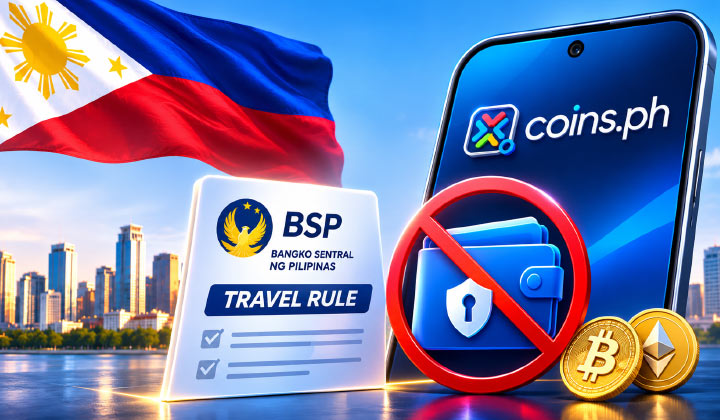
- All deposits and withdrawals using self-custody wallets have been paused. This was communicated to clients on 21st Nov: “Self -custody wallets are no longer supported”.
- All external transfers now require full Travel Rule information recipient/sender name, address, wallet type, exchange platform, and purpose regardless of amount.
- Deposits to self-custody wallets will be rejected. The user will be refunded, with network fees deducted. Withdrawals to self-custody wallets will fail automatically.
- The BSP’s Memorandum M2023042 does not categorically ban self-custody wallet dealings Coins.ph’s blanket exclusion is its own policy choice, going beyond what regulators strictly require.
What Changed On November 19
Effective November 19, 2026, Coins.ph the Philippines’ largest crypto exchange with an estimated 18.6 million registered users stopped processing all direct onchain deposits and withdrawals involving self-custody wallets. On November 21, the company updated their notice for customers, stating that transfers from Self-custody wallets are no longer allowed.
The restriction applies to all external transfers regardless of size there is no minimum amount exemption. Transfers from self-custody wallets within Coins.ph have been paused.
Philippines’ Largest Crypto Exchange Coins ph Halts Transfers to and from Self-Custody Wallets
Coins ph, the Philippines’ largest cryptocurrency exchange, announced that effective November 19, it no longer supports direct crypto deposits or withdrawals involving self-custody wallets. Users may only transfer assets to or from accounts at other regulated exchanges. Under the Bangko Sentral ng Pilipinas (BSP) Travel Rule requirements, all external transfers, regardless of amount, require counterparty details, wallet type, exchange platform, and transaction purpose. Incoming deposits will be credited only after the required information is verified.
— Wu Blockchain (@WuBlockchain) November 22, 2026
However crypto held within the app without making any transfers is unaffected. Changes to the Wallet OpenAPI endpoints were also made on 19th November. Developers should refer to the updated documentation. It is unclear if/when transfers from self-custody wallets will resume.
Information Required & What Happens To Noncompliant Transfers
For all transfers out of the account, the following information is requested: Full name of recipient, recipient wallet address, type of wallet (self-custody or exchange), name of exchange, and reason for sending. For transfers in, all funds will be put into a hold status, requiring completion of a Travel Rule form.
The sender’s full name, address, wallet address, type of wallet, sending exchange name and reason for sending will be required. Names must match what is registered with the other exchange. If a business account, entity names must be used. If attempting to send to self-custody wallet addresses, the withdrawal will fail and the funds will remain within your Coins.ph account.
If receiving from self-custody wallets, the deposit will be rejected and sent back to original sender. Network fees will be deducted. Some transfers may require manual checking, and then will be sent back. CEO Wei Zhou told BitPinas that any regulated exchange both local and international qualifies as a valid counterparty.
Regulatory Background & Policy Choice
Coins.ph complies under the guidelines given by Bangko Sentral ng Pilipinas. These guidelines include Circular 1108, issued in 2021, and Memorandum M2023042, issued in December of 2023. All virtual asset transactions of more than Php50,000 must be reported. In Memorandum M2023042, stricter requirements have been added.
All virtual asset transactions in unhosted wallets must undergo increased customer due diligence, and in the case that sufficient information on the transaction counterparty is not provided, funds may not be released.
However, that memorandum does not categorically ban exchanges from dealing with self-custody wallets Coins.ph’s blanket exclusion goes beyond what the regulation strictly requires and reflects the exchange’s own risk management decision.
With the Philippines successfully taken off the grey list by FATF in February 2025, and with the next mutual assessment in 2027, domestic VASPs face increased pressure to be fully compliant with the Travel Rule. Crypto commentator Ethan Rose (@pouchceo) posted on X: “Self-custody is under attack in the Philippines.”
Stay informed with the latest trends in Web3, blockchain innovation, and cybersecurity updates at 3verseTV
You need to login in order to Like












Leave a comment