


- CFTC Chairman Michael Selig has outlined two possible ways for Hyperliquid to enter the US market and offer derivatives trading.
- The platform can either establish its own registered exchange and clearinghouse or partner with companies that already have regulatory approval.
- Selig made it clear that blockchain-based trading platforms must follow the same financial rules as traditional companies when serving US customers.
Two Possible Ways To Enter The US Market
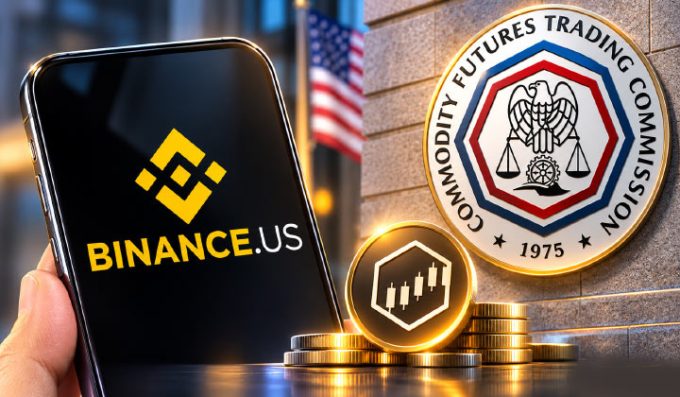
Hyperliquid may enter the US market in the future. In an event on Capitol Hill on 19 th November, Chairman of the Commodity Futures Trading Commission (CFTC), Michael Selig outlined that Hyperliquid may provide derivative products to US consumers, compliant with US financial regulations. Hyperliquid is a key platform for perpetual futures on the blockchain, especially for retail participants.
On Monday, the @CFTC authorized the first exchange and clearinghouse to offer onchain markets for derivatives.
Today, @ChairmanSelig explained another pathway to bring onchain markets into the United States: https://t.co/g20iVEvnKa
— Hyperliquid Policy Center (@HyperliquidPC) November 19, 2026
Furthermore, recent authorisations granted to blockchain derivative exchanges and clearing houses demonstrate that crypto platforms can comply with financial regulations.
Backpack & tZERO Set Examples
Hyperliquid has two potential options. It can set up its own authorised clearing house and exchange, and work with an approved Futures Commission Merchant (‘FCM’) and National Futures Association (‘NFA’). Alternatively, Hyperliquid can work with entities who are appropriately authorised, which could simplify the process.
Selig stated that Backpack has been recently authorised, demonstrating how blockchain-based derivatives platforms can enter the regulated financial market.
TLD Clearing, operating as Backpack Clearing was authorised as a Derivatives Clearing Organisation (DCO) by the CFTC on 13 th November. Additionally, on 16 th November, TLD Markets was authorised as a Designated Contract Market (DCM).
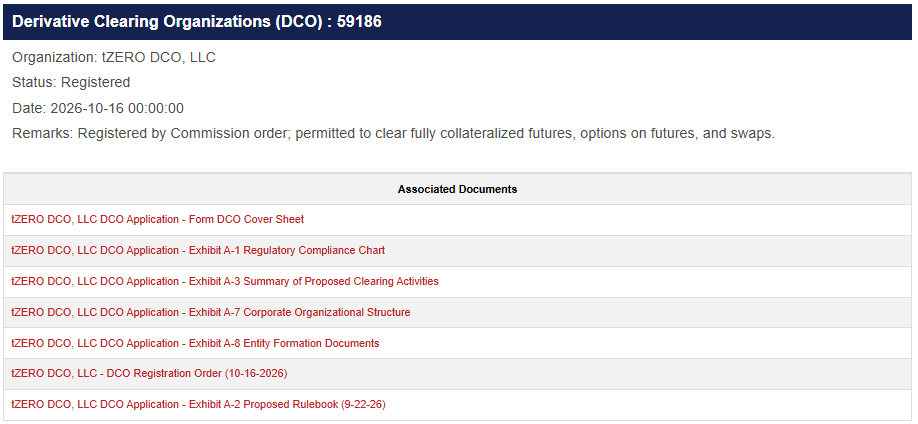
Source: cftc.gov
These roles within the derivatives market mean that whilst a DCM is an authorised trading platform on which derivatives can be bought and sold, a DCO facilitates settlement and clearing of derivatives. The DCO also handles margin requirements, and ensures that both parties meet their financial obligations.
Backpack can now facilitate both roles through multiple authorised entities. The authorisation allows Backpack to facilitate a range of products; futures, futures options and swaps. tZERO has also been granted both authorisations as a clearing house on 16th October and as an exchange on 10th November.
Blockchain Technology Does Not Mean Exemption From Rules
Selig also noted that although crypto platforms may incorporate blockchain technologies, it does not mean that they are exempt from financial regulation. However, simply delivering financial services using blockchain technology does not mean that financial regulation can be avoided.
The @CFTC approved the first exchange and clearinghouse applications for a firm utilizing blockchain-based architecture for the execution and settlement of derivatives.
These approvals demonstrate that there is a regulated pathway for a new generation of market infrastructure built using blockchain technology and reinforce that the United States is open for business to innovators.
— Mike Selig (@ChairmanSelig) November 16, 2026
Derivatives provided to retail clients must be provided by an authorised exchange. As such, just like traditional financial institutions, blockchain-based derivatives platforms must follow this rule.
This is particularly important for Hyperliquid as it provides decentralised trading. Users interact with the trading platform directly through blockchain.
On regulatory issues, Hyperliquid has previously engaged with the CFTC. In July 2026, a joint letter was sent to the CFTC by Hyperliquid Policy Center and Phantom Technologies. The letter requested clarification from the regulator as to whether simply developing/publishing on-chain software means that financial authorisation is required. It also argued that non-custodial wallets should not be automatically considered financial intermediaries.
Although Hyperliquid has a better understanding of how it may enter the US market as a result of Selig’s comments, this is not regulatory approval. In order for Hyperliquid to legally provide derivatives to retail clients in America, it must still meet certain criteria.
Stay informed with the latest trends in Web3, blockchain innovation, and cybersecurity updates at 3verseTV
You need to login in order to Like











Leave a comment