


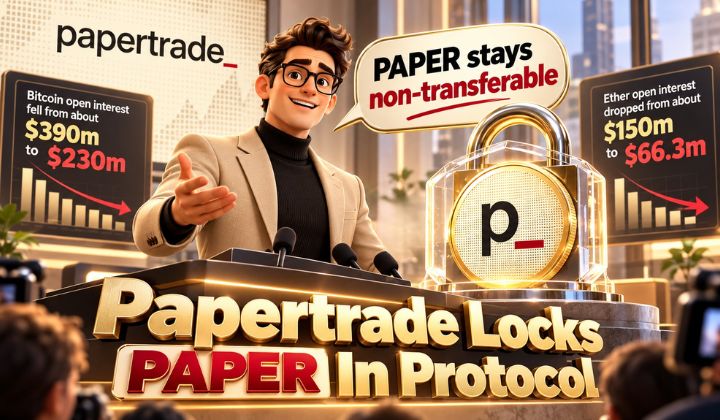
- Papertrade confirmed on October 19 that its PAPER token will stay non-transferable for the foreseeable future, citing solvency risks from external perpetual markets.
- A new issuance curve will mint about 0.1% of the then-current supply per $1 million in losses, gradually diluting early holders.
- Higher fees on quick-close trades are also planned, aimed at low-time-frame bot strategies.
- After the announcement, Bitcoin open interest on the platform fell from about $390 million to $230 million, and Ether open interest dropped from about $150 million to $66.3 million.
Papertrade, a synthetic perpetuals protocol on Hyperliquid’s HyperEVM layer, said on October 19 that its PAPER token will remain non-transferable for the foreseeable future. The team also revised how new tokens are issued, a change that will dilute early holders over time. The decision drew sharp criticism from users who had deliberately taken losses at launch to build up PAPER positions.
A note on transferability.
Papertrade is a complicated primitive, and managing it from a risk standpoint is a complicated problem. The PAPER token is far more integrated into the economics of the primitive than most tokens are in their respective protocols today, and, broadly, was designed to act as a counter insolvency incentive coupled with a rebate mechanism to losing traders. Market makers and exchanges are by far the two most profitable businesses in crypto, and our goal was to try and externalise as much of their margins back to users as possible. We are now just over a week into the life of papertrade and we are becoming increasingly confident that this is both possible, but also a likely outcome as agentic led software becomes the norm.
As it stands, the paper token traded as a perp becomes a leveraged bet on bankroll solvency – and being able to short bankroll solvency materially changes the payoff curve of a manipulation attack. The target number goes from the bankroll, to the bankroll + short side exposure on paper. We can, and do limit bankroll size specifically to control this payoff curve and ensure it never becomes existentially problematic, but external perp markets are not something we would have any control over if left to float of their own accord. For example, if our bankroll is $10m, an attack costing $15m manipulating the price of bitcoin or ether is not viable. You simply lose money. If however you were also able to put on $10m of PAPER short side exposure, suddenly an attack costing $15m is very viable indeed.
If we were to make the token transferable at this point, we are confident we would quickly enter a state too dangerous to allow any material exposure to be taken on papertrade, an end result that benefits no party beyond the wolves who have done the math on the short and are waiting in the wings with sharpened knives.
We would also like to thank the various perps teams who have reached out about pre-market listings for their understanding and patience regarding this issue, and especially to the paragon team who, despite jumping the gun on us, have behaved with the utmost integrity and transparency once a dialogue was opened.
Perps on PAPER will always act as a self-limiting exposure ceiling for a token with this type of utility, and we think it would be a shame to limit the growth of papertrade to the extent that allowing perps would necessitate. As such, at this juncture we do not have plans to allow off-contract token transferability.
Structurally, papertrade is limited by the quality of the data it receives from hyperliquid, but we strongly believe that hyperliquid has a very large part to play in the future of global exchanges, and expect their books to continue to thicken and strengthen over time.
A note on fees.
Papertrade launched with a deadband fee from entry of 0.2bps. This means you don’t earn anything until the price has moved by 0.002% in your favour. Over the months before launch, we played around with many different curves and fee structures affecting exclusively positions closed very close to entry price in order to try and devise a structure that removed the edge against the bankroll low time frame scalp bots have, whilst also minimally impacting the traders around which and for whom the product was devised. We were never able to find anything we were absolutely happy with and so decided to stay with the 0.2bp deadband fee through launch. This has however meant we have had to be very restrictive when it came to certain parameters, such as OI caps.
Now, however, we have enough live data to fully understand exactly which strategies work, and to make the necessary changes to stop them. The changes we are making will have an on hours and off hours fee mode to account for the relative differences in liquidity the hyperliquid books see between these two time periods, and the ease with which low time frame moves are signalled. The changes we are making will only affect positions closed within 6bps of entry (0.06%) in on hours, and 10bps (0.1%) in off hours. Any trades closed above these threshold price shifts will see no change to their fees at all. On a look back to launch basis, these changes affect the profitability of bot strategies roughly 15x more than they do normal traders, for whom a very small proportion of overall winnings come from within this band.
These changes should serve to flatten much of the edge our microfee structure necessarily creates on low time frames, and will help with long term exchange sustainability. This should hopefully allow us to open up parameters such as OI caps a little more so those of you who wish to can put on the size you want to, when you want to.
It is possible these changes are still too lax, and that further revisions to this structure may be necessary going forwards. If so, we will notify users ahead of time.
A note on paper tokenomics.
In conjunction with the fee changes, we will also be implementing a change to the token issuance curve.
Going forward, every $1 lost mints a fixed share of PAPER’s supply at that moment, roughly 0.1% of supply per $1M lost (the exact number depends on the mint rate at the time the contracts are upgraded). PAPER minting in and near insolvency will also change, switching from a flat 100 per $1 of loss, to a time weighted multiplier on the curve growing over time, effectively acting as the house running a discounted auction on its own future cash flows. This change also removes the risk of the paper-mint-straddle-attack, temporarily pushing the protocol insolvent by closing only the winning side of a large straddle position and then attempting to mint as much paper as possible.
In the immediate term these changes will only have a very subtle effect on PAPER minting, but in the long run will structurally change the outlook of the system beyond the first few weeks, serving to slowly dilute out older holders and leaving more recent users with an advantage. Reconstituting the PAPER system into something much closer to the exchange rakeback it was intended to be.
We have been very reticent to touch this particular aspect of the system for obvious reasons, but ultimately we believe that these changes provide all users with the optionality to take a smaller piece of a potentially much larger pie than the current dynamic might necessarily allow.
Other, miscellaneous notes.
These contract upgrades will include a few other contract changes, including the addition of builder codes so that builders can utilise papertrade in whatever capacity they choose to. This will be a whitelist only to begin with and we will have more for you later in the week on where/how this will be rolled out. A small change to contract permissions on the reward distributor and a change on how below bust closes are processed by the exchange are also included, largely to block gas griefing attacks.
These changes will be pushed to docs in full over the coming day, and we will further announce once the changes are queued into the timelock pending final security passes, scheduled to go live 24 hours after that point.
Final note.
We’d like to thank everyone that has tried out papertrade over the last 10 days. It has been a labour of love building this product and both of us have been taken aback at all of the positive feedback we have received. We’d also like to thank all those of you who have spent considerable time musing on the system we have built, and much of your advice has been taken onboard and will likely affect the colour of what papertrade becomes going forward. We know some of these changes will be unpopular with some, but we would not be making them if we did not feel them to be absolutely necessary.
– blurr, jez
— papertrade.xyz (@papertrade_xyz) October 19, 2026
The announcement came from the project’s official account and was signed by co-founders Blurr and Jez. It followed a launch about ten days earlier that produced heavy notional trading volume and a wave of intentional loss-taking aimed at minting the token.
How Papertrade & PAPER Work
Hyperliquid is a blockchain-based trading venue known for perpetual futures, and HyperEVM is its smart contract layer. Papertrade runs on top of it, offering up to 1,000x leverage on Bitcoin and Ether positions. Trades are executed as synthetic swaps against one protocol-owned USDC liquidity pool, which starts empty and is funded only by traders’ realized losses. Prices come from the midpoint of Hyperliquid’s best bid and offer.
According to the project’s documentation, PAPER is minted only for traders who close losing positions or get liquidated. The initial rate was 100 tokens per dollar of eligible loss while the tracked pool stayed below roughly $2 million, after which the rate was designed to decay.
The token launched with zero supply, with no team or investor allocation and no airdrop. At first it could only be staked or unstaked. Stakers earn USDC distributions funded by protocol fees and pool surplus under set conditions.
Founders Say Transferability Would Put The Protocol At Risk
In their statement, the founders argued that a transferable PAPER would create a material threat to the protocol’s solvency. An external perpetual market on the token, they said, would turn it into a leveraged bet on the health of the bankroll.
That opens the door to an attack. Someone could short PAPER while also manipulating the Hyperliquid reference price for BTC or ETH, turning an otherwise unprofitable exploit into a profitable one. The team gave an example: against a $10 million bankroll, a $15 million price-manipulation attack would lose money by itself, but adding $10 million of PAPER short exposure could make it viable.
“If we were to make the token transferable at this point, we are confident we would quickly enter a state too dangerous to allow any material exposure to be taken on papertrade,” the founders wrote.
They added that perpetual markets on PAPER would cap the protocol’s growth and that they currently have no plans to allow off-contract transfers. The post also thanked teams that had asked about pre-market listings, and noted constructive talks with Paragon after an earlier HIP-3 market was opened without prior approval.
New Issuance Curve & Fee Changes
Papertrade also announced changes to how PAPER is issued. Each dollar lost will now mint a fixed share of the then-current supply, roughly 0.1% per $1 million in losses. This replaces the earlier front-loaded rate that favored the first participants. Minting rules near insolvency will move to a time-weighted multiplier.
The founders said the change would have only a subtle effect in the near term. Over longer periods, though, it will slowly dilute older holders and give newer users a relative edge, making the token work more like ongoing exchange rakeback. They acknowledged the move would be unpopular with some users but said live operational data made it necessary.
Fee changes are also coming. Positions closed within 6 basis points of entry will cost more during active hours, and within 10 basis points during off-hours. The team said this falls harder on low-time-frame bot strategies than on ordinary traders.
The upgrades, which also include builder codes and certain gas-griefing mitigations, are subject to a timelock following a final security review. They follow earlier reporting on a single wallet that turned launch-day losses into large staking rewards under the original emissions design.
Users Push Back As Open Interest Drops
The mix of continued non-transferability and the new emissions curve drew immediate criticism from users who had treated early losses as a route to a large PAPER stake. Many had expected a secondary market to emerge. External pre-market contracts were later halted or settled.
Activity on the platform fell after the post. Bitcoin open interest slid from roughly $390 million to $230 million, and Ether open interest dropped from about $150 million to $66.3 million, according to platform data referenced around the announcement. Total value locked also edged down from earlier peaks near $100 million.
Critics said the changes remove both the ability to sell and the scarcity advantage early farmers had built, leaving staking for USDC yield as the main use of the token. “Imagine if you farmed late, you just got rekt so hard right now. Idk what the point of $paper even is anymore tbh,” wrote X user cnig69.
Did @papertrade_xyz just completely change their tokenomics just like that after people farmed and burnt money? Sheesh, imagine if you farmed late, you just got rekt so hard right now. Idk what the point of $paper even is anymore tbh.
— cnig69 (@cnig69) October 19, 2026
Supporters, including the founders themselves, argued that external leveraged markets on a token tied to protocol solvency create an attack surface the protocol cannot control. In effect, Papertrade has chosen to limit external short exposure and spread claims on future revenue more widely, rather than preserve the concentrated upside that drove much of its early activity.
Stay informed with the latest trends in Web3, blockchain innovation, and cybersecurity updates at 3verseTV
You need to login in order to Like

















Leave a comment