


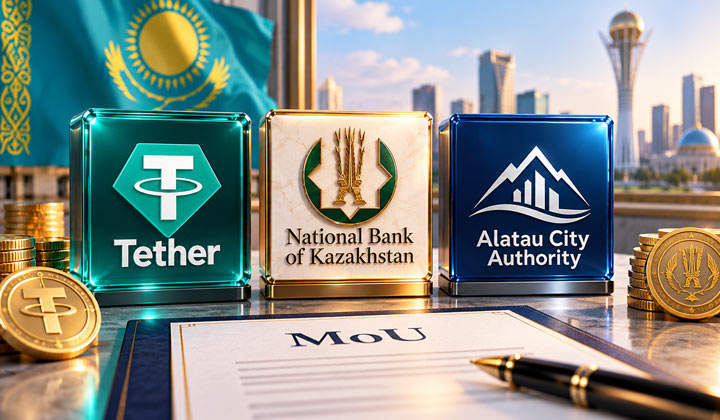
Tether has signed an agreement with Kazakhstan’s National Bank and the Alatau City Authority to explore a new stablecoin linked to the Kazakhstani tenge. They will also study how real-world assets such as property and bonds can be converted into digital tokens. The agreement was signed on October 7. It does not mean that the stablecoin has been launched. The three parties will first study the idea, prepare plans for possible pilot projects and conduct training programmes.
Tether Signs MoU with the National Bank of Kazakhstan and the Alatau City Authority to Explore Stablecoin Use Cases and Asset Tokenization
Learn more: https://t.co/99Cwo0yiBj— Tether (@tether) October 7, 2026
The agreement covers three main areas.
The first is a possible stablecoin linked to the tenge, Kazakhstan’s national currency. The parties will study how other countries use stablecoins and look at possible uses for a tenge-based stablecoin. They will then prepare a proposal for a pilot project.
A stablecoin is a cryptocurrency designed to maintain a stable value. In this case, the proposed stablecoin would be linked to the tenge.
The second area is asset tokenization.
Tether and the Kazakh authorities will study which assets could be included in the project. They may then start a pilot project in Alatau. Tether’s Hadron platform could be used, although the agreement does not confirm this.
The third area is training. Tether, the National Bank and the Alatau City Authority will organise workshops and seminars for government officials and central bank staff. The training will cover stablecoins, digital assets, managing stablecoin reserves and tokenization.
Kazakhstan is already working on digital assets. The country has its own digital tenge, which is a central bank digital currency, or CBDC.
Therefore, the new agreement does not replace Kazakhstan’s digital tenge programme. It is a separate effort to study stablecoins and blockchain-based assets.
Tether CEO Paolo Ardoino said digital assets are increasingly being used for real-world financial activities. Kazakhstan’s central bank, however, said financial stability, transparency and investor protection will remain important.
There are still many unanswered questions. There is no confirmed date for the launch of a tenge stablecoin. It is also not clear who would issue it, how it would be backed or which assets would be included in the tokenization pilot.
For now, the agreement is only a study and pilot plan, not a product launch. The next step will be to see whether Kazakhstan’s National Bank and other authorities publish a detailed proposal for the stablecoin and tokenization projects.
Stay informed with the latest trends in Web3, blockchain innovation, and cybersecurity updates at 3verseTV
You need to login in order to Like

















Leave a comment