


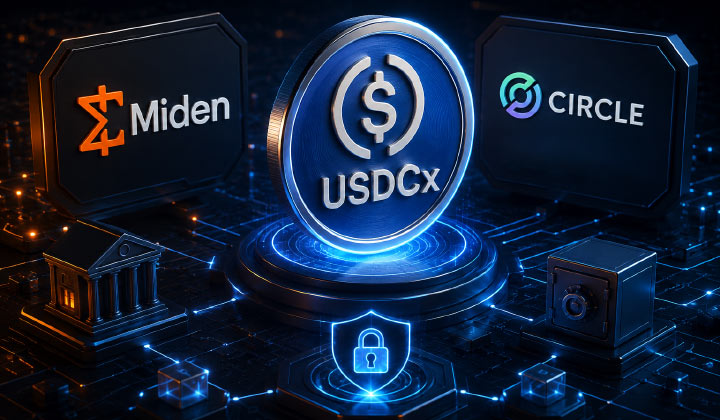
As the zero-knowledge blockchain prepares for its mainnet release later this month, Miden is getting ready to introduce USDCx, a privacy-focused stablecoin supported by USDC.
The stablecoin will be released natively on Miden via Circle’s xReserve infrastructure and backed 1:1 by USDC stored in an xReserve smart contract, according to a blog post published on Wednesday. By default, USDCx will keep individual balances, counterparties, and transaction histories private, in contrast to regular USDC transactions on the majority of public blockchains.
The stablecoin is meant to facilitate payments and other financial applications where transaction anonymity is crucial, according to Miden, who announced the scheduled debut on August 12.
Today we’re announcing that USDCx on Miden is coming soon: a native, @USDC-backed stablecoin, issued by Miden via @Circle xReserve.
Stablecoins on Miden will be private by default.
Hold and transact USDCx without publishing your balances, counterparties, or payment history to… pic.twitter.com/r1DOFlIGLf
— Miden (@0xMiden) August 12, 2026
A distinct dollar reserve system is not what USDCx is. Rather, Miden will issue the token against USDC reserves using Circle’s xReserve concept. According to the agreement, USDCx is backed by USDC placed into xReserve, and it runs natively on Miden.
The purpose of Circle’s xReserve was to enable blockchains to issue representations backed by USDC without the need for conventional third-party bridges. USDCx has previously been deployed on other networks using this concept.
As of August 12, the DeFiLlama statistics showed that USDC’s market value was around $72.22 billion. Approximately 72.25 billion USDC were recorded as in circulation on the site, with an additional 1.139 billion USDC designated as unreleased.
The numbers set the stage for Miden’s intended USDCx launch, which will make use of Circle’s current USDC infrastructure in place of a new dollar-reserve system. The intended Miden debut comes after USDCx was used in an actual institutional transaction on Canton.
A real-time transaction between a tokenized U.S. Treasury and USDCx on the Canton Network was finished by Tradeweb on July 1. The transaction made advantage of Canton’s synchronized settlement system and matched tokenized cash with tokenized Treasury.
Virtu Financial received the tokenized Treasury instrument from Franklin Templeton, and Tradeweb was in charge of price discovery and execution. Using Canton’s infrastructure, the two assets were settled together onchain.
Using a stablecoin backed by USDC as the cash leg of a tokenized securities transaction is one possible application of USDCx in institutional markets, as demonstrated by this transaction. In a network where transaction data is by default private, Miden is implementing the same fundamental USDC-backed paradigm.
The action coincides with stablecoins’ expansion into financial infrastructure, payments, and settlement in addition to cryptocurrency trading. Although public blockchains offer clear transaction records, companies who use stablecoins for regular financial transactions may encounter issues as a result of this openness.
Stay informed with the latest trends in Web3, blockchain innovation, and cybersecurity updates at 3verseTV
You need to login in order to Like
















Leave a comment