


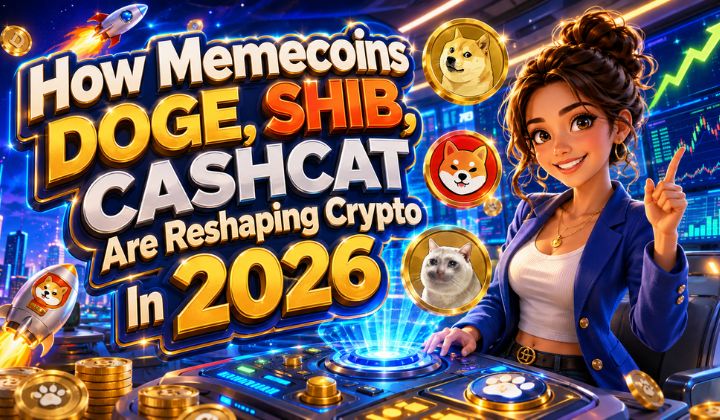
A few years ago, memecoins used to be the joke corner of crypto. Most of them didn’t make sense. Often, a funny picture, a catchy name or a viral social media post was all it needed to send prices skyrocketing. That excitement drove the memecoin market to an all-time high market capitalization of almost $137.19B in December 2024.
But hype alone could not last forever.
As the wider crypto market cooled down, so did memecoins. As late as 2025, memecoin’s total market cap had fallen to around $47B, a stark reminder of how quickly attention can fade in crypto. Even in 2026, the sector is lower at a Market Cap of $23B. Yet despite that decline, memecoins have refused to disappear.
That is because something much bigger has changed.
The strongest projects are no longer relying on memes alone. Some are building payment networks. Others are creating blockchain ecosystems. A few are even proving that an internet personality or a brand can become the foundation of an entire crypto community.
That is why memecoins in 2026 tell a very different story from earlier market cycles.
For eg., Dogecoin is no longer seen only as internet’s favourite joke coin. It is slowly becoming a payments network. Shiba Inu is trying to build an entire blockchain ecosystem around its community. ANSEM crypto showed how a creator’s influence can become the centre of a memecoin narrative. CASHCAT crypto proved that when a brand-new blockchain launches, retail traders often rush towards the memecoin before exploring anything else. FEFER crypto repeated the same pattern on Stable Blockchain.
So, the future of memecoins is no longer simply about buying the funniest coin on social media.
It is becoming a story about attention, communities and utility coming together.
How Are Memecoins Evolving Beyond Speculation In 2026?
To understand why the category looks different today, it would be better to look back at how memecoins usually worked.
Earlier, the formula was way too simple.
Someone launched a token around a dog, a cat, a frog or another internet joke. The community shared memes, influencers talked about it, trading activity increased and prices often moved rapidly. Whether the project built anything rarely mattered.
That model still exists today.
But it is no longer the only model.
Over the past year, the market has quietly started dividing memecoins into different groups. Some are largely mere speculation. Others are trying to solve real problems, like making payments simpler or building apps people can use. There’s also a newer category popping up where communities are built around creators and not animals or internet jokes.
This is a big change, because it means memecoins can be created for more than one reason, and even for a meaningful purpose other than making quick money.
Some projects are looking to create reasons for people to continue to use them even after the initial excitement wears off, instead of just surviving because people are talking about them.
You can already see this change across the biggest names in the sector.
One project is trying to become a payment network.
Another is building an ecosystem.
Third is experimenting with creator-led communities.
And the newest blockchains are discovering something interesting: before traders explore complicated infrastructure, they often arrive through memecoins first.
That journey begins with the biggest name of them all: Dogecoin.
DOGE Vs SHIB 2026
When people think about memecoins, two names almost always come to mind first: Dogecoin (DOGE) and Shiba Inu (SHIB).
They began with nearly the same reputation. Both were considered community driven tokens that took off because of internet culture rather than any new technology.
But if you look at them today, they are trying to solve two very different problems.
That difference tells us a lot about how memecoins in 2026 are evolving.
Dogecoin has decided to focus on payments.
Shiba Inu has decided to focus on creating an ecosystem.
Both are searching for the answer to the same question: How does a memecoin remain relevant when the hype has been faded ?
What Utility Does Dogecoin Have In 2026?
Dogecoin has been the internet’s favorite joke coin for some time now. Millions of people knew about it, but only a few used it for anything besides buying and selling.
That started changing slowly.
One of the biggest amendments was House of Doge’s partnership with MoonPay, a crypto payments company that helps businesses accept digital currencies. They announced plans to enable more than 6,000 merchants globally to accept native dogecoin payments. ÐOGE Pay is expected to roll out during 2026.
Why does this matter?
Because it changes what Dogecoin can acually do!
Now, rather than sitting in a crypto wallet, DOGE can be used to purchase goods and services from merchants that accept it. That’s a tiny step, compared to traditional payment networks, but a significant one, since it provides Dogecoin with a real-world use case beyond speculation.
But payments are only part of the picture.
The second big change is how traditional investors can now access dogecoin.
In the past, anyone wanting to invest in DOGE needed to open an account on a cryptocurrency exchange, buy the token and keep it safe in a wallet.
Today, there is another option.
A Spot Exchange Traded Fund (ETF) is an investment product that is traded on a stock exchange and that aims to track the price of an underlying asset. Instead of buying Dogecoin directly, investors can buy shares of the ETF using a regular broking account.
In 2025, REX-Osprey launched DOJE, the first U.S.-listed Spot Dogecoin ETF. Since then, products like Grayscale’s GDOG have also entered the market, giving traditional investors another regulated way to gain exposure to Dogecoin without managing private keys or crypto wallets themselves.
That does not remove the risk.
In fact, many of these products have experienced significant volatility since launch, showing that an ETF wrapper does not make a memecoin any less volatile.
What it does show is something else.
Dogecoin is gradually becoming easier to access, easier to spend and easier to understand for people outside the crypto industry.
That is a very different story from the Dogecoin people knew just a few years ago.
But payments are only one way a memecoin can grow.
Shiba Inu decided to take a completely different route.
Shiba Inu Builds An Entire Ecosystem
Rather than aiming to be a payments network first, over the past couple of years Shiba Inu has built its own blockchain ecosystem.
To understand why that’s important, we first need to understand what Shibarium actually is.
The industry calls Shibarium a layer 2 blockchain. In simple terms, it is a second layer on top of another blockchain (Ethereum in this case) that makes transactions faster and cheaper for the users .
That provides developers with a place to build applications without the higher fees often associated with ethereum’s main network.
More importantly, it gives SHIB something that many memecoins never manage to build: an ecosystem.
The numbers show that people are using it.
The network has processed over one billion transactions, generated more than 175 million wallet addresses and produced over 10 million blocks since its launch, according to the official Shibarium website. At its peak, it has processed almost four million transactions in a single day, with average transaction fees of less than 10 gwei, a tiny unit that measures fees on the Ethereum network.
Those numbers matter because they tell us something beyond price.
They suggest people are not only buying SHIB. They are also using applications built around its ecosystem.
The greater Shiba Inu project, too, has grown beyond a single token. Today it includes a number of ecosystem tokens, developer tools and projects like ShibOS, which is intended to help businesses and institutions to create blockchain applications using the Shiba Inu ecosystem.
It remains to be seen if all that vision will work.
But the key thing is that SHIB is trying to create value through infrastructure, not just internet culture.
That creates an interesting contrast.
Dogecoin is trying to become a cryptocurrency people can actually spend.
Shiba Inu is trying to be something you can build on.
Both approaches indicate that the biggest memecoins are attempting to find ways to remain relevant well after the original meme’s heyday.
But perhaps the biggest surprise of 2026 came not from DOGE or SHIB.
Instead, it originated from a token based on a person not an animal.
That is where the story of ANSEM crypto begins.
What Is ANSEM Crypto And Is It Connected To Ansem?
For years, most successful memecoins had one thing in common.
They were built around animals.
Dogs, cats, frogs and countless internet characters became the face of entire communities. The idea was simple. If the meme proved entertaining enough to enough people, the token could attract attention, trading activity and, sometimes, billions of dollars in market cap.
But in 2026 something else happened.
Instead of building a memecoin around an animal, the market started building one around a person.
That person was Ansem, one of crypto’s best-known traders and content creators.
This naturally led many people to ask one question:
Was ANSEM Crypto Actually Created By Ansem?
No.
The token was originally issued by an independent developer, not Ansem himself. However, a significant portion of the supply eventually found its way into wallets linked to him, and rather than distancing himself from the project, Ansem began engaging with the community. Reports later showed that creator fees generated from the token were being redirected towards community rewards and liquidity support, giving the project a stronger connection with the people trading it.
That small difference changed the entire narrative.
Earlier memecoins usually depended on whether a meme stayed funny.
ANSEM depended on whether a creator could keep a community engaged.
That may sound similar, but it is a completely new model.
A creator posts content regularly. People interact with that content every day. The community grows over time. If that attention continues, the token can continue receiving attention too.
In other words, the community is no longer gathering around a dog or a frog.
It is gathering around a personality.
The market responded almost immediately.
Within just one week, ANSEM became one of the biggest talking points on Solana. Some reports showed the token surging by nearly 19,900% around late June 2026, while early participants who entered before the wider market noticed saw extraordinary returns. Daily trading volumes also crossed tens of millions of dollars, showing that the excitement was not limited to social media alone.
Of course, moves like these are extremely rare and highly risky. They should not be seen as normal market behaviour.
But they do tell us something important about memecoins in 2026.
Attention itself has become an asset.
Earlier, the meme created the community.
Now, sometimes the community creates the meme.
That’s a nuanced but an important change to note.
And the story doesn’t end there.
If ANSEM showed that a creator could become the centre of a memecoin narrative, the next examples showed something equally interesting.
Sometimes, a brand-new blockchain does not become popular because of its technology.
It becomes popular because of its very first memecoin.
What Is CASHCAT And Why Is It Popular On Robinhood Chain?
When Robinhood announced its own blockchain in 2026, many people expected the first big conversation to be about tokenized stocks.
Tokenized stocks are digital versions of traditional company shares that can be traded on a blockchain instead of through conventional stock market infrastructure. Since Robinhood is already one of the leading global investing platform, that seemed like the obvious narrative.
But crypto rarely follows the obvious path.
Almost immediately after Robinhood Chain went live, one of the first projects to capture traders’ attention was not a tokenized stock.
It was a memecoin called CASHCAT.
That surprised many people.
Here was a blockchain launched with serious ambitions around financial markets, yet the first breakout story came from a cat-themed token. CASHCAT’s name itself comes from an early “Cash Cat” concept associated with Robinhood before the company adopted its current name. However, the token was created by the community and is not an official Robinhood token.
What made it rise so fast?
Part of the answer was the Robinhood connection itself.
On July 8, 2026, Robinhood CEO Vlad Tenev posted that while the company was building Robinhood Chain to become a major network for real-world assets, “it works great for memes too.” Around the same time, CASHCAT was already becoming the chain’s biggest memecoin and had surged by more than 1,000% in a single day. Tenev also followed the token’s account, giving traders another reason to believe the memecoin had caught the attention of Robinhood’s leadership, even though there was no official endorsement of CASHCAT.
That attention became important again later in the month.
During Robinhood’s second-quarter earnings call on July 29, 2026, Tenev was demonstrating the Robinhood applications on his phone when traders noticed CASHCAT in his recent search history. The token then rose about 16% in 24 hours, according to reports, as traders speculated that Robinhood could eventually support or list the token. Eventually Robinhood listed CASHCAT on August 6, 2026 on their app and platform.
By August 10, 2026, the listing had helped push CASHCAT much further. At the time of writing, CoinGecko’s market snapshot showed that CASHCAT was worth around $150M in market capitalization, gaining more than 200% in the week prior. That’s a good move for a token that didn’t even exist before Robinhood Chain went live.
And that is exactly what makes CASHCAT interesting.
Its rise has not been driven by a complicated technology story. It has been driven by a combination of Robinhood’s brand, the launch of a new blockchain, growing trading activity and repeated attention from the company’s CEO.
The story also shows why memecoins can become the quickest way for traders to explore a new blockchain.
Launching infrastructure takes time.
Building applications takes time.
But creating a community around a meme can happen almost overnight.
That does not necessarily mean CASHCAT will remain successful over the long term.
What it does show is how crypto communities usually behave.
A new blockchain often gives traders a fresh ecosystem to explore, and a memecoin can become the easiest entry point.
We have seen this pattern before on Solana.
We saw it on Base.
And Robinhood Chain showed that the same behaviour still exists among memecoins in 2026.
Interestingly, Robinhood Chain was not the only new network where this happened.
A similar story was beginning to unfold elsewhere.
This time, the spotlight shifted to Stable Blockchain and a memecoin called FEFER.
What Is FEFER And How Is It Driving Activity On Stable?
If CASHCAT showed how a new blockchain could attract traders through a memecoin, FEFER crypto showed how the same thing could happen on a network built for a very different purpose.
The story starts with Tether.
Tether is the company behind USDT, a stablecoin designed to stay close to the value of the U.S. dollar. Its CEO, Paolo Ardoino, shared a picture of a blue dinosaur in July with the word “Fefer” as a joke around the pronunciation of Tether. The image quickly caught the attention of the crypto community, and traders turned the joke into FEFER, which became the first major memecoin on Stable Blockchain. Stable itself then amplified the meme through its social media channels.
That connection is important, but it needs to be understood correctly.
FEFER is not an official Tether or Paolo Ardoino token. Its connection to Tether is indirect. The meme that inspired the token came from Tether’s CEO, while Stable itself is closely connected to the wider Tether ecosystem. That gave FEFER something most new memecoins do not have on day one: a story that was already familiar to a large crypto audience.
And that story quickly moved from social media onto the blockchain.
Stable Blockchain is designed around stablecoin activity and payments, but a memecoin became one of the first major reasons for traders to use the network. FEFER gave people a simple reason to create a wallet, move funds onto Stable and start trading.
That is where the bigger lesson begins.
A new blockchain can have strong technology, but technology alone does not guarantee users. People still need a reason to arrive there. A popular memecoin can provide that reason because it gives traders something simple to buy, sell and talk about while they are learning how the new network works.
FEFER showed exactly that.
On July 23, 2026, Stable said FEFER-related activity generated more than 167,000 transactions in the last 24 hours. Stable said the surge was substantial enough to increase liquidity for cross-chain bridges and improve Remote Procedure Call (RPC) performance, which is what helps wallets and apps communicate with the blockchain, to handle the rising demand.
That number matters because it gives us a better way to understand FEFER’s impact.
It was not simply a token going up on a price chart.
The memecoin was making people interact with the network itself.
Traders were moving funds onto Stable, swapping tokens and making transactions. That activity put pressure on the network’s infrastructure and forced Stable to improve the systems supporting those users.
In other words, FEFER became an early stress test for Stable.
That is the lesson CASHCAT and FEFER share.
When a new blockchain attracts memecoin activity, traders are not just speculating on the token. They are also testing whether the network can handle real users, real transactions and real demand.
For Stable, the first major wave of retail attention did not come from a complicated financial application.
It came from a blue dinosaur meme that was indirectly connected to Tether.
And that is exactly why FEFER matters in the bigger story of memecoins in 2026. The meme may bring people through the door, but the blockchain must give them a reason to stay.
Looking at DOGE, SHIB, ANSEM, CASHCAT and FEFER together, a much bigger picture starts to emerge.
Each one shows a different way memecoins are trying to remain relevant.
The Risks Still Matter
None of this means memecoins have suddenly become safe investments.
They still remain some of the most volatile assets in crypto.
Prices can shoot up in hours only to crash down just as quickly the moment the spotlight moves on.
That is something every investor must remember.
Dogecoin now has payment integrations and regulated investment products.
Shiba Inu has a growing blockchain ecosystem.
ANSEM introduced the creator-coin narrative.
CASHCAT and FEFER helped attract users to entirely new blockchains.
All of those developments make the stories behind these projects stronger than they were a few years ago.
But they do not remove risk.
It doesn’t matter how active the community is, how great the technology or how exciting the announcements are, if the trading activity slows or market sentiment changes, a project can lose a lot or all of its value.
That is how crypto works.
The lesson is not that utility guarantees success.
The lesson is that utility gives a project another chance to survive after the initial excitement disappears.
That’s a much different position than previous memecoin cycles, in which many projects vanished when the jokes stopped.
Key Takeaway
The biggest lesson from memecoins in 2026 is not that memecoins have stopped being speculative.
They have not.
The real lesson is that the category has started to grow beyond speculation.
Dogecoin is showing how a memecoin can become easier to spend through real-world payment integrations and regulated investment products.
Shiba Inu is trying to build an ecosystem where developers and users can build applications instead of simply trading a token.
ANSEM crypto introduced the idea that an entire community could form around a creator rather than a traditional meme.
CASHCAT crypto reminded the market that new blockchains often find their first wave of users through memecoins before people explore more complex applications.
FEFER crypto on Stable is exhibiting the same pattern, suggesting that memecoins are often the first sign that a new ecosystem is beginning to see real action.
These projects are collectively telling a much bigger story.
Memecoins aren’t just about the funniest picture on the internet anymore.
It is becoming a combination of culture, communities, payments, blockchain ecosystems and creator-led narratives.
The memes may still be the reason people gather.
But increasingly, utility is becoming the reason they stay.
Disclaimer: This content is for educational purposes only and is not meant to be financial advice. Please consult a financial advisor before making any investment decisions.
Stay informed with the latest trends in Web3, blockchain innovation, and cybersecurity updates at 3verseTV
You need to login in order to Like














Leave a comment