



- Token buyback regulations for functional cryptocurrency networks without a central authority are clarified by the SEC.
- When a functional system is not under the control of a central party, buyback announcements typically do not raise Howey problems.
- If buybacks are marketed as producing yield or token-holder rewards, non-functional networks come under different scrutiny.
The SEC staff updated its crypto asset FAQ on September 28, explaining that a buyback announcement generally does not represent a promise of essential managerial efforts when a crypto system is functional and has no central party.
The clarification addresses how buyback programs involving non-security crypto assets should be considered under the Howey test, particularly when assessing whether token buyers expect profits from the efforts of others.
🚨NEW: The @SECGov just updated its crypto FAQ on token buybacks to add a stipulation that if there is no central party behind those token buybacks, then this arrangement likely does not constitute an investment contract.
It comes following comments from @a16zcrypto General… https://t.co/wSrfO9hZQN pic.twitter.com/csVnKCTLKm
— Eleanor Terrett (@EleanorTerrett) September 28, 2026
SEC Draws Line Between Functional & Nonfunctional Networks
The updated Question 2.5 makes an important distinction between functional and nonfunctional crypto systems.
For a functional system without a central party, an issuer’s announcement of a token buyback would generally not qualify as a representation or promise to perform essential managerial efforts.
However, the analysis can change when a network is not yet functional. In such cases, a buyback announcement could become relevant if the issuer presents the program as a way for token holders to generate yield or financial returns.
The guidance does not mean that every crypto token buyback is outside securities laws. The SEC staff tied its conclusion to the specific circumstances, including network functionality and the absence of central control.
Howey Analysis Still Depends On The Facts
The clarification builds on the SEC’s March interpretation of federal securities laws and certain crypto assets.
Under the framework, the analysis considers whether buyers have an expectation of profit based on the essential managerial efforts of others. The latest FAQ provides additional detail on how issuer statements and network conditions may affect that assessment.
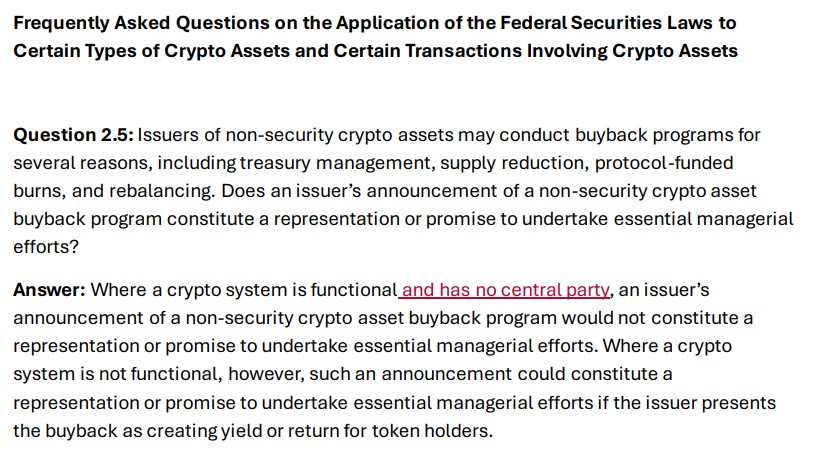
Source: sec.gov
The SEC staff also noted that becoming functional or decentralized does not automatically resolve whether an issuer has fulfilled previous promises. The analysis can depend on what the issuer previously represented as necessary for reaching those conditions.
SEC Also Clarifies Staking & Trading Platforms
The September FAQ covers more than token buybacks. It also addresses staking receipt tokens and secondary trading platforms.
Staff said certain staking receipt tokens can qualify as digital tools when they represent ownership of an underlying digital commodity under the circumstances outlined in the SEC’s March interpretation.
Meanwhile, a trading platform does not automatically become a promoter simply because it facilitates secondary-market trading. The platform must meet the definition of a promoter under Securities Act Rule 405.
Stay informed with the latest trends in Web3, blockchain innovation, and cybersecurity updates at 3verseTV
You need to login in order to Like















Leave a comment