



Ethereum co-founder Vitalik Buterin has outlined a vision for how the network could change by 2030, saying it may still be called a blockchain but could work very differently from today. In a post titled “The cryptographic world computer”, Buterin described an Ethereum that combines its blockchain with cryptographic proofs and networks of computers working outside the chain.
The approach could make Ethereum more scalable, cheaper and more private while allowing users to verify results without repeating all the calculations themselves. Buterin also expects the network to increasingly rely on mathematical proofs and stronger security technologies after its planned Hegotá upgrade.
The cryptographic world computer:https://t.co/ueayODeUPo
My attempt to express in somewhat concise terms the true meaning of basically everything planned to happen to Ethereum starting from the fork after Hegota. It’s really not just a blockchain anymore. It’s a hybrid…
— vitalik.eth (@VitalikButerin) September 27, 2026
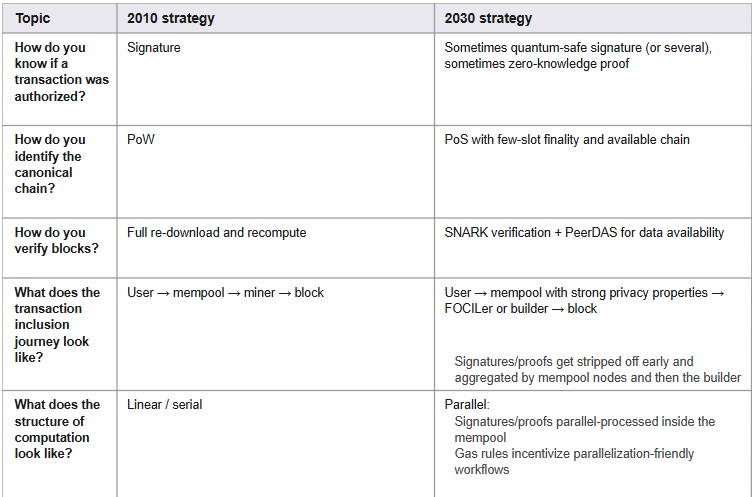
Today, Ethereum relies on computers across the network to repeat much of the work involved in processing transactions. This helps participants independently check that transactions follow the rules. But it also creates a limitation: simply adding more computers does not automatically increase Ethereum’s capacity because many of them are performing the same calculations.
Buterin believes advances in cryptography can change that model. Under his proposed approach, computers could handle different tasks and produce short mathematical proofs showing that they completed those tasks correctly.
Other computers would then verify those proofs without having to repeat the entire calculation. Separate checks could also confirm that the underlying transaction data remains available for anyone who wants to inspect it.
This could allow Ethereum to distribute work more widely while maintaining independent verification. In other words, computers would no longer need to duplicate so much of the same work simply to establish that the network is operating correctly.
The idea is not entirely new. Ethereum developers had wanted to divide computing work among different groups years ago, Buterin said, but a major problem remained: there was no reliable way to verify that every participant had actually completed its assigned work correctly. Cryptographic proofs could provide that missing layer of verification.
There would still be some limits. Ethereum needs to settle situations where transaction order matters, such as two payments attempting to spend the same funds. Buterin suggested that more of the work could be completed before transactions reach the blockchain, with proofs combined to reduce the amount of information that ultimately needs to be recorded on-chain.
Source: vitalik.eth.limo
Privacy is another major part of his 2030 vision. Today, checking information such as a wallet balance can involve asking an outside server about an address. That can reveal which accounts a person is monitoring, even when the transactions themselves are not public.
Buterin wants Ethereum to hide such requests along with payment information and the rules used by an account to approve spending. This could allow businesses, for example, to keep payment activity private while employees check balances without exposing the company’s accounts to an outside service.
Other blockchain projects are exploring similar ideas. Zcash already supports shielded transactions in which addresses and transaction amounts can be encrypted. Researchers working on Bitcoin privacy have also proposed borrowing elements of Zcash’s payment design for BTC.
For Ethereum, however, turning the vision into reality will require significant engineering work. Generating cryptographic proofs needs to become efficient enough for widespread use. Computers working on separate parts of the network will also need to coordinate changes to shared balances and application data without creating new conflicts.
Buterin’s roadmap also includes improvements to transaction finality. He envisages payments becoming effectively irreversible in roughly eight to 32 seconds.
He expects Hegotá, the upgrade planned for next year, to be Ethereum’s final “normal” fork using technology that would still look familiar to someone working on Ethereum in 2015.
After that, he expects mathematical proofs, software-verification tools and security designed to withstand future quantum computers to play a much larger role. The broader idea is to turn Ethereum from a system where many computers repeat the same work into a distributed computing network where different machines can perform different tasks and prove that they have done them correctly.
If Buterin’s vision can be implemented, Ethereum’s identity as a blockchain may remain, but much of the technology underneath it could look very different by 2030.
Stay informed with the latest trends in Web3, blockchain innovation, and cybersecurity updates at 3verseTV
You need to login in order to Like
















Leave a comment