



Key Takeaways
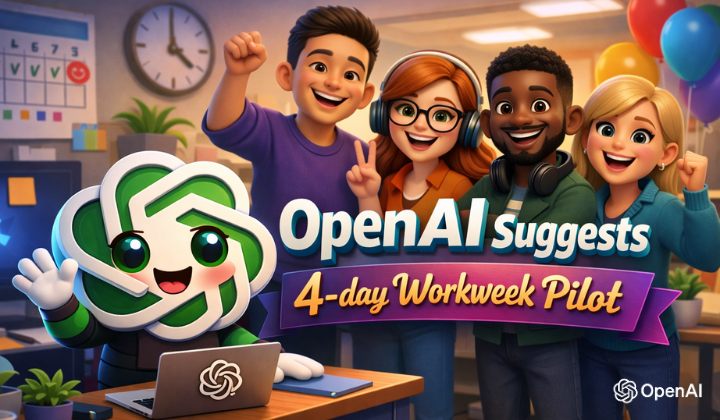
- OpenAI demonstrates a significant shift in the future of work as AI becomes smarter. In order to allow employees to work less hours and still make the same amount of money, the company supports a 4-day workweek.
- In order to distribute AI earnings and assist workers, it also proposes a robot tax. AI can boost business profits, but it may also lower worker salaries, thus new regulations are required.
- Shorter workweeks are also supported by experts like Jamie Dimon and Bill Gates. Positive results are found in tests conducted in Iceland and the United Kingdom.
Work and tire or rise up higher, will AI lift us from the fire? OpenAI develops intelligent AI solutions, such as ChatGPT, to facilitate learning, work, and problem-solving.
OpenAI presented a daring strategy to prepare for a time when AI would be extremely potent. “Industrial Policy in the Age of Intelligence: Human-Centered Ideas” is the name of the plan.
According to OpenAI, minor adjustments are no longer sufficient. It holds that to prepare for this new AI era, we must completely overhaul how society and the economy function.
AI could eventually outperform humans in terms of intelligence. This may alter people’s lifestyles and occupations. People might not have to work long hours, and jobs might become quicker and simpler.
OpenAI says, “AI can help companies earn more money, but workers may earn less, making the tax system weaker.” According to OpenAI, significant adjustments are required to prepare for this period.
It proposes a robot tax that would require businesses to pay more if they use AI to increase revenue. In order to allow people to work less hours and still make the same amount of money, it also proposes a 4-day workweek.
What Does Robot Tax Mean?
OpenAI also discusses the concept of a robot tax. This indicates that
- Businesses that employ robots or artificial intelligence to increase profits will be subject to higher taxes.
- This money can be used by the government to assist citizens.
This money can be used to support
- Individuals who lose their employment due to AI
- Innovative programs for job training
- Public services such as education and healthcare
OpenAI wants individuals to benefit from artificial intelligence. It proposes a 32-hour workweek with the same compensation, allowing workers to rest more. Additionally, it intends to assist jobless individuals in finding new employment in care and community services.
OpenAI thinks we need to remain prepared for safety. It recommends precise guidelines, a fast “kill switch” to halt AI if necessary, and robust safeguards to monitor risks and promptly report issues.
Work Less, Live More?
Many leaders believe that workweeks can be shortened. According to Bill Gates, if machines do most of the work, individuals might only need to work 3 days a week. Jamie Dimon thinks that due to technology, future workers might work about three and a half days a week.
Countries like the United Kingdom and Iceland tested this work culture, and people stayed happy and worked well.
Conclusion
Old rules fade, new ones made, will AI upgrade the work we trade? A bold concept offered by OpenAI. According to the corporation, employees no longer need to work five days a week.
Alternatively, we may work four days a week and still make the same amount of money. This concept emerges when AI (Artificial Intelligence) continues to advance in speed and intelligence.
You need to login in order to Like














Leave a comment