


Key Takeaways
- Mastercard’s AI-powered strategy and global development plan are propelling the payments industry forward. By 2030, the company hopes to reach 500 million consumers through solid alliances with local groups, governments, and fintech companies.
- It focuses on giving underprivileged and rural people access to digital payments. AI improves security, speed, and user-specific financial insights. Transactions are protected by sophisticated fraud detection and real-time monitoring.
- This strategy increases financial inclusion and fosters the expansion of small businesses. In a fast-changing digital economy, Mastercard enhances its market position by fusing innovation, security, and scalability.
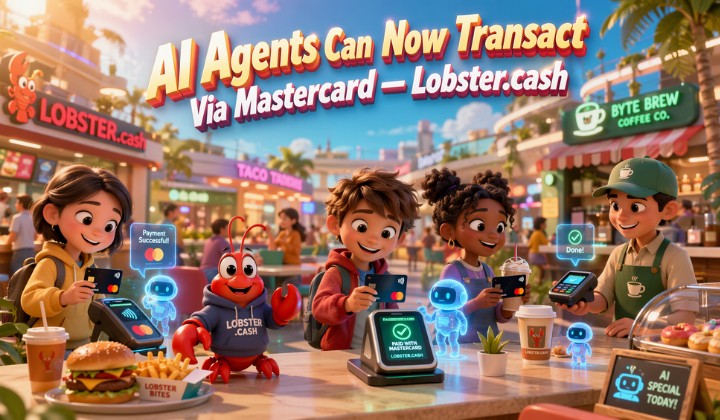
From cards to code, Mastercard is redefining how the world pays. Crossmint’s AI agent payment solution, Lobster.cash, has revealed plans to incorporate Verifiable Intent and Mastercard Agent Pay, enabling AI agents to safely make transactions with customers’ current Mastercard cards.
Users of OpenClaw, which has more than a million agents deployed across more than 20 messaging platforms, will be the first to get access to the integration.
Through the agreement, OpenClaw users will be able to give their AI agents permission to conduct transactions on their behalf. Each transaction will be verified by Mastercard’s network, subject to issuer rules, and cryptographically linked to the user’s express consent. The solution’s agentic credential layer will be Basis Theory.
With Mastercard Agent Pay, customers may assign purchasing authority to AI agents without disclosing private payment information, all the while preserving issuer control, network security, and complete traceability.
The framework allows developers to work in a controlled and accountable environment by supporting scalable agent-driven commerce and providing issuers with visibility into agent activities.
Why Mastercard’s AI Strategy Signals Strong Future Growth?
The company’s long-term vision is demonstrated by its objective of reaching 500 million users by 2030. To increase its reach, it intends to collaborate with local organisations, governments, and fintech companies.
Digital payment solutions will be made available to underserved and rural communities thanks to these agreements. By doing this, Mastercard promotes economic expansion and speeds up the expansion of small enterprises.
This technique heavily relies on AI, which increases transaction speed, improves fraud detection, and makes the user experience more customised. AI, for instance, can analyse expenditure trends and recommend wiser financial choices. This lowers risks and improves users’ financial management.
Mastercard continues to place a high premium on security. Mastercard involves issuers and networks in the approval process, even when transactions are handled by AI agents. Users can use new technologies with confidence thanks to this multi-layered security mechanism.
Final Thought
Less cash, more speed, that’s the future we need. Mastercard is guiding the way in digital finance, not only responding to change. Its emphasis on financial inclusion and AI-powered payment approach opens up new growth avenues and unexplored areas.
By combining innovation, security, and worldwide reach, the corporation fortifies its position. With clever, scalable solutions, Mastercard maintains its lead as the use of cash decreases and digital payments increase.
This innovative strategy draws investors, helps companies, and empowers users everywhere. Mastercard is creating a faster, safer, and more interconnected financial environment for the years to come with AI and inclusiveness at its core.
Stay informed with the latest trends in Web3, blockchain innovation, and cybersecurity updates at 3verseTV
You need to login in order to Like















Leave a comment