



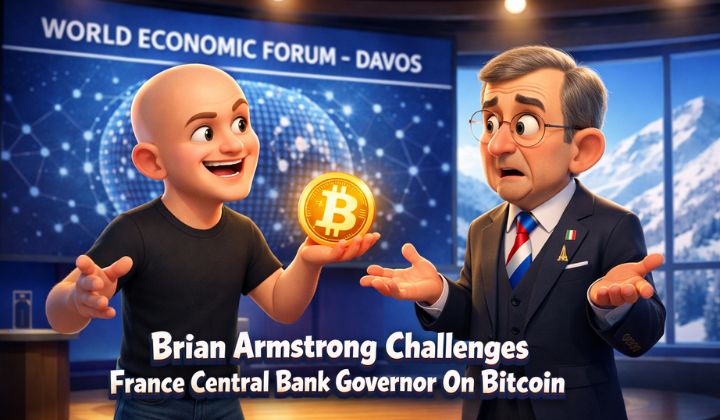
Who really controls money , governments or code? On January 21, 2026, Coinbase CEO Brian Armstrong and Banque de France Governor François Villeroy de Galhau engaged in a heated and passionate argument at the World Economic Forum (WEF) in Davos. One central theme dominated the conversation, who should be in charge of money’s future?

Villeroy de Galhau stated during the meeting that he had more faith in autonomous central banks with democratic mandates than in private Bitcoin issuers. He emphasised that central banks are responsible organisations created to safeguard public confidence and financial stability.
Brian Armstrong vehemently disagreed with this viewpoint. He explained that there is absolutely no private issuer for Bitcoin. Armstrong claims that Bitcoin is a completely decentralised protocol that is not governed by any corporation, government, or person.
He maintained that despite their claims to independence, central banks nevertheless function within political and territorial borders. In contrast, Bitcoin functions internationally and without a centralised authority.
According to Armstrong, the strength of Bitcoin is its impartiality. It operates on clear code, is accessible to all, and is protected by an international network as opposed to a single organisation.
Who Controls Money in 2026, Bitcoin or Central Banks? This, in his opinion, makes Bitcoin even more autonomous than conventional monetary systems.
You need to login in order to Like















Leave a comment