


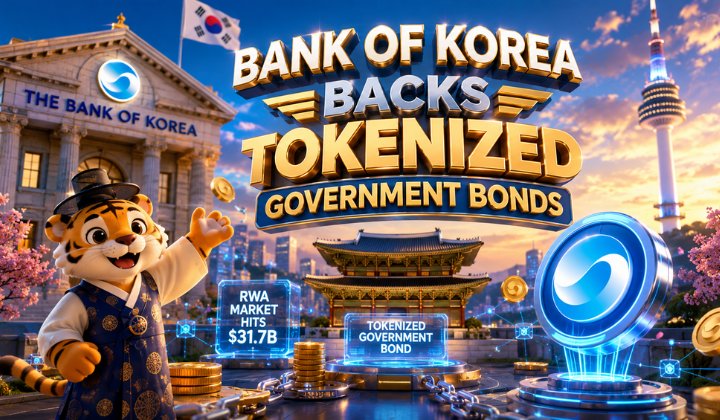
- The Bank of Korea has backed tokenized government bonds as a key step toward modernizing financial infrastructure.
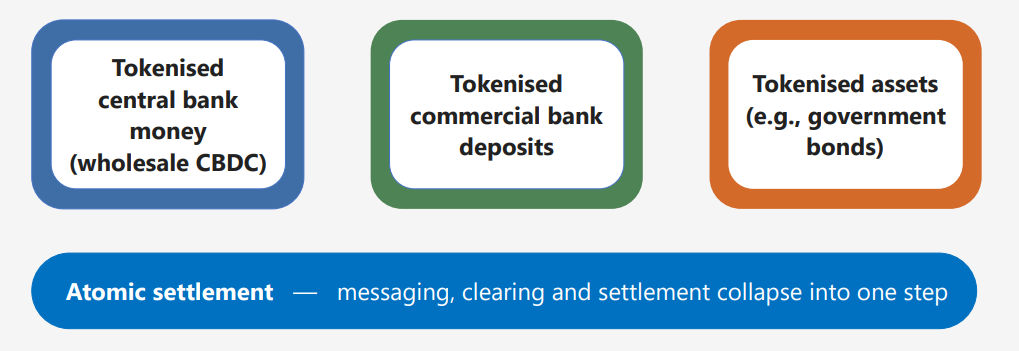
- Project Hangang will connect tokenized bonds, wholesale CBDCs, and tokenized bank deposits on a unified ledger.
- Atomic settlement aims to reduce settlement risk, improve transaction speed, and increase efficiency in financial markets.
Tokenized real-world assets (RWAs) are becoming more and more popular worldwide, and the Bank of Korea has expressed strong support for tokenized government bonds as an important component of the financial system of the future. The action underlines central banks’ growing belief that blockchain technology may enhance financial markets’ effectiveness, security, and transparency.
Tokenized government bonds are one of the biggest potential areas for modern finance, according to Bank of Korea Governor Hyun Song Shin, who spoke at the European Central Bank (ECB) Forum on Central Banking in Sintra, Portugal. Shin claims that tokenization can lower operational errors and streamline collateral verification, settlement, and account crediting.
🔵 Watch live: the #ECBForum on Central Banking session on “Tokenisation: challenges and opportunities when money, payments and financial transactions become digital” with:
– Piero Cipollone
– Hyun Song Shin @hyunsongshin
– Catherine Casamatta
Follow the event… pic.twitter.com/QI261BikhR— European Central Bank (@ecb) July 1, 2026
Shin stated, “The big prize is tokenizing government bonds,” stressing that when assets are fully tokenized, financial transactions become quicker and less error-prone.
Project Hangang Powers Tokenized Bonds & CBDCs
The project is a component of South Korea’s Digital Currency System (DCS), Project Hangang. The project’s goal is to link tokenized commercial bank deposits and wholesale central bank digital currencies (CBDCs) with tokenized government bonds on a single ledger.
The technology functions as a permissioned blockchain network, guaranteeing security while upholding regulatory control by limiting participation to only recognized financial institutions.
Atomic settlement, which allows for the simultaneous exchange of assets and payments, is one of Project Hangang’s most notable features. Financial transactions become more dependable and effective as a result of the elimination of settlement delays and the substantial reduction of counterparty risk.
Between April and June of 2025, Project Hangang finished its initial testing phase, which involved 12,000 merchants and about 80,000 users. In the second half of 2026, a second testing period with more participants and more features is anticipated.
Source: ecb.europa.eu
$31.7B RWA Market Drives Tokenized Bond Adoption
The conventional banking system is not replaced by the suggested framework. Rather, it maintains the current framework, with commercial banks handling customer deposits and the Bank of Korea continuing to issue base money. Financial institutions would mainly use wholesale CBDCs as settlement assets.
The announcement’s timing coincides with the tokenized real-world asset market’s explosive expansion. Tokenized U.S. Treasury debt makes up $14.6 billion, or almost 46%, of the $31.7 billion worldwide RWA market.
The numbers show that investor demand for blockchain-based depictions of public debt is rising. International support for tokenized bonds is also growing.
Tokenization can increase market efficiency, lower settlement risk, increase investment access, and promote financial innovation, according to a recent statement from the Bank for International Settlements (BIS).
In the meantime, South Korean regulators are anticipated to publish guidelines for tokenized securities in July 2026, further bolstering the nation’s aspirations for digital banking.
Stay informed with the latest trends in Web3, blockchain innovation, and cybersecurity updates at 3verseTV
You need to login in order to Like













Leave a comment