



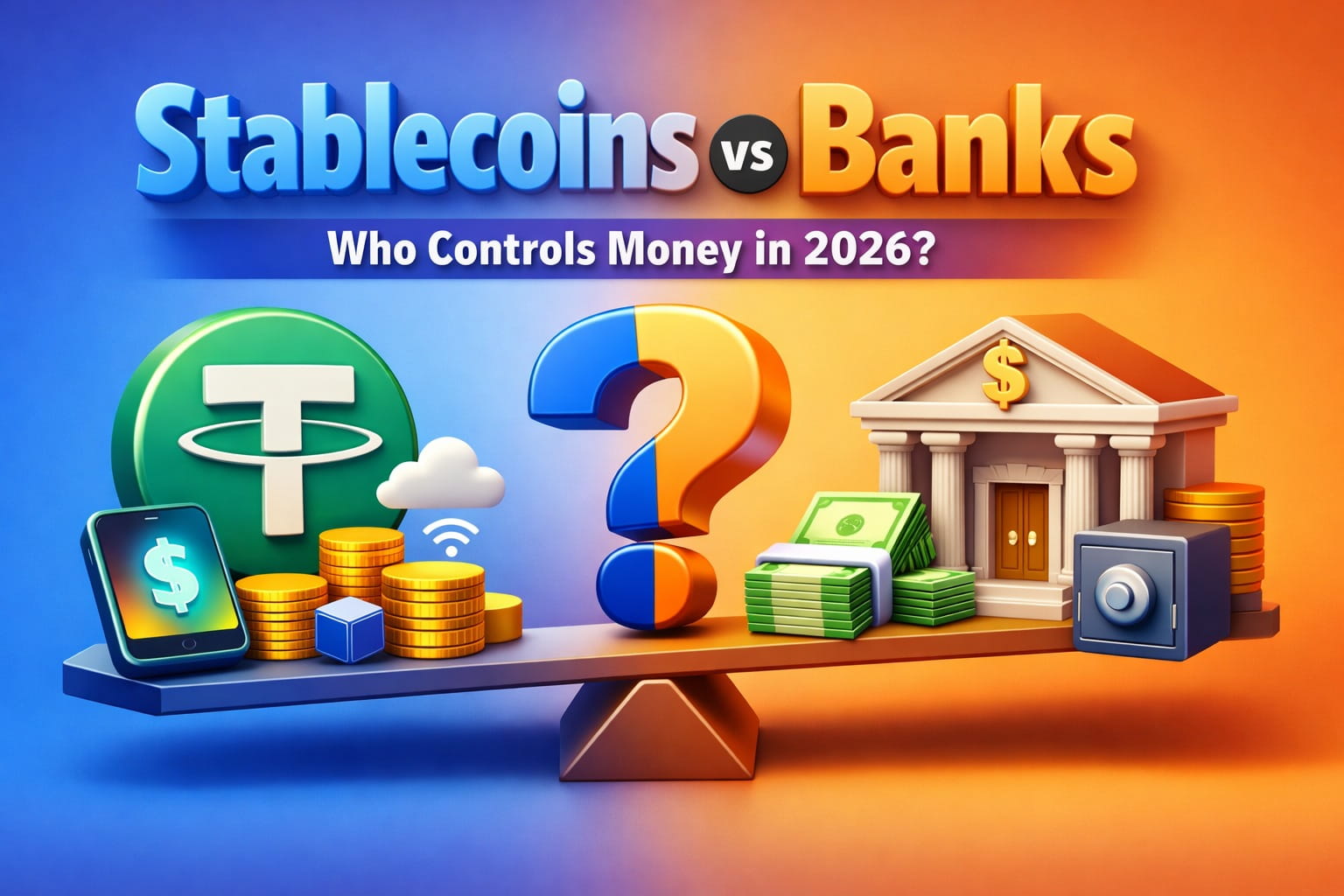

The matter of who has more control over money- Stablecoins vs banks has now moved to a real world discussion from just an online discussion.
In today’s time the traditional financial institutions along with governments are looking at how lenient or strict they can be when it comes to stablecoins. This topic is not new but has always been a sensational point.
Centralized vs Decentralized argument has now become a pressing point when it comes to control over money, financial power, and trust in general. The core of it has the main question- who is the controlling authority in the digital assets world? Specifically in the Indian market where these assets are legitimate yet stringently regulated.
To gauge the status of it in 2026, we need to understand how banks have been controlling money, the disruption stablecoins bring in this and future regulations we need keeping India in mind.
Glancing at the core
Conventional banks function in a centralized monetary system. They receive deposits, provide loans, process transactions, and function under the regulation of central banks like the Reserve Bank of India (RBI). The system provides governments with extensive control over money transactions, inflation, and economic stability.
Stablecoins, on the other hand, are blockchain cryptocurrencies that have fixed prices pegged to fiat money such as the US dollar. Unlike other cryptocurrencies, stablecoins are expected to serve as digital forms of real-world money, allowing for faster and less expensive transactions.
This is the basic premise of the crypto vs traditional banking argument.
How Banks Manage Money Supply
Before delving into why stablecoins are important, it is essential to understand how banks manage money supply. In the conventional system:
– Central banks are the only authority creating new currency and control liquidity
– Interest rates and reserve ratios and decide determine lending and spending in turn
– Commercial banks generate money through lending.
– Payment systems are centralized and controlled.
In the Indian context, the RBI is the central authority that manages monetary stability. The centralized system enables governments to act on inflation, economic downturns, and financial crises.
Stablecoins challenge the conventional system by facilitating the flow of money through non-banking channels, creating ambiguities regarding control and accountability.
Stablecoins and Monetary Control
The emergence of stablecoins brings a new dimension to the topic of stablecoins and monetary control. Governments do not issue stablecoins, but their value is derived from traditional money.
The Irony:
Stablecoins get their value from fiat money. However, they are not part of central banking systems.
This concerns regulators:
- Taking the onus and making sure that there are reserves backing stablecoins
- In case of a liquidity issue what’s the way ahead?
- Managing compliance
Crypto Legal Status in India: An Important Background
As we all know, cryptocurrency is no longer banned in India. The Supreme Court overruled RBI’s banking ban in 2020, declaring cryptos as legal for involvement in business.
However there is still a certain ambiguity and stigma around it in normal people’s minds.
- India has taken a cautious and controlled stance on crypto:
- Crypto assets are considered Virtual Digital Assets (VDAs)
- There is taxation on trading
- Emphasis is on compliance and disclosure
- No crypto asset is considered legal tender
This is important background information when assessing whether stablecoins are replacing banks, particularly in India.
Stablecoins can be used as assets or as a payment system within legal frameworks, but they do not substitute the rupee or diminish RBI’s authority.
Are Stablecoins Replacing Banks in 2026?
The question on everyone’s mind today is: are stablecoins replacing banks? The answer is: stablecoins are not replacing banks, but they are disrupting certain banking activities, especially payments and settlements.
Where Stablecoins Compete:
- International payments
- Faster processing
- Lower transaction costs
- 24/7 accessibility
Where Banks Still Have an Edge:
- Credit extension
- Savings and deposits
- Trust and regulatory compliance
- Consumer protection
- Execution of monetary policy
It’s 2026 and banks still have the critical role in maintaining economic stability. Whereas stablecoins play a role of an instrument rather than an independent system.
Hence neither of these replacing each other is possible.
The win-win situation is to have both banks and stablecoins coexist and compete with each other in certain areas.
2026 Reality: Stablecoin or Banks?
India is a great example of how the financial system can be in balance. Banks still dominate the deposits and lending sectors.
The RBI has complete control over the money supply in the economy. Stablecoins are also operating within certain regulatory frameworks. Crypto exchanges are also required to follow KYC, AML, and tax laws.
India is a great example of how the financial system is in balance rather than being disrupted.
Who Controls Money in a Crypto World?
So, who controls money in a crypto world in 2026? The answer is shared control:
- Central banks control sovereign currencies and monetary policy
- Banks manage credit, deposits, and regulated financial services
- Stablecoin issuers shape payment efficiency and digital liquidity
- Regulators set boundaries and compliance
- No single entity has absolute control. Instead, control is shared, tracked, and limited by regulation.
This ensures there is no financial pandemonium but still room for advancement.
Future of Money: Stablecoins vs Banks
The future of money stablecoins vs banks is not a battle of winners and losers but a process of growth. Significant trends impacting future:
- Banks adopting blockchain
- Authorities controlling stablecoins
- Central bank digital currencies (CBDCs)
- Demand for fast and cheap payments from customers
- Stablecoins will probably continue to be instruments of efficiency, while banks will continue to be the guardians of financial stability.
Conclusion: A Regulated, Hybrid Financial Future
In 2026, the discussion on stablecoins vs banks who control money has evolved. Stablecoins are no longer alternative technologies – they are mainstream financial tools that operate within increasing regulatory frameworks.
Banks are no longer opposed – they are adjusting. Most notably in India, where crypto is legal but regulated, the future is neither decentralized nor traditional. It is organized, regulated, and hybrid.
Stablecoins could revolutionize money flows, but banks and central banks continue to determine money functions. And perhaps this is the most stable future of all.
You need to login in order to Like
















Leave a comment