



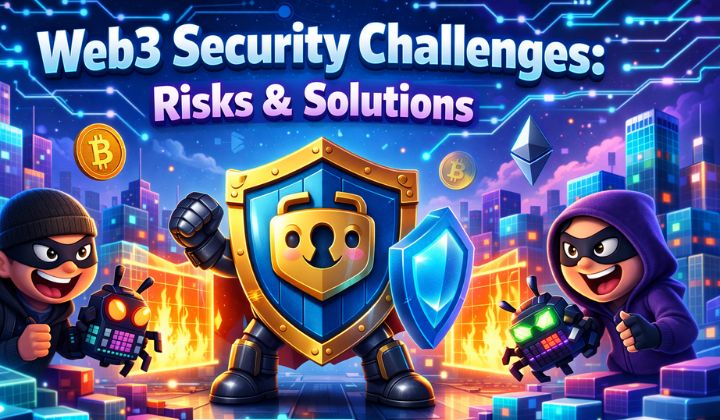
An Overview of Web3 Security Challenges
Web3 companies have lost around $1.26 billion dollars due to hacks in 2024. The main causes of the assaults were inadequate infrastructure, private key management, a lack of validation and checks, and bad smart contract logic.
All things considered, 2024 was a big year for value hacks and data breaches. We can see from these vulnerabilities and security breaches that there is much potential for improvement in terms of data protection and security.
IOG is creating the Midnight network, a next generation blockchain centered on data security with capabilities that can enable cookieless settings and selective data sharing, in response to the growing demand for safe and private solutions.
Using Zero-Knowledge Proofs (ZKPs), Midnight, a companion chain to the Cardano blockchain, guarantees safe transactions that safeguard user data and hide information from malicious actors.
Web3 ecosystems are vulnerable to a wide range of dangers, including human mistakes, social engineering assaults, and software flaws. This section will discuss these security issues and look at how assaults of this nature might jeopardize the systems’ integrity.
Input Validation
In order to prevent unexpected behavior from user-provided inputs, input validation should be managed at the smart contract level. When inputs are not validated, vulnerabilities may be revealed, opening the door for exploits like fund theft, exorbitant gas prices, or denial-of-service (DoS) attacks that cause the contract to stop responding.
For example, if numerical inputs are not validated, an attacker may cause overflow or underflow issues, which would interfere with the logic and operation of the contract.
Mathematical Errors
Any computations made at the smart contract level, such as using token balances, that might provide a user or attacker more value than expected, are referred to as mathematical mistakes.
Due to Solidity’s lack of native support for decimals, rounding mistakes might happen and have unforeseen financial repercussions. Significant losses might result from treating floating-point arithmetic incorrectly.
Developers should use precision control methods to guarantee precise computations in order to solve problems.
Oracle Manipulation
Among the most well-known Web3 hacks that result in unexpected token pricing are Oracle manipulation attacks. This could start if a protocol utilizes an internal oracle, a service that improperly validates pricing, or unreliable validators or network users.
When determining position sizes and liquidation criteria in the DeFi ecosystem, this might have significant effects. Flash loans may also be used to carry out these manipulations, which can assist the attacker influence DeFi protocols by inflating the value of an asset.
Absence of Proper Access Control
Any application should have access control, which defines permission according to particular responsibilities. Malicious actors may be able to execute unauthorized code due to improper access control.
This may be accomplished at the smart contract level, where users can give roles as modifiers to a function and have addresses with certain roles for carrying out specific contract tasks.
To lessen a contract’s attack surface area, it is crucial to avoid granting any role unauthorized access and to employ numerous roles. In this manner, exploits can be reduced in the event that an EOA (Externally Owned Account) with special access is hacked.
Reentrancy Attacks
When a contract function permits external calls to be made both during execution and prior to finishing state modifications, this is known as a reentrancy attack.
This enables an attacker to replicate certain malevolent activities, such as withdrawals that might deplete a contract’s cash, using the same contract state.
Replay Attacks
Replay attacks happen when a hacker replicates a legitimate transaction or activity carried out by the sender. In order to get authentication or start harmful activities on the network, attackers intercept or seize the message transmitted by the original sender and rebroadcast it to the network.
Frontrunning & Sandwich Attacks
Frontrunning is the practice of an attacker seeing a transaction that could influence the price of a specific asset and sending their own transaction with a higher gas price so that the new transaction is executed first, and the frontrunner can profit from the transaction’s updated price.
Although they function similarly, sandwich assaults are characterized by a frontrunner placing a sell order just after the frontrun transaction.
Governance Attacks
When a hacker gains sufficient voting rights to carry out nefarious operations via a DAO, governance assaults take place.
Attackers can do this by obtaining tokens using flash loans, which will give them the temporary authority to approve and carry out a governance decision in the DAO. Projects usually use stringent governance structures that are impossible to tamper with in order to avoid this.
The 2024 occurrences highlight the need for stronger security and privacy measures in Web3 ecosystems. The general pattern, which ranges from extensive data breaches to focused attacks on blockchain protocols, makes it abundantly evident that better technological protection is required.
You need to login in order to Like



















Leave a comment