



Crypto does not usually move in a straight line. It moves in stories.
A narrative is the market’s way of turning a complex idea into a tradeable theme. One month it is AI tokens, then memecoins, then real-world assets, then Decentralized Physical Infrastructure Networks (DePIN). The traders who do well in those phases are not the ones who arrive after the crowd. They are the ones who notice where attention, liquidity and capital are moving before the headline writers catch up.
That is the real edge here: not guessing the future perfectly but spotting the next area of interest while it is still early.
What Is A Crypto Narrative?
A crypto narrative is the story the market is willing to pay for. Sometimes that story is about technology. Sometimes it is about liquidity. Sometimes it is simply about attention.
In late 2024, memecoins showed how powerful that can be. The memecoin market was reported to have surged from about $20B to $118B after Donald Trump’s election victory, while a Solana memecoin study showed how one platform, Pump.fun, became a major driver of the memecoin boom on Solana. At its peak point, Pump.fun was responsible for a large part of new token launches and trading on the Solana chain. Memecoins became the hottest sector in Crypto Markets.
That is why narratives matter. They are not just chatter. They often determine which sector gets liquidity first.
Why Narratives Matter More Than Most Traders Think
Narratives do three things at once.
- They attract attention.
- They pull in liquidity.
- They give a reason for people to stay interested.
The market usually needs a story to justify the move. That is why a sector with a strong narrative can outperform a sector with better technology but weaker attention.
We saw that again with tokenized finance. Tokenized U.S. Treasury funds jumped 80% in 2025 to $7.4 billion according to the Financial Times. This surge happened as traders and institutions looked for cash alternatives that could earn interest on the blockchain.
At the same time, Stablecoins have continued to grow and become a basic part of the crypto market. As of today, Stablecoin’s total market value is over $300B.
So, the market often moves like this: first attention, then flows, then products, then institutions.
Early Rotation Signals
If the goal is to find the next narrative early, do not start with price alone. Start with the signs that capital is moving.
1. Capital Flow Starts To Shift
This is the cleanest signal.
Look for capital moving into a sector through Total Value Locked (TVL), fresh token launches, treasury allocations, or new inflows into a specific ecosystem. When money starts showing up, the narrative usually has a chance to run.
A good example is the Real World Assets (RWA) sector. Throughout 2024 and 2025, capital steadily flowed into tokenized Treasury products and other on-chain real-world assets. That wasn’t just social media excitement, it was real money entering the ecosystem.
According to RWA.xyz, the value of tokenized real-world assets has grown to nearly $35 billion, from just a few billion dollars in early 2024. At the same time, the number of asset holders crossed 1 million.
2. KOLs Start Talking About The Same Theme
KOLs, or Key Opinion Leaders, are often the first public layer of narrative discovery.
A few names repeating a theme is normal. A cluster of traders, founders and analysts suddenly talking about the same sector in the same week is more interesting. That is usually where attention starts before it becomes mainstream.
The trick is not to chase every post. The trick is to notice acceleration. If a theme goes from a few mentions to constant discussion across X, Telegram and crypto chats, it may be moving from niche to investable.
A recent example is The Black Bull ($ANSEM) on Solana.
In late June 2026, prominent crypto trader Ansem, who has over 1 million followers on X, published his “ANSEM Thesis“, introducing the idea of a Tokenized Creator Economy, a new narrative where creators and their communities could be connected through crypto tokens.
The idea caught on everywhere. Crypto influencers started talking about the idea, crypto news outlets ran articles on the thesis, and the conversation was everywhere on social media.
As attention increased, capital followed. $ANSEM went from around $0.0002 on June 27 to more than $0.12 on June 29, gaining over 50,000% in less than a week, according to CoinGecko. Ansem’s market capitalization briefly crossed $100 million.
The lesson isn’t that every token promoted by a KOL will succeed. Rather, when multiple respected voices begin discussing the same new idea and that discussion starts spreading across the wider crypto community, it can be one of the earliest signs that a new market narrative is beginning to emerge.
3. On-Chain Usage Starts To Rise
A narrative is much stronger when people are actually using the product.
That means more wallets, more transactions, more fees, and more capital sitting inside the ecosystem. The memecoin cycle was a good example of attention being supported by real
on-chain activity, even if much of it was speculative. The Solana memecoin study showed how heavily one launchpad could dominate minting and trading activity on the chain.
If the buzz is loud but the chain is quiet, that is usually a warning sign.
The Solana memecoin boom is a great example. During Q4 2024, activity on Pump.fun exploded as retail traders rushed to create and trade memecoins. On-chain data for Solana shows that Pump.fun accounted for as much as 71% of all new tokens created on Solana and generated 40% to 67% of all decentralized exchange (DEX) transactions. Its daily active users grew to 260,000 from about 60,000 in the same period.
4. New Listings & Partnerships Begin To Appear
When wallets and big platforms and exchanges start listing projects in the same sector repeatedly, that’s often a sign the narrative is moving beyond early adopters and into the mainstream.
Listings and partnerships do not build a narrative themselves, but they can help to add strength to an already building narrative by making it more accessible, liquid and credible.
A recent example is the Real World Assets (RWA) sector on Solana. During June 2026, several major developments happened within weeks of each other. Backpack Securities launched tokenized SpaceX shares on Solana, Mastercard enabled always-on stablecoin settlement using Solana, and the network’s total RWA value surpassed $3 billion for the first time. Meanwhile, the cumulative tokenized stock trading volume topped $10 billion, and daily tokenized stock volume hit a record $683 million. These announcements feed off each other and helped to strengthen the RWA narrative across the market.
Often when you see several exchanges, wallets, payment companies and institutional partners supporting the same sector in a short space of time, it is an indication that the narrative is maturing and seeing wider market participation.
5. The Sector Starts Outperforming The Rest Of The Market
Relative strength is one of the best telltales of a developing narrative.
In plain English don’t ask ‘Is this sector going up?’ Ask, “Is it going up faster than everything else?”
For example, let’s say the entire crypto market rises 5% over a month. If the AI sector is up 30% in the same time frame, then AI is clearly outperforming the broader market. But if a token in the DeFi sector is up 4%, that’s good on its own but it’s lagging because the whole market did better.
A real example came from the RWA sector in June 2026. While many altcoins struggled to find footing, Solana’s tokenized asset ecosystem continued to grow at a rapid pace.
A real example came from the RWA sector in June 2026. While many altcoins struggled to gain momentum, Solana’s tokenized asset ecosystem continued expanding rapidly. The value of tokenized assets on Solana rose rapidly in one month, from $2.7 billion to $3.5 billion, and was supported by new institutional products and increased adoption. In the same period, Solana also became the leading blockchain for tokenized assets by active addresses, demonstrating how capital and user activity was concentrated in one narrative rather than the market as a whole.
When a sector consistently outperforms the market in terms of price, capital flow and user activity, it’s not just showing a trend, it’s already become the market leader.
The 5-Step Narrative Rotation Framework
This is the part traders can actually use.
Step 1: Build A Narrative Watchlist
Track a small list of themes instead of trying to watch every coin.
Examples:
AI, memecoins, RWAs, DePIN, gaming, on-chain social, restaking, and tokenized Treasuries.
You do not need 40 sectors. You need a shortlist that you can review every week.
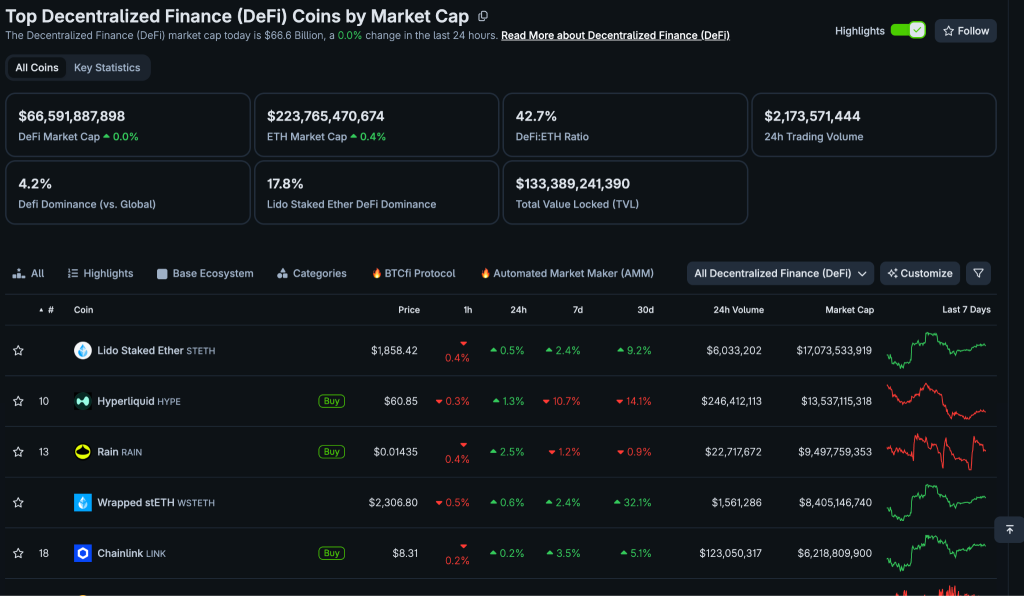
One of the easiest ways to do this is by using CoinGecko’s Categories page (or CoinMarketCap’s Categories section). The pages are sorted by sector and show important measures such as market cap, 24-hour trading volume, Total Value Locked (TVL) and
7-day/30-day performance. These metrics make it easy to see which sectors are attracting capital and beating the rest of the market every week.
Step 2: Check Where Money Is Flowing
Now ask one question: Where is capital actually going?
Use tools like DeFiLlama, RWA.xyz, Dune, Token Terminal and Arkham to see where TVL, fees, wallet flows and treasury allocations are rising. Use Kaito or X (Previously, Twitter) lists to see where the discussion is accelerating. Kaito uses AI to scan X conversations, podcasts, research reports, blogs, governance forums, and other crypto content. Keep an eye out for any upcoming catalyst or unlocks on CryptoRank or TokenUnlocks.
The point is not to collect dashboards; the point is to confirm whether a sector is receiving real capital or just social media attention.
Step 3: Check If The Market Is Using It
This is where most people get caught.
A theme can have good narrative momentum but weak usage. That usually leads to a
short-lived move.
A stronger setup usually has all 3, more users, more transactions, more money deposited into the ecosystem.
If you can find a sector where attention is growing and on-chain usage is also rising, that is where the alpha starts to become interesting.
Step 4: Watch KOLs & Listings For Confirmation
As discussed earlier, growing KOL attention combined with new listings, integrations, and partnerships helps confirm that a narrative is moving from early adoption towards the mainstream.
Step 5: Scale In Early, Not Late
The edge is in the timing.
When a narrative is on every homepage, the easiest part of the move is often done. The better way is to size early, keep risk small, and wait for confirmation rather than chasing a candle once it has moved.
That does not mean buying everything. It means entering only when the data supports the theme.
Mini Case Study: How Capital Rotated From AI To Memecoins To RWAs
The last few market cycles show how quickly capital can rotate between narratives.
In 2024, AI became one of crypto’s biggest stories as investors looked for blockchain projects connected to the rapid growth of artificial intelligence. Soon after, memecoins took over as retail speculation accelerated, with the sector’s market capitalization surging from around $20 billion to nearly $118 billion by the end of the year.
By 2025, attention began shifting toward Real World Assets (RWAs) and tokenized finance. Tokenized U.S. Treasury funds grew 80% to $7.4 billion, while stablecoins and other
yield-generating on-chain assets attracted increasing amounts of institutional capital.
By the middle of 2026 the rotation kept going. As the story around RWA got more interesting people started to pay attention to things like tokenized stocks, prediction markets, perpetual DEXs, and AI infrastructure began attracting fresh attention and capital. For example, Solana handled over $10 billion in trading of tokenized stocks in June 2026 which shows that traders were already getting ready for the next narrative.
The lesson is simple: Capital rarely stays in one place for long. As one narrative matures and becomes crowded, attention and liquidity begin rotating into the next emerging opportunity. The traders who recognize these shifts early are often better positioned than those chasing yesterday’s winning sector.
The Tools That Actually Help
If the goal is to spot narratives early, the tool stack should stay simple.
Use:
- DeFiLlama for TVL and sector flows.
- xyz for tokenized assets.
- Dune for custom on-chain dashboards.
- Token Terminal for fees, revenue and activity.
- Arkham for wallet tracking.
- Kaito or X lists for attention and KOL acceleration.
- CryptoRank or TokenUnlocks for catalysts and unlocks.
That is enough for most traders. You do not need 20 dashboards. You need a small number of sources that tell you where the story, the money and the activity are going.
What To Watch Next
Every week, ask yourself these 5 questions:
- Where is the capital flowing?
- Which sector is KOL attention accelerating in?
- Is on-chain usage indeed rising?
- Are exchanges and platforms supporting the theme?
- Is the sector outperforming the market or just talking about it?
If all the 5 start lining up, the narrative may still be early.
Conclusion
Narrative rotation is not about guessing the next shiny coin; it’s about spotting where attention and capital are moving before the crowd arrives.
The strongest sectors usually have 3 things in common: Real flows, rising attention and a product that people actually use.
If the market is only talking about a trend, stay cautious but if that trend is confirmed by data, the narrative could be real.
That is where mature traders find the edge.
Disclaimer: This content is for educational purposes only and is not meant to be financial advice. Please consult a financial advisor before making any investment decisions.
Stay informed with the latest trends in Web3, blockchain innovation, and cybersecurity updates at 3verseTV
You need to login in order to Like













Leave a comment