


The U.S. Securities and Exchange Commission (SEC) has warned that some decentralized finance (DeFi) vaults and onchain lending products could fall under federal securities laws, depending on how they are designed and managed.
SEC Commissioner Hester Peirce said blockchain technology does not automatically place crypto products outside the agency’s jurisdiction.
Some thoughts on vaults and onchain lending: https://t.co/ekmod1dJVa
— Hester Peirce (@HesterPeirce) July 22, 2026
Her remarks immediately caught the market’s attention, with DeFi token MORPHO slipping around 5% after the statement. Peirce also urged developers to engage with regulators instead of assuming decentralized products are exempt from existing securities rules.
In a statement released on Wednesday, Peirce stressed that the legal status of an investment product depends on its structure rather than the technology it uses. Repeating a point she has made before, she said, “Tokenized securities are still securities. That principle holds for vaults.”
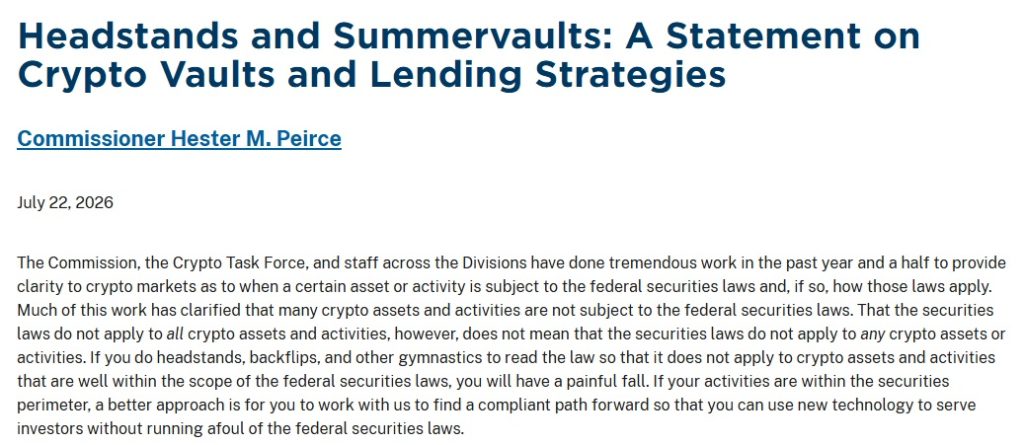
Source: sec.gov
She also cautioned the industry against trying to reinterpret securities laws simply because financial products operate on blockchain networks. “If you do headstands, backflips and other gymnastics to read the law so that it does not apply to crypto assets and activities that are well within the scope of the federal securities laws, you will have a painful fall,” she said.
DeFi vaults have emerged as one of the fastest-growing segments of the crypto market. They allow users to deposit digital assets into smart contracts that automatically allocate funds across lending protocols and other yield-generating strategies. In some cases, the allocation process is fully automated, while in others, professional managers or “vault curators” actively decide where funds should be invested.
According to data from Vaults.fyi, the sector held $8.6 billion in assets across 788 curated vaults as of July, serving nearly 1.4 million users. The concept has also expanded beyond traditional DeFi platforms, with companies such as Coinbase and Robinhood offering similar yield-generating products for stablecoin holders.
Peirce said the level of human involvement could become an important factor in determining whether a vault falls under securities laws. Products where managers actively select strategies, rebalance portfolios or appoint others to manage assets may resemble investment companies or investment advisers already regulated under existing federal laws.
She offered similar guidance on onchain lending protocols. Decisions involving interest rates, collateral requirements and supported assets could also raise securities law questions, depending on how those services operate in practice.
Despite the warning, Peirce struck a constructive tone. She acknowledged that blockchain-based asset management tools have significant potential and encouraged developers to work with regulators as the technology evolves.
“These new approaches to the deployment of assets hold great promise,” she said. “The promise will only be realized, however, if we grapple now with the intersection between these asset deployment tools and the federal securities laws.”
The comments suggest the SEC is paying closer attention to newer DeFi products as the sector continues to grow. While Peirce did not announce any enforcement action, her remarks indicate that developers of vaults and lending protocols may face greater regulatory scrutiny if their products resemble traditional investment services.
Stay informed with the latest trends in Web3, blockchain innovation, and cybersecurity updates at 3verseTV
You need to login in order to Like















Leave a comment