


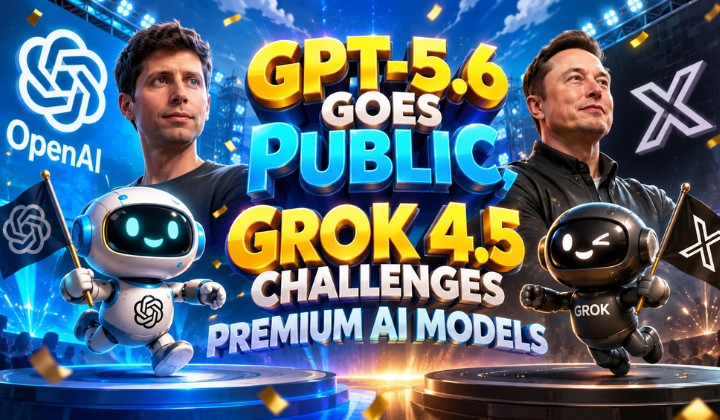
- OpenAI will launch GPT-5.6 Sol, Terra, and Luna after completing additional U.S. government security reviews.
- GPT-5.6 focuses on stronger coding, cybersecurity, biology, and agentic AI capabilities.
- SpaceXAI’s Grok 4.5 emphasizes faster performance, lower costs, and a new 1.5 trillion-parameter V9 architecture.
- Both launches underscore the growing competition among frontier AI developers as enterprise AI adoption accelerates.
OpenAI is getting ready to release its most recent AI models, GPT-5.6 Sol, Terra, and Luna, to the public on Thursday following a temporary postponement due to further security assessments by the US government. The release coincides with SpaceXAI’s launch of Grok 4.5, paving the way for one of the biggest AI product competitions of the year.
The debut of GPT-5.6 was first delayed after U.S. officials requested additional testing over concerns that advanced AI systems could be misused for military or cybersecurity purposes. OpenAI, the creator of ChatGPT and a leading AI research company known for developing frontier AI models, later provided GPT-5.6 to a limited group of vetted partners before securing approval for a broader public rollout.
GPT-5.6 Sol, along with Terra and Luna, will launch publicly this Thursday.
We’re expanding preview access globally now. pic.twitter.com/Uk5HcfSc2e
— OpenAI (@OpenAI) July 8, 2026
With advancements in coding, biology, cybersecurity, and agentic reasoning, the company claims that GPT-5.6 Sol is its most proficient model to yet. OpenAI is launching Terra and Luna in addition to Sol, which should provide more affordable options for developers and businesses looking for effective AI solutions.
US Security Reviews Shape OpenAI’s GPT-5.6 Rollout
The debut comes as the US government began to monitor frontier AI models more closely. In response to growing concerns about responsible deployment and national security, officials have implemented voluntary review procedures to assess highly capable AI systems prior to public release.
Grok 4.5, which SpaceXAI characterizes as a “Opus-class” model intended to compete with premium AI products, is the company’s entry into the market. Grok 4.5 is based on a new V9 architecture with 1.5 trillion parameters, which is substantially more than prior Grok models, according to SpaceXAI.
Based on strong positive feedback from customers in our beta test program, @SpaceXAI will make Grok 4.5 available to the public tomorrow.
It is an Opus-class model, but faster, more token-efficient and lower cost.
— Elon Musk (@elonmusk) July 8, 2026
According to SpaceXAI, Grok 4.5 supports long-context reasoning and sophisticated coding workflows while providing quicker responses, increased token efficiency, and reduced running expenses. After SpaceXAI acquired Cursor, the model was purportedly trained using more developer workflow data and improved through ongoing reinforcement learning.
GPT-5.6 Vs Grok 4.5
Both launches are aimed at developers and enterprise users, but they are positioned differently. While SpaceXAI is focusing on speed, cost effectiveness, and scalable enterprise deployment, OpenAI is stressing better agentic capabilities and benchmark performance across technical areas.
Grok 4.5 is released as SpaceXAI tries to attract developers again after reports of a drop in user participation in recent months. In contrast, OpenAI is launching GPT-5.6 following the completion of more safety assessments that U.S. authorities had requested.
Both businesses are vying to provide increasingly capable and effective models for organizations, developers, and academics as the AI battle heats up.
Stay informed with the latest trends in Web3, blockchain innovation, and cybersecurity updates at 3verseTV
You need to login in order to Like















Leave a comment