


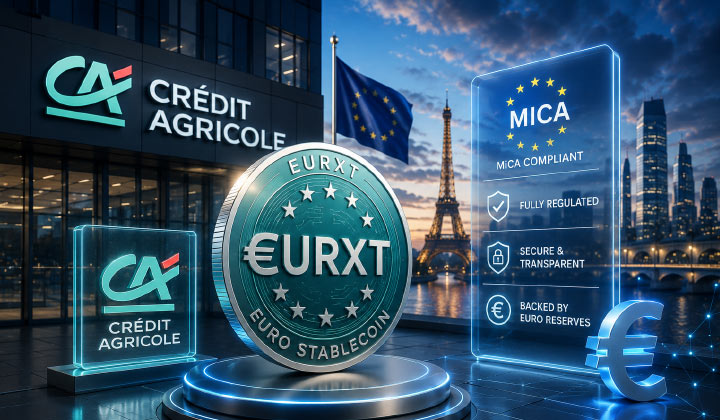
Crédit Agricole, a major French bank, has entered Europe’s growing stablecoin market by launching the EURO eXchange Token (EURXT), a euro-backed digital currency that fully meets the EU’s MiCA regulations. The stablecoin is issued by the bank’s asset servicing arm, Caceis Bank, and is backed one-to-one by euro reserves. It has already been used to settle investments in a tokenized money market fund managed by Amundi. This launch is another big move by a traditional European bank into tokenized finance as regulated stablecoins gain ground across the region.
EURXT is pegged 1:1 to the euro and now has 20 million tokens in circulation on the Ethereum blockchain. Each token is fully backed by euro reserves at Caceis Bank, giving users a regulated digital version of the euro.
The stablecoin has already been used in a real financial transaction with a tokenized Amundi money market fund. Amundi is one of Europe’s biggest asset managers, with about €2.4 trillion in assets. This makes the launch an important step for institutional adoption of tokenized financial products.
Crédit Agricole is joining a market that is getting more competitive. Circle’s EURC has about 378 million tokens in circulation, and Société Générale’s EURCV has around 124 million. Later this year, a group of 37 European banks under the Qivalis initiative is also expected to launch its own euro stablecoin.
Even with this competition, the euro stablecoin market is still small compared to US dollar-backed stablecoins like USDT and USDC, which lead the global digital asset markets. Still, the euro stablecoin sector has grown quickly since MiCA rules started, with its market value more than doubling in the past year.
Crédit Agricole said EURXT is part of its wider ACT 2028 strategy, which aims to grow the bank’s role in tokenized finance and blockchain-based services. The bank believes regulated digital assets will become more important in modern capital markets as financial institutions use blockchain for settlement, payments, and asset management.
This launch also shows how clear rules under MiCA are encouraging established financial institutions in Europe to adopt digital assets. Instead of seeing stablecoins as a threat, many banks are now creating their own regulated products to support tokenized securities, digital payments, and new financial infrastructure.
As institutional demand for blockchain-based financial products continues to grow, traditional banks such as Crédit Agricole are positioning themselves to play a larger role in Europe’s evolving digital asset ecosystem.
Stay informed with the latest trends in Web3, blockchain innovation, and cybersecurity updates at 3verseTV
You need to login in order to Like
















Leave a comment