

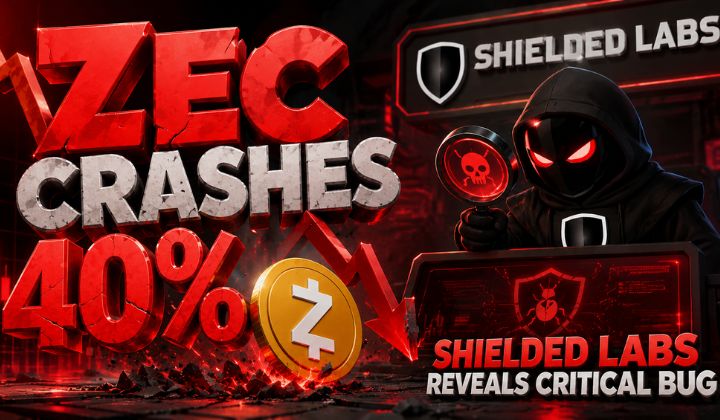
- Zcash (ZEC) price crashed 40% after Shielded Labs disclosed a critical vulnerability in the blockchain’s Orchard privacy pool.
- The flaw could have allowed attackers to create unlimited fake ZEC tokens without detection, potentially impacting the token’s supply integrity.
- Security engineer Taylor Hornby discovered the bug on May 29 using advanced AI-assisted analysis of Zcash’s privacy infrastructure.
A decentralized cryptocurrency called Zcash (ZEC) was created to give users more privacy and anonymity. It was created as a fork of Bitcoin and validated transactions using zero-knowledge proofs (zk-SNARKs), a cutting-edge cryptographic approach, without revealing personal details like the sender, receiver, or transaction amount.
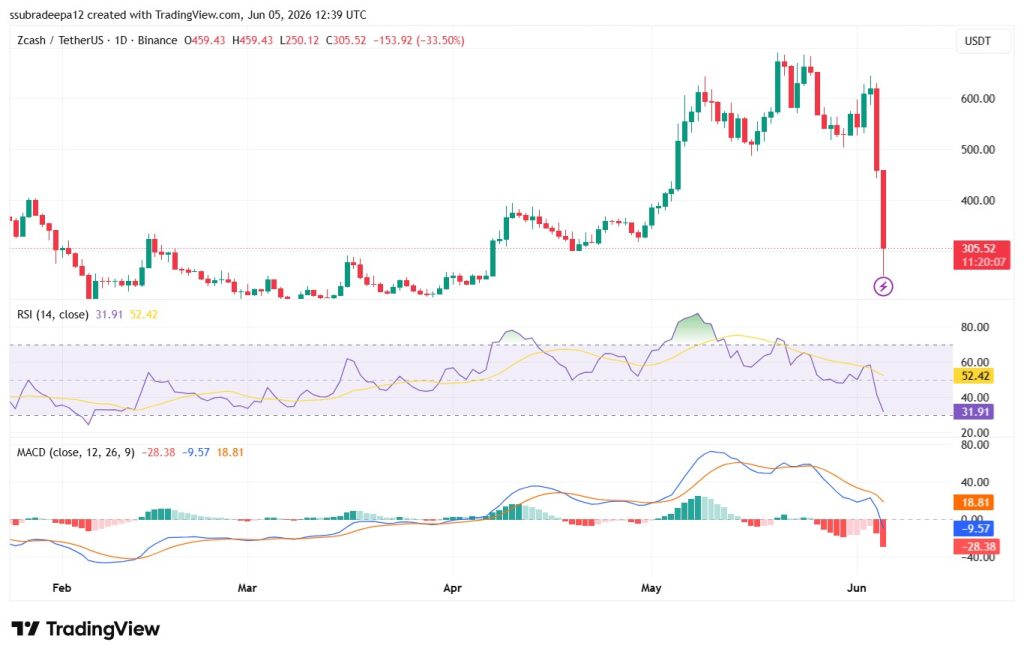
After Shielded Labs, a nonprofit company that developed the privacy token system, disclosed a significant flaw in the blockchain’s Orchard privacy pool that would have compromised the token’s supply, ZEC dropped 40% in a single day.
Source: TradingView
At the time of writing, ZEC was currently trading at about $309.66, having earlier traded as high as $530.
Infinite Fake ZEC Threat Exposed
In a thorough disclosure on X released late on Thursday, Shielded Labs revealed a vulnerability that, if abused, may have allowed an attacker to produce an infinite number of fake ZEC tokens without anybody noticing.
Imagine someone sneaking into the Federal Reserve’s dollar-printing press, but in this scenario, not even the Fed would be able to detect that these extra dollars had been generated.
Taylor Hornby, a security engineer hired by Shielded Labs in April 2026, particularly to find protocol flaws before malevolent actors could, found the vulnerability on May 29. Hornby carried out a very focused analysis of the Orchard circuit, the cryptographic mechanism supporting Zcash’s most sophisticated privacy pool, using Anthropic’s freshly published Opus 4.8 AI model.
Zcash Supply Trust Tested By Hidden Bug
According to Shielded Labs, Hornby created a full exploit that produced infinite, undetectable fake ZEC when tested in a local testing environment.
According to Shielded Labs, the identical program would have produced an infinite number of undetectable counterfeit tokens in his mainnet wallet if it had been used on the Zcash mainnet.
Imagine a hacker printing an infinite number of fake ZEC covertly and keeping them hidden. Trust in the supply and, thus, the market value of the token might have suffered significant harm.
The Zcash Open Development Lab (ZODL) planned an emergency fix on June 1 after Hornby promptly reported the vulnerability, shutting it within days of discovery.
It took Shielded Labs four years to find and address a serious flaw in Zcash’s Orchard system. Investors are concerned about the network’s security because the team is unable to verify whether anyone took advantage of the vulnerability during that period.
“What makes this so difficult is that, due to Orchard’s privacy features and the nature of the fault, there is no conclusive method to confirm whether such exploitation occurred prior to the vulnerability being detected and addressed using only cryptography. We believe it is critical to be open about that uncertainty,” the company stated.
Shielded Labs Moves Fast To Secure Zcash
Nonetheless, it stated that exploitation was unlikely to occur for a variety of reasons. Initially, the flaw had escaped years of examination by seasoned cryptographers. It was only discovered with the aid of state-of-the-art AI algorithms and extremely talented researchers who were actively searching for it.
It was swiftly corrected after it was found, giving anyone little opportunity to take advantage of it. Regarding Hornby’s efforts to identify the vulnerability before malevolent actors could, Shielded Labs stated, “We think he probably succeeded.”
The group suggested a network update that would enable anyone to independently confirm the integrity of the ZEC supply and was cautious to note that customers should not rely only on their judgment.
The plan calls for implementing turnstile accounting on all coins from the Orchard pool and establishing a new protected pool. The company stated that a thorough post on the subject could be published the following week.
It stated that it is stepping up security efforts with new recruitment for a Head of Security and a Cryptographer, ongoing collaboration with Hornby, and a formal verification project that aims to write a mathematical proof that there are no unknown defects in the Orchard circuit.
Stay informed with the latest trends in Web3, blockchain innovation, and cybersecurity updates at 3verseTV
You need to login in order to Like
















Leave a comment