


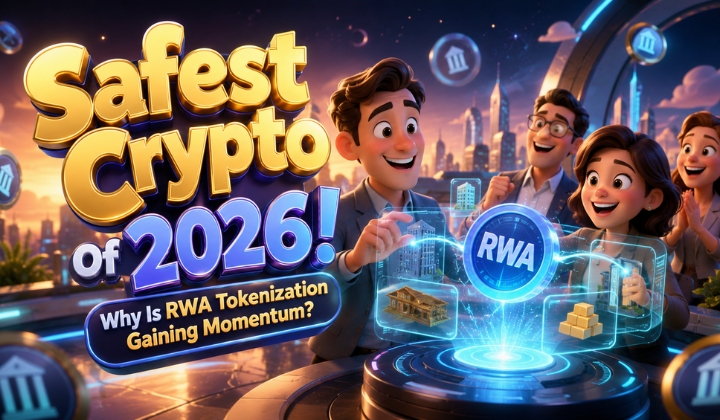
Did you know the tokenized RWA market increased 34 times from early 2023, reaching $33.78 billion in May 2026? That’s quite big, right? Yes, indeed.
Real-World Asset (RWA) tokenization is rapidly gaining momentum as investors seek more secure and reliable cryptocurrency options. By integrating assets like U.S. Treasuries, bonds, and cash equivalents onto blockchain networks, RWAs integrate traditional finance with digital innovation.
Major names like BlackRock, JPMorgan, Ondo Finance, and Franklin Templeton are gaining momentum. So, let’s try and take a look at why RWA tokenization is gaining this kind of momentum in 2026?
What Is RWA Tokenization?
One of the biggest market opportunities in the blockchain sector is real-world asset (RWA) tokenization which has a potential market size of hundreds of trillions of dollars. Anything valuable might theoretically be tokenized and added to blockchain networks.
“Bitcoin is the greatest distraction from the biggest opportunity in finance, tokenized assets,” according to Jenny Johnson, CEO of Franklin Templeton, a $1.5 trillion global investment business.
Even though real-world asset tokenization has been under development for the past five years and has undergone multiple “rebranding,” it is currently seeing rapid growth.
Here’s a quick look at some of the most important events in the history of the RWA market (also known as the Security Token Offering (STO) market) or digital securities or tokenized securities market.
For this reason, the market for tokenized RWAs is expanding within the digital asset sector, as more projects seek to tokenize a wide range of assets, such as currency, commodities, real estate, and much more.
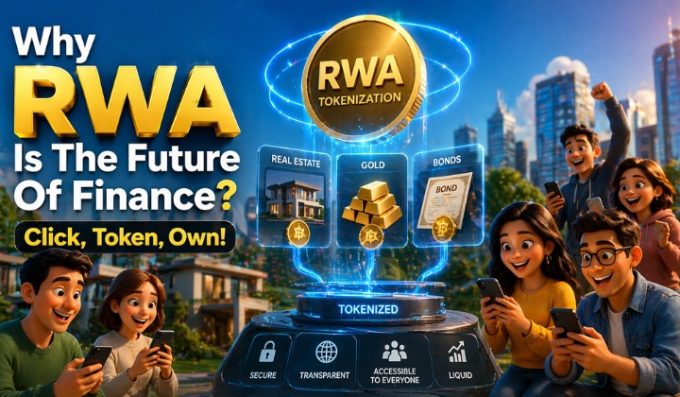
So, there are some common tokenized assets that are:
- Real estate, such as houses and buildings
- Bonds and Treasury bills
- Commodities like silver and gold
- Collectibles and fine art
- Private loans and credit
How Does RWA Tokenization Work?
The tokenization of RWAs represents a major transformation in the way these assets can be accessed, traded, and managed, opening up a broad range of new possibilities for financial services driven by blockchain technology as well as a wide range of non-financial use cases supported by cryptography and decentralized consensus.
Why do experts expect tokenized assets to increase massively by 2030? The tokenized asset market might reach $16 trillion by 2030, according to Boston Consulting Group (BCG), and up to $30 trillion by 2034, according to Standard Chartered’s bold projections.
Tokenization of Real-World Assets (RWAs) connects traditional or tangible assets to the blockchain. On a distributed ledger, it transforms ownership rights into digital tokens. It makes fractional ownership of traditional assets such as real estate or art in decentralized finance (DeFi) possible.
For example, tokenized money market funds from UBS function as buy-and-hold investments; investors purchase tokens that reflect fund shares but they are only able to redeem them directly with UBS instead of exchanging them on secondary markets.
Why Is Future Of RWA’s Growing Rapidly?
Why is Wall Street betting big on RWA tokenization as the market crosses $30 Billion? Morgan Stanley declared real-world asset tokenization to be a major worldwide business priority in April 2026 describing it as a crucial step toward enhancing financial systems.
The market for tokenized assets is expanding quickly at the same time. The value of tokenized U.S. Treasuries alone currently stands between $12 bn to $ 13 billion while the on-chain RWA market has already surpassed $27 to $30 bn. This quick expansion demonstrates growing trust amongst major financial institutions.
- Institutional Validation: The technology has been fully adopted by major actors in traditional finance (TradFi). For example, BlackRock increased the total amount of tokenized U.S. Treasury assets to over $13 billion by spreading its tokenized U.S. Treasury fund (BUIDL) among several networks.
- On-chain Premium Rails: Predictable returns are becoming more important to investors and institutions. Yield-bearing assets provide the security and returns of conventional government bonds and private credit while enabling capital to stay in decentralized finance (DeFi) systems.
- Fractional Ownership & Liquidity: Tokenization enables the division of previously high-barrier and illiquid assets, such as Swiss gold bullion or London real estate, into digital fractions. Smaller shares of premium assets can be purchased by investors worldwide, opening enormous global liquidity pools.
Why Experts Call RWAs The ‘Safest Crypto Narrative’ Of 2026?
Because Real-World Assets (RWAs) are linked to actual, off-chain value rather than just speculation and hype, experts consider them to be the safest cryptocurrency narrative.
RWAs offer consistent return and dependable collateral that safeguard portfolios amid erratic market fluctuations by putting assets, including U.S. Treasuries, real estate, and private credit on-chain.
- Tangible Value and Sustainable Yield: RWAs get their value from actual economic activity, like rental income or interest on sovereign debt, in contrast to meme coins or speculative utility tokens. For example, companies such as Ondo Finance provide investors with direct access to short duration U.S. Treasury bonds via blockchain tokens.
- Institutional Legitimacy: RWAs serve as an essential link between decentralized finance (DeFi) and traditional finance (TradFi). Massive asset managers like Franklin Templeton and BlackRock (via BUIDL) are spearheading adoption, and the industry is supported by real “smart money” rather than merely consumer enthusiasm.
- Resilient DeFi Collateral: Tokenized assets are great collateral for lending and borrowing procedures since they are yield-bearing and stable. This protects DeFi ecosystems from the extreme price swings and liquidations that are common to assets that are only crypto-native.
What’s Behind The Explosive Growth Of The 2026 RWA Boom?
Momentum is clearly reflected in the data from tracking platforms. In the first quarter of 2026 alone, the tokenized RWA market, which does not include stablecoins, grew by almost 30%, increasing the total on-chain value to approximately $27 to $ 29 billion. By mid-April, some estimates put the amount close to $30 bn.
As yield-seeking cash rushes in, tokenized U.S. Treasuries lead with a value of $12 to $13 bn, a huge increase from previous periods. Tokenized gold and commodities add several billion more while private credit comes in second, frequently surpassing $5 to $ 19 bn depending on the inclusion of represented assets.
For important segments, overall growth since early 2025 has shown multiples in the 4x range. As products mature, the number of unique holders interacting with these assets has increased dramatically to over 700,000.
Inflows are dominated by institutional products from firms like BlackRock, Ondo Finance, Franklin Templeton, and Circle; flagship funds like BUIDL and USYC have both crossed the $2 bn threshold at different times.
This scale shows that RWAs have progressed from testing to production systems handling real capital flows daily. With on-chain Treasuries providing accessible yields in a still high-rate environment, return continues to be a key motivator.
The figures show substantial batch transfers indicative of institutional activity in addition to retail interest.
How Is RWA Tokenization Unlocking New Yield Opportunities In 2026?
Composability, which allows tokens to interact with lending, trading, or structured product protocols, gives on-chain RWAs more power. Tokenized Treasuries continue to accrue underlying rates while acting as collateral in DeFi-like arrangements. Sophisticated users looking for optimal returns are drawn to this dual utility.
Under regulated frameworks, Morgan Stanley’s infrastructure push might make these features available to its customers. Funds that use tokenized assets for margin or liquidity management without selling core investments are amongst the early examples.
Conversations are dominated by yield narratives with on-chain products providing easy access to rates that formerly required significant commitments. Automated strategies that combine RWAs with other digital assets appear as ecosystems evolve.
As a result, the financial layer becomes more integrated, and capital flows more effectively. Institutions keep a careful eye on these advances to see if they can be integrated.
True innovation lies in combining traditional asset backing with programmable features that improve usability without increasing complexity for end users. Growth in this RWA tokenisation suggests that blockchain will become more deeply integrated into everyday finance.
The Bottom Line
The big question that begs for an answer is: Has RWA Tokenization moved from the experimental stage to becoming a financial reality in 2026? In 2026, multiple factors and strategies converged to boost RWA implementation.
Institutional pilots grew into actual products worth billions of dollars. Infrastructure, including settlement layers, wallets, and ATS platforms, was prepared.
As such, market data now indicates growing holder bases and steady quarterly growth as Morgan Stanley’s strategic focus increases the sector’s credibility and distribution reach.
Tokenization is no longer viewed as a side project but rather as a key strategy by industry leaders in banks and asset management companies. Although projections differ, the trend suggests that RWA Tokenization growth will continue as new asset classes join and efficiency accumulates.
Although challenges around education and interoperability remain, adoption metrics on everyday usage figures show a steady progress. More advisors and clients see on-chain options as useful instruments for building portfolios.
For mainstream finance, this year is notable as the time when abstract concepts became operational reality. Every week, new insights are revealed as participants exchange integration lessons and performance statistics.
This ethos is reflected in Morgan Stanley’s strategic actions which position the company and the industry for greater influence in capital markets and wealth management.
Stay informed with the latest trends in Web3, blockchain innovation, and cybersecurity updates at 3verseTV
You need to login in order to Like












Leave a comment