



Truth Social, which is linked to Trump, has pulled its applications for several crypto exchange-traded funds (ETFs). This move shows the increasing pressure in the highly competitive Bitcoin ETF market.
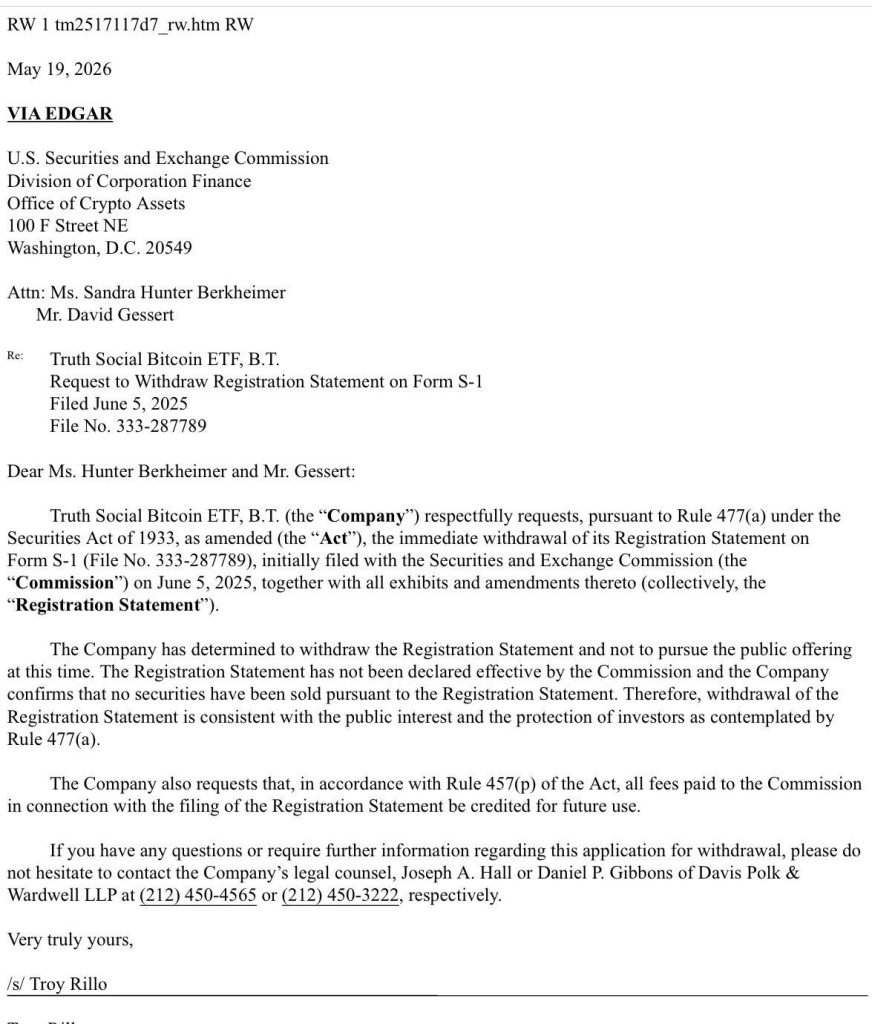
Yorkville America Digital, the sponsor, withdrew the filings by submitting them to the U.S. Securities and Exchange Commission on May 19, 2026. The products pulled were the Truth Social Bitcoin ETF, a Bitcoin-Ethereum ETF, and a Crypto Blue Chip ETF.
The filing states that the company chose not to move forward with the offerings “at this time.” No securities were sold, and the SEC never declared the registration statements effective.
This decision shows how tough it is for new players to enter the Bitcoin ETF market. Since spot Bitcoin ETFs were first approved in early 2024, the market has matured quickly. Large financial firms now dominate by cutting fees and offering deep liquidity.
Yorkville now plans to use a more flexible fund structure under the Investment Company Act of 1940 instead of the older 1933 Act grantor trust structure used by early Bitcoin ETFs. This new approach could enable broader investment strategies, easier integration with retirement accounts, and active management.
Even though these filings were withdrawn, institutional demand for Bitcoin ETFs is still strong. U.S. spot Bitcoin ETFs now manage about $100 billion in assets, and total inflows since launch have passed $57 billion. BlackRock leads the sector with its iShares Bitcoin Trust (IBIT), holding about 60% of the market.
Recent outflows indicate that investors remain cautious amid economic uncertainty and rising Treasury yields. Analysts say that fee competition is now the main factor in the ETF industry. Low-cost products, like those from Morgan Stanley, make it hard for niche or politically branded ETFs to compete.
This withdrawal also points to a bigger change in crypto investing. Investors now care more about liquidity, fees, and reliability than about branding or political ties.
Still, Yorkville made it clear that it has not given up on crypto. The company says it will continue to explore digital asset investment products using alternative structures better suited for long-term institutional use.
Reasoning is below in press release. But it doesn’t make a ton of sense to me. Of course a 33 act ETP is different from a 40 act ETF and it has less protections. Anyone in this space knows that. Nothing has changed. I suspect it more has to do with the competitive landscape for… pic.twitter.com/HDs2tKSxiN
— James Seyffart (@JSeyff) May 19, 2026
You need to login in order to Like

















Leave a comment