


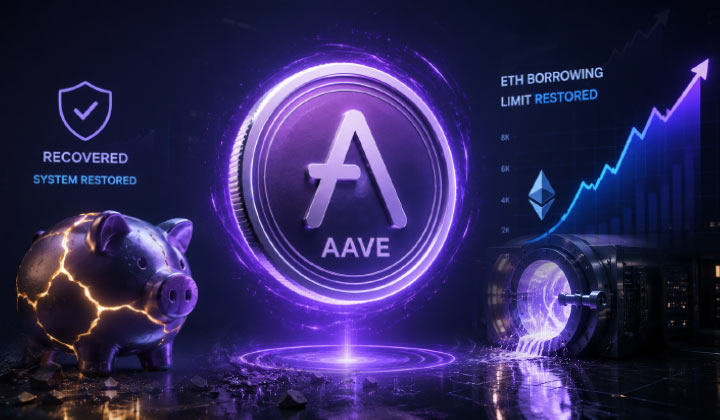
Decentralized lending platform Aave has brought back borrowing limits for wrapped Ether on several blockchain networks after emergency limits were set following a major hack earlier this year.
The limits were first put in place after hackers took advantage of a connection related to Kelp DAO’s rsETH token, creating hundreds of millions of dollars in fake assets and using them to steal about $230 million worth of Ether from Aave.
During the crisis, Aave greatly lowered the amount users could borrow against their wrapped Ether, basically stopping borrowing with that asset. This was done to reduce widespread risk in decentralized finance markets.
According to updated rules, the system has now returned borrowing limits to normal on Ethereum, Arbitrum, Base, Mantle, and Linea networks. This shows the platform thinks the immediate danger is mostly under control.
Aave also said that most of the fake rsETH made during the hack has been recovered through selling off assets and joint efforts by the industry. Only a small amount is still missing.
The restoration is important for DeFi markets because wrapped Ether is one of the most commonly used assets for loans. Limiting its use had lowered available funds and reduced borrowing options on several blockchain networks.
Even though some legal and recovery problems are still not solved, reopening borrowing is seen as a sign that confidence is returning to the wider decentralized finance market after months of security problems.
In accordance with the rsETH technical recovery plan, WETH LTVs on Aave V3 Ethereum Core, Ethereum Prime, Arbitrum, Base, Mantle, and Linea have been restored to their pre-incident values.
WETH now operates as normal across all affected V3 deployments.
— Aave (@aave) May 17, 2026
You need to login in order to Like

















Leave a comment