


Key Takeaways
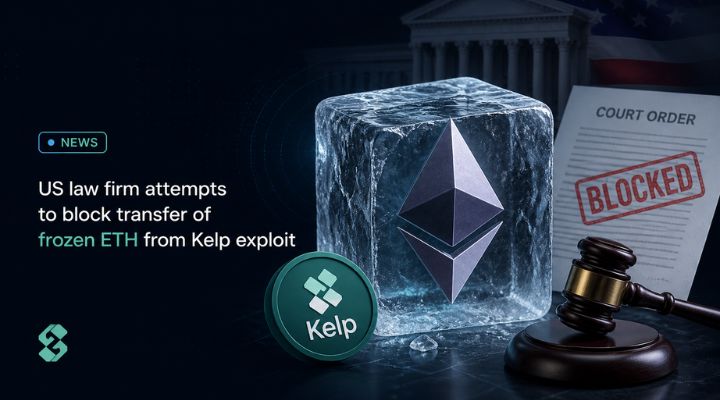
- Citing an important $877 million claim against North Korea, a US legal company called Gerstein Harrow LLP is attempting to stop the transfer of $73 million in frozen ETH connected to the Kelp DAO hack.
- The company claims that because of purported connections between the government and the cyber organization, stolen Ether is DPRK property.
- A restraining order has been approved by a New York court, preventing the Arbitrum DAO from transferring the money for the time being.
- This legal action raises questions about justice since it would postpone compensation for victims of Kelp exploitation.
- Aave Labs suggested rerouting money to “DeFi United” in order to assist victims, but there are legal obstacles to the scheme.
- The lawsuit might establish a significant precedent in which legal claims take precedence over attempts to collect cryptocurrency, raising the stakes in DeFi.
Funds on hold, truth untold, are victims paying twice the toll? A US law company has submitted a restraining notice to stop the transfer of frozen Ether from the Kelp exploit, claiming that North Korea owes its clients more than $877 million in restitution and damages.
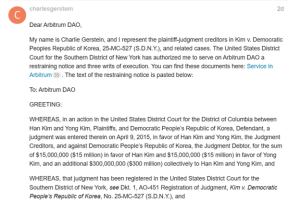
Charlie Gerstein, a lawyer with US legal firm Gerstein Harrow LLP, claimed in a post on the Arbitrum DAO forum on Friday that a New York district court approved a restraining notice and three writs of execution prohibiting the DAO from moving the Ether under pain of contempt of court.
The law company claimed that its customers, who were not harmed by the Kelp exploit, obtained default judgments against North Korea in three different US court actions in 2010, 2015, and 2016 and are due a total of $877 million in compensatory and punitive damages, plus interest.
$73M ETH Frozen Longer?
It also contended that its clients have a right to DPRK property. Gerstein stated in the restraining notice that the stolen Ether is “property” in which the DPRK has an interest because the hacker organization is associated with the government.
The freeze could imply that people affected by the Kelp exploit will have to wait longer to see their money returned. This is not the firm’s first attempt to reclaim stolen cryptocurrency.
Charlie Gerstein, a lawyer for Gerstein Harrow, filed a restraining order to prevent the Arbitrum DAO from transferring the frozen Ether.
Source: Arbitrum DAO.
“Justice Or More Damage?” DAO Member Slams Legal Move
On April 25, Aave Labs requested that the Arbitrum DAO unfreeze the $73 million in Ether linked to the Kelp DAO assault and redirect the assets to “DeFi United,” a fund dedicated to recovering rsETH and paying its holders.
An Arbitrum DAO member known as Zeptimus stated that if the law firm’s case is successful, the DPRK debt will not be passed to the Kelp DAO victims.
“Your clients’ losses are genuine, and the DPRK must answer for them. However, the remedy proposed by the restraining notice, which prohibits the restoration of stolen cash to their rightful owners, moves the expense of the DPRK’s debt to a different set of victims who were also plundered. That exacerbates the original problem; it does not repair it,” they stated.
Crypto gone, battles drawn, justice late or justice wrong?
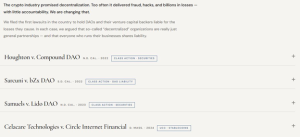
Gerstein Harrow has filed similar cases in the past, saying that its customers are entitled to funds stolen by the DPRK and frozen by crypto businesses. In February, the firm filed a claim against Tether monies that were frozen after being taken in the 2023 Heco Bridge hack.
Final Thought
The case highlights a difficult conflict between the rights of cryptocurrency victims and legal claims. Blocking the frozen ETH could delay or prevent restitution for victims of the Kelp breach, even though the law firm wants to get money back from North Korea.
An important point is brought up by this: who should get paid first? If the claim is upheld by the courts, it might start a new pattern in which legal issues delay the recovery of funds, increasing the risks associated with cryptocurrency for regular users.
You need to login in order to Like
















Leave a comment