



With the goal of releasing around $330 million in staked POL that is presently locked in safeguarding the network, Polygon Labs has introduced sPOL, a protocol-level liquid staking standard. The standard transforms locked POL tokens into a yield-bearing, transferable asset that may be used anywhere in DeFi.

The statement claims that sPOL enables POL holders to maintain the productivity of their tokens in two ways at once: obtaining a liquid, tradable receipt that can be used as collateral, traded, or utilised across DeFi applications, in addition to earning staking yield for network security.
In Proof-of-Stake networks, capital must be locked up as a security deposit by validators and delegators. They receive yield in exchange, but the underlying tokens remain dormant and cannot be used, lent or exchanged.
This restriction presently affects roughly $245 billion in staked assets across the cryptocurrency market.
By providing a transferable receipt that reflects both the staked capital and its growing yield, liquid staking solves the issue. On Ethereum, almost 43% of all staked ETH has been transformed into liquid staking derivatives, demonstrating the model’s widespread adoption. That percentage has stayed below 5% on Polygon, which Polygon Labs blames on a fragmented market lacking a single norm.
Instead of relying on outside suppliers like Ankr and Lido to fill the gap piecemeal, the company is attempting to address it with a native, protocol-level solution called sPOL.
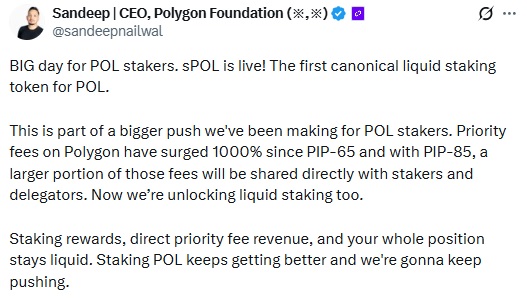

Source: X.com
Stay informed with the latest trends in Web3, blockchain innovation, and cybersecurity updates at 3verseTV
You need to login in order to Like

















Leave a comment