


Key Takeaways
- The first licenses for Hong Kong’s regulated stablecoin market were given to HSBC and a Standard Chartered-led company. The Hong Kong Monetary Authority is concentrating on risk management, KYC regulations, and strict compliance.
- HKD stablecoins seek to enhance trade and cross-border payments in Asia, in contrast to global USD stablecoins. Hong Kong is demonstrating its faith in a regulated financial model by favouring bank-issued stablecoins over retail CBDCs.
- Adoption is still the biggest obstacle since HKD stablecoins need to outperform dominant dollar-backed tokens and create powerful network effects in order to be successful on a global scale.
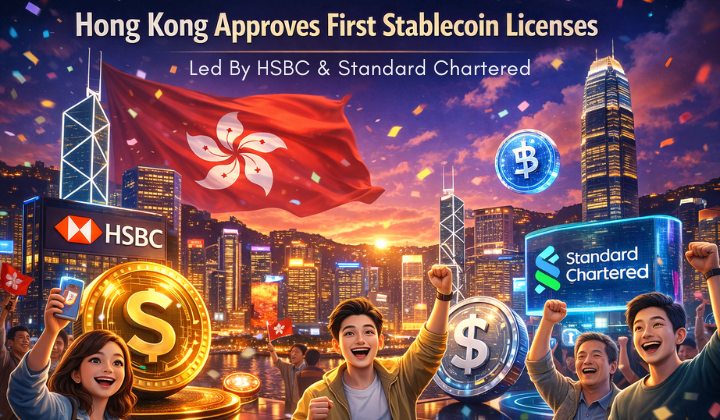
Hong Kong makes moves, future looks bright… but is this control or new money right? HSBC and Anchorpoint Financial, a joint venture run by Standard Chartered that includes Animoca Brands, received Hong Kong’s first two stablecoin issuer licenses on Friday.
The licenses by the Hong Kong Monetary Authority (HKMA), the territory’s central bank, represent the first under the Stablecoins Ordinance, which went into effect in August 2025.
“We look forward to the issuers commencing operations according to their plans, exploring development prospects while properly controlling risks,” HKMA chief executive Eddie Yue said in an announcement on Friday. ”
Experts anticipate that their advocacy of regulated stablecoins would alleviate problems in financial and economic operations, generate benefits for people and companies, and promote the sound growth of digital assets in Hong Kong.
The new Stablecoins Ordinance, which went into force in August 2025, governs the approvals. Only a few of the 36 applications were chosen at this initial stage.
Regulators focused heavily on sound risk controls, adequate reserve backing, and robust anti-money laundering procedures. Hong Kong is obviously putting stability ahead of speed by selecting reputable banks.
Can HKD Stablecoins Really Compete With USDT & USDC?
This choice was not made at random. Among the few banks permitted to print Hong Kong dollar banknotes are Standard Chartered and HSBC. Authorities are expanding an effective system by extending its responsibility into the digital realm.
Banks can handle digital money backed by actual reserves if they can handle physical currency securely.These new stablecoins won’t function like well-known international tokens, though.
One of the most stringent compliance frameworks in the world was established by the HKMA. Before any transactions take place, each wallet must be validated. Transfers beyond a certain threshold will adhere to international “travel rule” regulations.
To put it simply, these stablecoins will be traceable, monitored, and built for security rather than privacy. This poses an important question.
Can HKD stablecoins compete in a market where assets backed by US dollars predominate? The majority of the $300+ billion stablecoin market is currently dependent on the US dollar.
Tokens like USDT and USDC have already created significant global networks. They are generally accepted, easy to use, and tightly interwoven with crypto trading and payments.
Final Thought
Asia in sight, not chasing global might… can bank-backed coins win trust and take flight? Hong Kong is going in a different direction. It is concentrating on regional use cases rather than pursuing global supremacy.
Enhancing cross-border trade, accelerating settlements, and reducing friction in financial transactions across Asia are the objectives. Stablecoins issued by banks may also foster confidence among organisations that are still wary about cryptocurrencies.
Hong Kong is focusing more on stablecoins and has held down its ambitions for a retail central bank digital currency. This demonstrates faith in a private-public arrangement in which banks spearhead innovation while being closely regulated.
Stay informed with the latest trends in Web3, blockchain innovation, and cybersecurity updates at 3verseTV
You need to login in order to Like














Leave a comment