



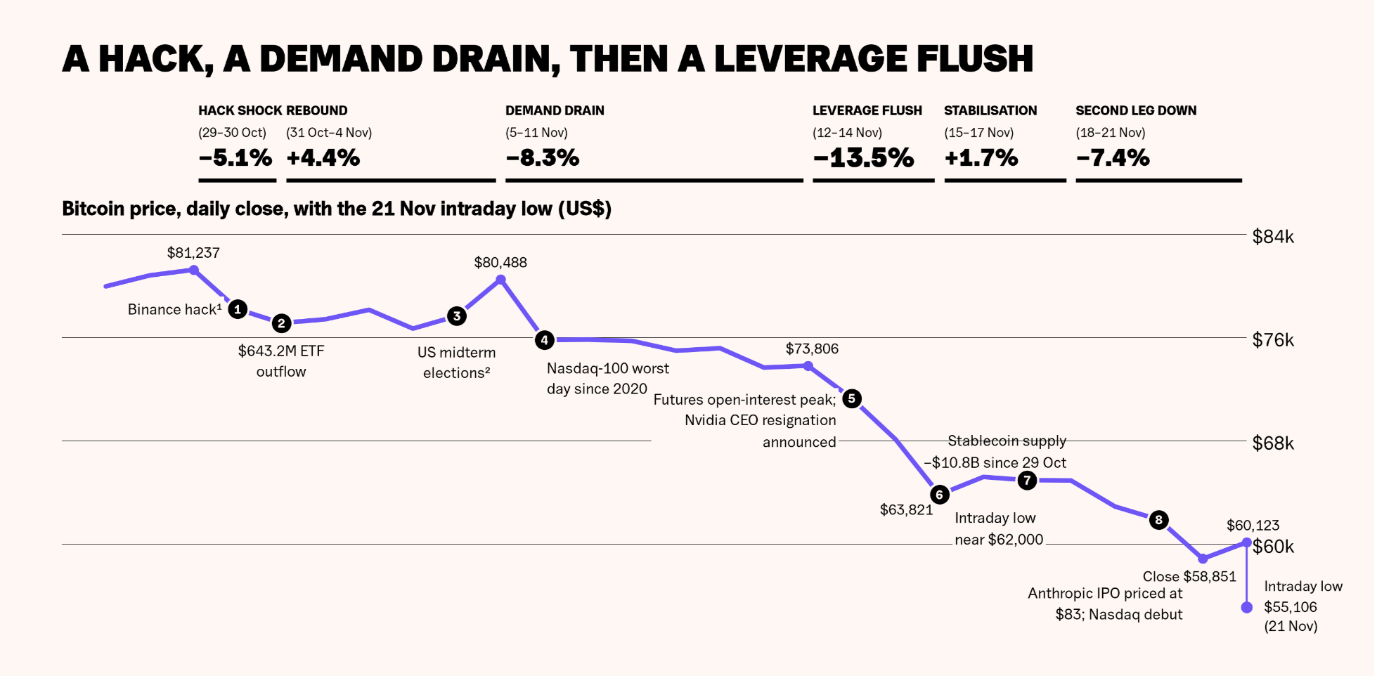
Bitcoin has dipped below a key support level at $60,000, continuing a corrective move which has highlighted the vulnerability of its recent upswing. Whilst a tech-related surge in Bitcoin was initially buoyed by positive news around semiconductor giant Nvidia, it has subsequently failed to maintain strength as investors continue to dump the token, question the value of AI and remain nervous about the Federal Reserve’s monetary policy.
On November 25, Bitcoin hovered around the $59,400 mark having given back advances made during an earlier rally which had taken it up to $64,500. This has followed large volumes of redemptions from Bitcoin spot ETF’s. In November alone, nearly $5 billion worth of Bitcoin has been redeemed from these schemes.
Bitcoin Slump In November 2026
In an already volatile month for digital assets there was a large data breach from the world’s largest crypto exchange Binance. Around $6.34 billion worth of digital assets were reportedly impacted by this, reigniting questions around exchange and investor safety.
Alongside the data breach, there have been other issues that have also impacted Bitcoin. Namely; lower ETF appetite, challenges facing digital asset holders, lower market liquidity and a poor macro environment. All of these are contributing to the strain on the ability for institutions to continue to provide sustainable long term support for the crypto sector in an economically challenging environment.
Binance Hack 2026: How Did It Impact Bitcoin?
On October 29, hackers were able to take advantage of Binance’s signing functionality and move funds from Binance’s hot wallets on a number of blockchains.
Source: 21shares.com
After the $6.34 billion hack Binance stated that it will take on the costs of the event and not transfer these costs onto clients. It has also collaborated with blockchain analytics companies, police and projects to investigate and seize the impacted funds.
Why Did Bitcoin Continue Falling After The Binance Hack?
Investors were clearly spooked by the news and there was renewed downward pressure on Bitcoin. Having previously been changing hands for around $81,500, Bitcoin was hit and Ethereum dropped below $2,000. Investors also sold off Binance’s own cryptocurrency (BNB) as they reappraised the security credentials of centralized exchanges.
At the same time as Binance investigated the hack, and enhanced its security, it halted client withdrawal functionality. Following the resumption of withdrawal capability, clients extracted a total of $4.72 billion from Binance as per a Reuters report. This equated to around 3% of Binance’s total holdings and so did not result in a mass exodus of clients.
Nonetheless, the hack highlighted a key weakness in crypto. Despite core blockchain technology continuing to operate efficiently, issues with exchange security can negatively influence market sentiment.
Whilst the Binance hack did initially drive market concern, it was by no means the only factor to contribute to Bitcoin’s later downturn. Indeed, Bitcoin managed to partially reverse its earlier falls in early November. However, as ETF redemptions increased, liquidity reduced and margin liquidations occurred, renewed downward pressure was placed on Bitcoin.
Bitcoin ETFs: The Sell-Off
Bitcoin has so far failed to successfully continue its recovery despite experiencing a tech driven surge to near $64,500. US spot bitcoin ETFs have proved to be a significant vehicle for investors to sell Bitcoin.
Overall, in November alone, net outflows from these funds neared $5 billion. This means that November has proven to be one of the most difficult months of operation for US spot Bitcoin ETFs since they were first launched in January 2024.

Source: 21shares.com
Whilst these sell-offs are clearly relevant to Bitcoin’s price, the role of spot Bitcoin ETFs was also pivotal in opening up access to the crypto market for conventional investors.
Nevertheless, it appears that institutional investors are not always long term holders of financial assets. As markets become more volatile, and/or as investors identify alternative investment avenues, fund managers will often sell-down their holdings.
Despite this, there is still considerable net inflow into US spot Bitcoin ETFs. Data from Nansen shows that overall, they have seen net investment of around $52 billion. Therefore, despite the recent downtrend in investor sentiment, it seems that the channel for institutional investment has by no means been fully extinguished.
The issue for now is to assess whether today’s outflow represents a short-term defensive move or is signalling the initiation of a more sustained withdrawal from institutional investors.
More Selective Institutional Approach
Beyond ETFs, there has been a re-evaluation of institutional interest in digital assets. According to the research October 2026 corporate Bitcoin & digital assets adoption report, the sector experienced a 10.3% reduction in holdings within both crypto ETFs and digital asset treasuries. This was due to falling prices and redemptions.
There was $1.86 billion in net outflows from crypto ETFs in October, breaking a three-month streak of inflows. Around $1.66B was taken out of Ethereum ETFs and there was a small net inflow into Bitcoin ETFs of $87.4 million.
Whilst this demonstrates that institutions are not disengaging completely from digital assets, it appears they are becoming more discerning about where they place money. In October, Bitcoin made up 79.5% of overall ETF assets. Yet the amount of Bitcoin ETF assets under management fell. Ethereum ETFs experienced much larger redemptions.
Alongside ETFs, digital asset treasuries are also an indicator of corporate interest. These corporations hold digital assets predominantly Bitcoin as part of their business strategy. In October, corporate digital asset treasuries increased holdings by around $1.16B, or a net addition of 15,976 BTC according to the research. Despite this, the market value of these treasuries’ digital assets fell to around $129B.
A number of large digital asset treasuries were also seen to be trading at a discount to the value of their crypto assets. On November 24 2026, for example, global Bitcoin corporate heavyweight Strategy traded at around 0.69x its Bitcoin asset value. Similarly, Japanese corporation Metaplanet was worth c.0.53x and US firm Strive at 0.74x.
In other words, for every $1 of Bitcoin a corporation holds, its market capitalization was worth around 69 cents (based on the methodology used by the tracker to assess market cap against Bitcoin value).
Discounts were also evident for Ethereum treasuries. BitMine was valued at around 0.84x and SharpLink at around 0.68x in relation to their crypto assets. This indicates that institutions are no longer prepared to pay a premium for companies merely because they hold digital assets.
For firms which rely on equity issuance and/or fundraising to further invest in crypto, this can present a challenging situation. If an entity’s stock is trading at a discount to the value of its digital assets, then further fundraising may prove less appealing and/or costlier.
Whilst the trend in institutional adoption is not necessarily in retreat, it is certainly becoming more focused. It is also becoming more influenced by price and increasingly reliant on the ability of investment products to substantiate their value.
Worries About AI & Fed Policy
Outside the crypto sector there are other factors that are affecting digital assets. As Bitcoin continues to be viewed as part of a high-risk asset class, it is being affected by the wider market.
There have recently been concerns over the vast amounts of money being invested in artificial intelligence. Investors are wondering if companies will then be able to generate enough income to match these large outflows of capital expenditure.
According to Binance Research’s November market report, the five biggest spenders on AI invested $230 billion in capital expenditure within just the third quarter of 2026. This was despite these firms’ operating cashflow totalling only around $199 billion. Negative free cashflow has therefore intensified analysis of tech valuations.
As investors divest from costly high-tech assets, so too can altcoins come under pressure. Increasingly, Bitcoin is being influenced by global money supply and risk trends rather than behaving purely as a safe asset.
Then there is the effect of monetary policy. Rising interest rates increase the relative cost of low-yield assets like Bitcoin. Simultaneously, government debt and other conventional assets become relatively more appealing.
Minutes from the Federal Reserve’s meeting on 27-28 October showed that the central bank was broadly unified in its view that interest rates should rise by a quarter point in December. Some members even called for a more forceful approach to combatting ongoing inflation. Shortly after, market forecasts suggested there was a over 90% chance of a December interest rate hike.
With core inflation currently at roughly 3.5%, well above the Fed’s target of 2%, there are continuing concerns that accommodative monetary policy may still yet be some way off.
For crypto assets, ongoing inflation coupled with rising Treasury yields and a robust dollar could all serve to further tighten money supply for high-risk assets. In turn, apart from Bitcoin, this is probably also going to affect Ethereum, and other altcoins.
When Will Bitcoin Recover From The 2026 Crypto Market Crash?
The future of the crypto sector is set to hinge on factors such as increased institution adoption, renewed market confidence and favourable macro data.
Whilst upward price movements can be spurred on by tech related data and attitudes, for a longer term Bitcoin market recovery there must also be sustained ETF investment, increasing on-chain adoption and indications that investors in crypto are successfully buying available product.
In line with this, the problem at Binance illustrates the need for authourative and secure processes around digital asset custody. Exchanges will experience higher expectations to showcase both secure and clear accounting for their assets and strong protocols in the case of problems if they wish to continue to draw institutional investment.
Whilst market speculation could previously play a large part in future crypto bull cycles, it seems likely that future adoption will also hinge on crypto displaying superior security. Institutional investment and crypto’s ability to uphold standards within an increasingly discerning financial landscape will appear key also.
Source: 21shares, Bitcoin sell-off: Binance hack (November 2026)
Disclaimer: This article is for educational and informational purposes only and does not constitute financial or investment advice. Crypto assets are volatile and carry risk. Please do your own research or consult a qualified financial advisor before investing.
Stay informed with the latest trends in Web3, blockchain innovation, and cybersecurity updates at 3verseTV
You need to login in order to Like
















Leave a comment