


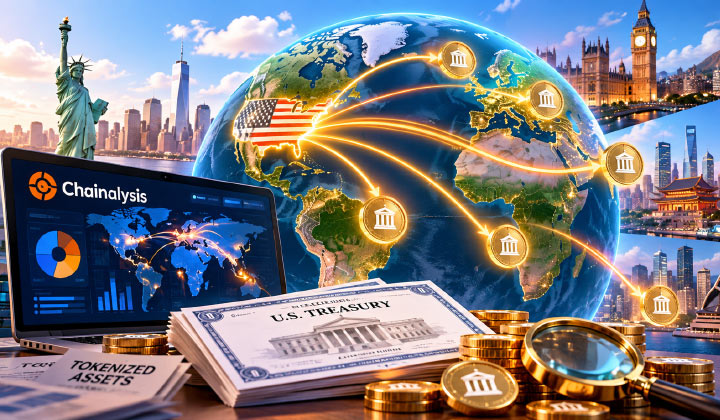
Blockchain analytics company Chainalysis has reported that Italy, Portugal & Singapore account collectively for 66.9% of tokenized U.S. Treasury holdings for which geographic ownership information could be identified. The United States accounted for 10.5% of the recorded value, showcasing the extent to which these countries are invested in blockchain-based investment products.
Tokenized Treasuries & Who Holds Them
Tokenized U.S. Treasuries represent traditional government debt instruments through digital tokens recorded on a blockchain. These products aim to combine exposure to Treasury securities with features of blockchain technology, such as digital transfers, programmable settlement & access through compatible platforms.
Tokenization is widening the overseas market for US government debt.
In our 2026 data, Italy, Portugal, and Singapore hold 66.9% of geolocated tokenized Treasury values. The US: 10.5%.
Tokenization lowers minimum position size and removes the need for a US brokerage relationship, giving overseas investors another route to US government debt.
— Chainalysis (@chainalysis) October 17, 2026
The Chainalysis figures offer an indication of the international distribution of this emerging market. However, the geographic percentages apply only to holdings with identifiable locations. They should not be interpreted as a complete breakdown of every tokenized Treasury investment worldwide, because some holders cannot be reliably located using available blockchain information.
Market Value Has More Than Doubled
The report also indicated that the value of tokenized U.S. Treasury assets increased from approximately $6.86B to $15.42B during the year ending July 1, 2026. That represents growth of roughly 125%, demonstrating the expansion of blockchain-based representations of traditional financial assets during the measured period.
Tokenized Treasury products have attracted interest from investors seeking exposure to government debt through digital financial infrastructure. Depending on the product, tokenization can potentially make transfers & settlement more flexible while allowing financial institutions to explore new ways of distributing investments.
Tokenization Doesn’t Erase The Risks
However, the risks inherent in the product are not reduced by the process of tokenization. The investors need to evaluate legal frameworks surrounding the structure of the product, the rights issued with the token, custody and liquidity in terms of the token, and the credibility of the issuer. The access to such products could also be restricted based on the jurisdiction or the specific qualifications of the investor.
The evidence found in the article suggests that the phenomenon of the demand for such a product is not particular only to the American market. Therefore, the international demand for products could influence the issuing structure’s strategy in terms of distribution, compliance, and access.
Stay informed with the latest trends in Web3, blockchain innovation, and cybersecurity updates at 3verseTV
You need to login in order to Like














Leave a comment