


A few months ago, Robinhood Chain did not exist.
Today, it has quickly become one of the busiest new networks in crypto.
Robinhood Chain went live on 1 July 2026 as an Ethereum Layer 2 built using Arbitrum technology. The original idea was simple: create a blockchain where financial assets such as tokenized stocks could move on-chain more easily.
But traders have taken the network in a much broader direction.
Memecoins, token launches, decentralized exchanges, AI projects and tokenized assets are all competing for attention. That activity has pushed Robinhood Chain to almost $931M in Total Value Locked (TVL), around $1.73B in 24-hour DEX volume and more than $10M in daily fees.
That makes Robinhood Chain interesting for a reason beyond Robinhood itself.
The network is starting to develop an economy of its own.
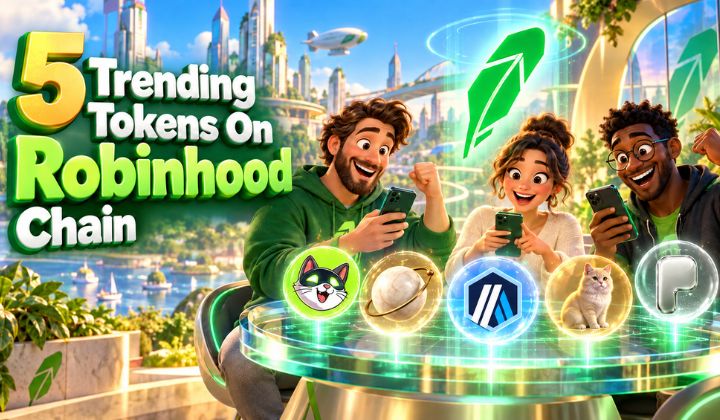
And within that economy, five tokens have emerged from very different corners of the ecosystem: PONS, Artificial Inu, CASHCAT, ORBIO and Arbitrum’s ARB.
Rather than calling them the “best tokens on Robinhood Chain,” this article looks at why these five are trending and what each one tells us about the growth of Robinhood Chain.
Why Is Robinhood Chain Growing So Quickly?
The original Robinhood Chain story was about bringing traditional finance onto blockchain rails.
Robinhood has been expanding its tokenized stock offering, while the chain gives those assets a dedicated environment for trading and other financial applications.
But once the network went live, crypto traders brought something else with them: speculation.
Launchpads began creating thousands of new tokens. Traders moved between memecoins and tokenized assets. Decentralized exchanges started processing much larger volumes.
That created a simple cycle.
More traders brought more volume. More volume created more fees. More fees attracted more projects. And more projects gave traders even more reasons to stay on the chain.
This is where the five tokens below become interesting.
Each one sits in a different part of that cycle.
Together, PONS, AI, CASHCAT, ORBIO, ARB represent five different sides of the Robinhood Chain ecosystem.
So, which tokens are trending on Robinhood Chain? The answer is coming from several different corners of the ecosystem.
1. What Is PONS Token On Robinhood Chain?
PONS is closely connected to the token-launch boom on Robinhood Chain.
Pons is a launchpad, which is a platform that helps projects create and launch new tokens without having to build the entire process themselves.
That may sound niche, but on Robinhood Chain it has become a major business.
Pons recently generated roughly $1.3M in daily protocol revenue, putting its annualised revenue run rate above $200M based on recent activity. It has also become one of the largest fee generators on the chain.
The reason is simple.
Every new token launch creates trading activity. That activity creates fees. And Pons captures a portion of that activity.
PONS has also introduced a token-burn mechanism, with around 80% of protocol revenue is used to accumulate PONS, which then gets burned.
That creates a direct relationship between the platform’s activity and the token’s supply.
The risk is just as clear.
Launchpad activity can change very quickly. If traders stop launching and trading new tokens, Pons revenue could fall just as quickly.
For now, PONS represents one of the clearest examples of Robinhood Chain turning speculative activity into protocol revenue.
2. What Is AI Token On Robinhood Chain?
Artificial Inu, or AI, takes a completely different approach.
It is a meme token, but instead of being paired mainly with ETH or a stablecoin, its main market is linked to tokenized NVIDIA on Robinhood Chain.
That creates a strange combination of two very different narratives.
On one side, you have the internet-driven world of memecoins.
On the other hand, you have tokenized financial assets.
The project has also built a community vault around this model. Fees generated through trading can be directed towards the vault which purchases tokenized $NVDA shares, while a portion of fees collected in AI is burned or locked.
That means the token is not simply relying on people talking about it.
Its narrative is increasingly tied to trading activity and the growth of the vault.
AI has also been one of the fastest-moving tokens on the network. In the latest market data, it was around a $268M market cap, after gaining more than 4,100% over the previous month.
But there is an important distinction.
Holding AI does not mean holding NVIDIA stock. The token does not give holders ownership of NVIDIA or a claim on the assets inside the vault.
That makes the tokenized-stock connection part of the narrative, not the same thing as owning the underlying company.
3. What Is CASHCAT Token?
CASHCAT is much simpler.
There is no complicated revenue model or tokenized-stock mechanism behind its story.
It is primarily a community-driven memecoin that has become one of the most recognisable Robinhood Chain meme coins.
And that matters because attention itself has become a major part of the network.
CASHCAT has built a large user base, with more than 110,000 holders in recent data. The token also sits at roughly a $156M market cap.
Its growth shows something important about new blockchains.
When a new network launches, users do not always begin with the most sophisticated financial application.
They often start with the easiest thing to understand.
A meme.
This makes CASHCAT an important part of the Robinhood Chain story because it shows how retail attention can be an entry point to a new ecosystem.
The problem is that attention can move as quickly as it comes.
4. What Is ORBIO Token On Robinhood Chain?
ORBIO is probably the most unusual project in this group.
Instead of focusing on memecoins or tokenized stocks, Orbio is building around AI credits.
These are credits that can be used for AI inference, meaning the computing required to run AI models.
The interesting part is how the token connects to the service.
Orbio charges a fee when ORBIO is traded, and part of that fee is converted into AI credits that are distributed to eligible holders.
Those credits can then be used for AI services, giving the token a connection to something outside the trading market itself.
So instead of simply giving users more tokens, the project is trying to give holders something they can actually use.
That makes ORBIO part of a wider trend in crypto: creating a reason to hold a token that goes beyond simply hoping its price rises.
The project is still very small compared with PONS, AI or ARB.
In the latest data, ORBIO had a market cap of around $30M and fewer than 4,000 holders.
That also means its market can move much faster in either direction.
A recent 24-hour gain of roughly 168% shows just how volatile smaller tokens on a new chain can become.
5. Is ARB Available On Robinhood Chain?
ARB is the least obvious token on this list.
It is not a token launched on Robinhood Chain like the other four.
Rather, it is the infrastructure beneath the network.
Robinhood Chain is built on the Arbitrum technology stack, so activity on Robinhood Chain is also relevant for the broader Arbitrum ecosystem.
10% of net protocol revenue collected by Robinhood Chain is sent to Arbitrum; 50% to the Arbitrum DAO treasury and 50% to a developer fund.
That has already become a meaningful source of revenue for Arbitrum.
Standard Chartered recently started coverage of ARB with a target of $10 by the end of 2030, compared with around $0.14 at the time of the report. The bank expects ARB to reach $0.50 by the end of 2026, $1.50 in 2027, $3.50 in 2028, $6.50 in 2029 and $10 in 2030. The thesis partly rests on Robinhood Chain, which has pushed Arbitrum’s monthly revenue run rate to around $5M, more than 5 times its level before Robinhood Chain launched. Standard Chartered also expects the tokenization of traditional assets to reach around $4T by the end of 2028.
But there is an important catch.
The revenue going to Arbitrum does not currently go directly to ARB holders.
That means the Robinhood Chain connection is currently an ecosystem and governance story rather than a direct revenue distribution to the token.
What Do These Tokens Tell Us About Robinhood Chain?
Robinhood Chain was launched with a focus on financial applications and tokenized assets. But its early growth shows that the ecosystem is becoming much broader.
Launchpads are bringing new tokens and traders onto the network. Memecoins are bringing attention and liquidity. AI projects are experimenting with new forms of on-chain utility, while tokenized stocks are connecting crypto trading with traditional financial assets.
And underneath all of it sits the Arbitrum infrastructure that powers the chain.
That is the more interesting Robinhood Chain story.
It is not just one new blockchain with one use case. It is becoming a market where different types of crypto activity are developing at the same time.
For anyone wondering how to buy tokens on Robinhood Chain, the process depends on the asset and the decentralized exchanges supporting it.
The question now is whether that activity can continue after the initial excitement around a new chain begins to fade.
Final Takeaway
Robinhood Chain has moved quickly from a new blockchain launch to a growing trading ecosystem.
Its rise is not being driven by one thing.
Tokenized assets are bringing financial activity on-chain, while launchpads, memecoins and new applications are bringing crypto-native traders.
That combination has created a growing market for Robinhood Chain crypto tokens, with different projects capturing different parts of the growth.
PONS, Artificial Inu, CASHCAT, ORBIO and ARB each represent a different side of that story.
The bigger question is whether Robinhood Chain can turn this early burst of activity into a lasting ecosystem.
Disclaimer: This content is for educational purposes only and is not meant to be financial advice. Please consult a financial advisor before making any investment decisions.
Stay informed with the latest trends in Web3, blockchain innovation, and cybersecurity updates at 3verseTV
You need to login in order to Like














Leave a comment