


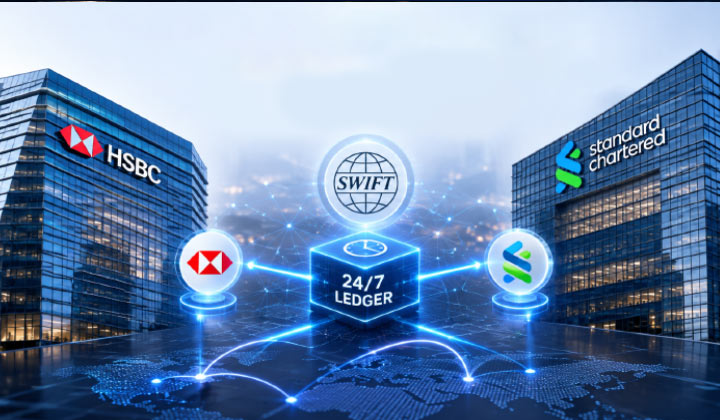
HSBC and Standard Chartered have completed the first live interbank transaction in a pilot of Swift’s new blockchain-based ledger, marking a significant step in the development of 24/7 cross-border payments. The banks used the network to issue, transfer and settle tokenized deposit obligations across borders in real time. The transaction is part of Swift’s effort to explore how shared-ledger technology could make international payments faster and more efficient.
The two banks exchanged payment messages through Swift’s ledger, which matched and netted the resulting obligations before final settlement took place through existing systems.
Source: sc.com
The transaction follows a pilot announced by Swift in July, when 17 banks across six continents agreed to test live transactions using tokenized deposits for round-the-clock payments.
Banks are increasingly exploring blockchain-based systems as they face pressure from stablecoins and other digital payment technologies. In traditional cross-border payments, several banks may need to maintain liquidity throughout the payment chain. This can increase costs and slow settlement.
A shared ledger could allow debits and credits to be coordinated more efficiently, potentially reducing liquidity requirements and improving the speed of settlement.
Lewis Sun, HSBC’s head of digital currencies, said the transaction demonstrates how digital money issued by banks can work across different financial institutions while maintaining the regulatory oversight of the existing financial system. He said the pilot is also aimed at addressing practical challenges such as moving money globally, improving cash visibility and reducing problems linked to legacy systems.
Standard Chartered payments chief Naveen Mallela said Swift’s core infrastructure has remained largely unchanged for decades and described the move from messaging towards ledger-based infrastructure as a natural evolution.
Swift brings a significant existing network to the project. The Belgium-based financial messaging network is used by more than 11,500 financial institutions and processes more than $7.5 trillion in transactions each day, according to the information provided.
That existing reach could give Swift an advantage over newer blockchain-based payment networks. Debo Sen, head of digital assets at Citi, said an organisation with Swift’s broad participation could play an important role in creating network effects for tokenized deposits.
Citi itself has been developing blockchain-based payment infrastructure through Citi Token Services, which Sen said is already processing billions of dollars a day across five branches.
The transition, however, is unlikely to happen overnight. Financial institutions still need to integrate new technology with existing systems while addressing regulatory, operational and liquidity considerations.
Standard Chartered’s Mallela said stablecoins and tokenized deposits should be viewed as complementary rather than competing technologies. In his view, tokenized deposits could eventually become a major part of wholesale institutional settlement, while stablecoins may find stronger use in areas such as retail payments, remittances and consumer transactions.
The first live transaction therefore represents more than a technology test. It is an early indication of how major banks could use blockchain-based infrastructure while continuing to operate within the existing financial system.
LATEST: 🏦 HSBC and Standard Chartered completed the first live interbank transaction on Swift’s new blockchain-based ledger. pic.twitter.com/fjGzO5Yowk
— CoinMarketCap (@CoinMarketCap) August 20, 2026
Stay informed with the latest trends in Web3, blockchain innovation, and cybersecurity updates at 3verseTV
You need to login in order to Like

















Leave a comment