


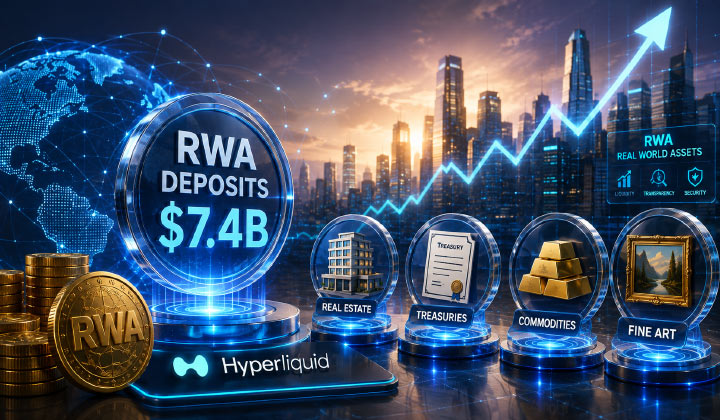
Despite a general slowdown in decentralized finance, real-world asset (RWA) deposits into DeFi platforms increased to $7.4 billion in the second quarter of 2026, and RWA contracts accounted for 32.2% of Hyperliquid’s trading activity. Even as the overall cryptocurrency market declines, investors are increasingly embracing tokenized conventional assets for lending, borrowing, and trading, according to CoinShares and Hyperliquid. This shows increased trust in blockchain-based financial products.
One of the few bright spots in an otherwise cooling market is tokenized real-world assets, which are gradually gaining traction throughout decentralized finance. Even tho overall DeFi activity has decreased, investors are still moving traditional financial assets onto blockchain networks and actively using them, according to recent data from CoinShares, Token Terminal, and Hyperliquid.
Over the past 365 days, real-world assets (RWAs) have moved beyond tokenisation into increasingly active onchain markets.
Together with @tokenterminal, we look at the growth of Hybrid Finance across deposits, trading and derivatives, and what could define its next phase.… pic.twitter.com/D8kEvM1A6j
— CoinShares (@CoinSharesCo) August 6, 2026
Tokenized RWA deposits into DeFi lending systems and decentralized exchanges totaled $7.4 billion in the second quarter of 2026, according to CoinShares. Compared to the $2.3 billion reported during the same period last year, it is more than three times greater. Conversely, overall DeFi deposits decreased by around 15% year over year as investors withdrew money from several crypto-native products due to declining cryptocurrency values.
According to the research, investors are using traditional assets instead than only tokenizing them. RWAs are being used as collateral by many to trade on blockchain-based platforms, generate income, and borrow money. Tokenized US Treasury and multi-strategy funds, such as BlackRock’s BUIDL, JTRSY, and Sky’s sUSDS, have contributed significantly to the recent increase. Because they continue to produce revenue while acting as collateral, private credit products like Ethena’s sUSDe also made a substantial contribution.
With around 70% of all RWA deposits in lending markets, Ethereum continues to be the most popular blockchain for tokenized RWAs. Solana improved its standing with the Kamino lending platform, and Plasma came in second. According to CoinShares, Ethereum’s substantial liquidity makes it simpler for lenders and borrowers to do business effectively, which is why it still dominates.
The increasing popularity of tokenized assets was also evident in trading activity. Over the previous year, RWA spot trading volume increased by nearly 220%, despite a roughly 70% decline in total decentralized exchange trade. Strong trading interest was generated by gold-backed tokens like XAUT and PAXG, and institutional adoption increased when BlackRock’s BUIDL started to be utilized as collateral in business transactions.
A similar picture is presented in Hyperliquid’s most recent quarterly report. According to the decentralized exchange, HIP-3 RWA perpetual contracts made up 32.2% of all trade volume in the second quarter, a significant increase from 20.7% in the previous quarter and only 1.8% in late 2025. 6.6% of the protocol’s $169 million quarterly income came from RWA trading, which totalled $213 billion during the quarter.
Stay informed with the latest trends in Web3, blockchain innovation, and cybersecurity updates at 3verseTV
You need to login in order to Like
















Leave a comment