


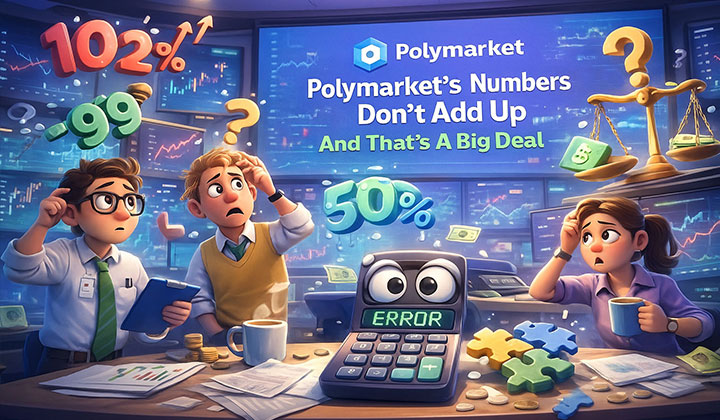
Forget the headlines that shouted 25 billion dollars in volume. What if much of that noise is just an echo, the same trade counted twice. Imagine investors, journalists, and potential buyers reading a number that looks like rocket fuel for a company, only to discover later that the fuel tanks were half empty all along.
That’s the story Paradigm’s researcher Storm uncovered: major analytics dashboards have been double counting Polymarket’s trading volume because the platform’s on-chain events describe each trade from multiple angles, and innocent duplication has been mistaken for extra activity.
Polymarket explained
Before we talk about dashboards, data bugs, and billion dollar valuations, let’s slow down for a second.
Imagine a website where people place bets on real world questions like Who will win the next election, Will interest rates go up this year, or Will a new technology be approved by regulators.
The prices people are willing to bet at reflect how likely they think something is to happen. That, in essence, is Polymarket.
Polymarket is a prediction market. It allows users to trade on the probabilities of future events. You do not need to be a trader in the traditional sense.
You are not buying stocks or complex financial products. You are simply expressing a view on the future and backing it with money. When many people participate, the market price becomes a surprisingly accurate signal of collective belief.
That is why prediction markets are often called truth machines.
To keep this system open and transparent, Polymarket runs on blockchain technology. Instead of a bank or company quietly updating a database, every trade is recorded publicly on a shared digital ledger.
This design builds trust, but it also introduces technical complexity. And that complexity is exactly where the story begins.
To keep this system open and transparent, Polymarket runs on blockchain technology. Instead of a bank or company quietly updating a database, every trade is recorded publicly on a shared digital ledger.
This design builds trust, but it also introduces technical complexity. And that complexity is exactly where the story begins
The subtle bug that inflated success
Picture this. A trade happens on Polymarket. The smart contracts emit two OrderFilled events, one describing the trade from the maker’s point of view, the other from the taker’s. Both events are true. Both are accurate. But they are not two trades. They are two descriptions of the same trade.
Now picture data engineers and dashboard feeds automatically adding up every OrderFilled event they find. What you get is not a single clean total. You get the same dollar value counted twice.
That’s what Storm at Paradigm says has happened across many popular analytics sites. DeFiLlama, Allium, Blockworks, and even multiple Dune dashboards all fell into the same trap. The net result is that headline volumes, the numbers that shape perception, valuations, and investor confidence, may be significantly overstated.
Why the mistake happened
Polymarket isn’t trying to deceive anyone. Its on- chain design is complex by necessity. Trades can be simple swaps, or they can be splits and merges where both parties exchange cash for opposing positions.
To keep track, the smart contracts emit redundant events for tracking and reconciliation. But most block explorers and data pipelines treat every event as a separate action. They do not always interpret the deeper contract level intent. These duplicate events are two views of one action, not two separate actions.
In simple terms, the data has too many layers, and standard tools were never built to fully understand them. Paradigm found that this duplication inflated both notional volume and cashflow volume, the two metrics most commonly used to measure prediction markets. On paper, Polymarket looked twice as busy as it truly was.
The stakes: perception, valuation, and trust
Numbers matter. The Intercontinental Exchange reportedly valued Polymarket at around nine billion dollars recently, citing trading figures from widely used dashboards.
Earlier reports suggested valuations between ten and fifteen billion dollars. Dune Analytics even highlighted a monthly record of three point seven billion dollars in November. If those figures include duplicated trades, the story changes quickly.
When numbers are overstated, perception runs ahead of reality. Investors make decisions on shaky foundations. Media narratives harden before anyone asks how the data was calculated. Internal teams celebrate milestones that may not reflect real growth. In markets driven by sentiment, especially crypto and prediction markets, these distortions spread fast.
A missed lesson for the industry
Here’s the uncomfortable truth. This is not just a Polymarket issue. It is an industry wide problem. As prediction markets become a more serious financial sector, the way activity is measured needs to mature too. Storm’s observation that analysts adopted flawed accounting methods because the data was complex should be a wake up call.
The industry needs shared standards. Clear definitions. Transparent explanations. Imagine dashboards that clearly state whether volumes are deduplicated. Imagine knowing whether a metric represents raw activity or actual cash movement. Imagine analysts and investors reading numbers with full context instead of blind trust. That is how healthier markets are built.
What should change and what you can do
First, data providers need to fix their pipelines. They must interpret contract logic, not just surface raw events. That means recognizing when multiple events represent a single economic action. Second, platforms like Polymarket should publish clear reporting guidelines that explain how to correctly calculate volume. Third, analysts and journalists should ask better questions.
Did the data account for duplicate maker and taker events. Which volume metric is being reported. Is this number notional volume or real cashflow. These are simple questions, but they change everything.
If you are an investor, imagine scanning the next opportunity with this checklist in mind. Verify how the volume was calculated. Check whether the data source explains its methodology.
Compare multiple interpretations before accepting a headline number. This habit alone can prevent expensive mistakes.
A narrative turned practical
A few months ago, an analyst at a mid sized investment fund pitched Polymarket as one of crypto’s rare success stories. The recommendation leaned on public dashboards and an impressive volume chart that seemed impossible to ignore. The fund committed capital.
Then Paradigm’s research surfaced. The team paused. They reviewed the methodology behind the reported numbers. They realized that a large portion of the volume stemmed from duplicate event counting.
The thesis did not collapse overnight, but it changed. What looked like unstoppable momentum became cautious optimism backed by closer scrutiny. That shift alone likely saved the fund from overextending.
The bigger promise: better markets through better data
Prediction markets are built on information. They price uncertainty and reward accurate beliefs. For them to work well, the underlying data must be trustworthy. Polymarket’s volume issue is not a scandal. It is an opportunity to improve.
It is a chance for platforms, data providers, and analysts to align on standards that prevent misleading metrics. Better tools mean clearer insight. Clearer insight means smarter capital allocation. And smarter decisions benefit everyone involved.
Final word: trust the method, not just the number
Big numbers are seductive. They compress complexity into clean charts and bold headlines. But complexity does not disappear just because it looks neat on a dashboard. Polymarket’s case shows how a small technical detail can ripple outward into valuations, narratives, and major financial decisions.
As prediction markets grow up, precision must grow with them. Demand transparency. Ask how the number was calculated. Look for clarity before excitement. Imagine being the analyst who caught the flaw early. The engineer who built the fix. The investor who paused before following the crowd.
Better markets start with better questions. Start by asking one simple thing. How exactly was this number counted?
You need to login in order to Like















Leave a comment