



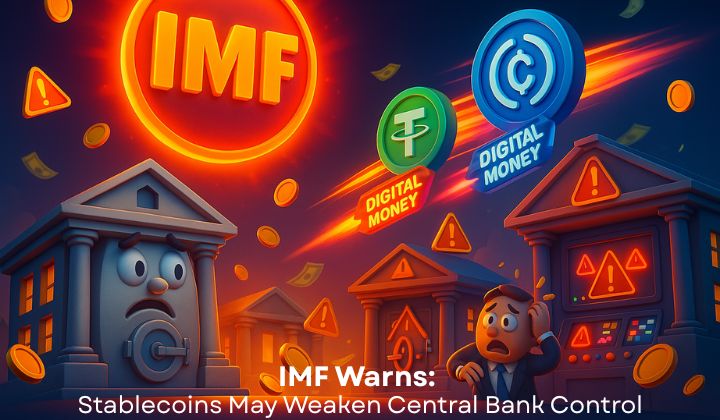
“A world where crypto grows so wide leaves shaky economies with little to hide.”
Global policymakers have received a dire warning from the International Monetary Fund (IMF). Digital stablecoins may weaken national currencies and lessen central bank supervision.
It is particularly in nations already dealing with inflation or inadequate financial institutions, according to a recent IMF paper titled “Understanding Stablecoins”.

According to the IMF, dollar-backed stablecoins like USDT and USDC are expanding quickly and becoming simple cross-border instruments.
Because of this, individuals and companies in unstable economies may begin to use stablecoins in place of their native currencies. The IMF worries that this change, known as currency substitution, may quicken.
The two largest stablecoins have tripled in size since 2023, reaching a combined worth of $260 billion, with trading volume surpassing $23 trillion this year, according to the IMF’s assessment.
They are appealing substitutes for weak national currencies because of their quick growth.
The IMF warned that if international coordination and interoperability are not guaranteed, this trend may increase the volatility of financial flows, circumvent conventional capital controls, and disrupt national payment systems.
According to the IMF, “these risks are strongest in countries with high inflation, weak institutions, or low confidence in central banks.”
However, the IMF did not completely oppose stablecoins. Rather, in order to remain competitive, it advised governments to create stricter laws, enhance domestic financial institutions, and update payment networks.
The IMF’s caution draws attention to an increasingly pressing issue as stablecoins become more prevalent in the financial sector: will digital dollars take over, or can weaker economies defend their monetary systems? The response could influence how international finance develops in the future.
You need to login in order to Like















Leave a comment