



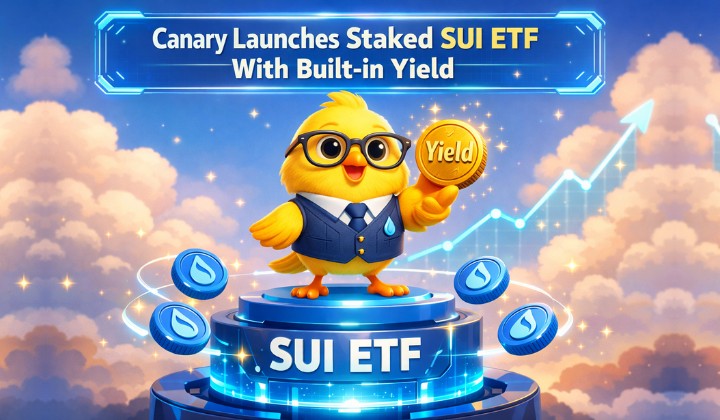
A spot SUI exchange-traded fund that is listed in the United States has been introduced by Canary Capital. It represents a further development of cryptocurrency investment products beyond bitcoin and ether by incorporating staking incentives.
The Canary Staked SUI ETF is structured to track the market price of the SUI token while simultaneously participating in the network’s proof-of-stake validation process.
By embedding staking within the fund, net rewards generated from validator participation are reflected in the ETF’s net asset value. As a result, investors can profit from yield and token appreciation without having to worry about wallet management or staking infrastructure.
The Sui blockchain, a layer-1 network created by engineers who were previously working on Meta’s Diem project, is powered by the underlying Sui token.
The blockchain has positioned itself as a platform for consumer applications, such as digital marketplaces, decentralised banking protocols and gaming ecosystems. Scalability and low-latency transactions appropriate for high-volume use cases are the goals of its architecture.
Asset managers are increasingly attempting to incorporate new layer-1 ecosystems into well-known investment frameworks, as demonstrated by the ETF’s filing. For traditional investors, ETF wrappers offer regulated access, brokerage compatibility and simplified reporting compared to direct crypto ownership.
Additionally, Grayscale’s Sui staking ETF is listed concurrently with the debut, indicating heightened competition among issuers aiming for yield-bearing cryptocurrency ETFs. Growing trust in proof-of-stake networks as investable assets with the potential to produce steady on-chain profits is indicated by this competition.
But the product can also test the limits of regulations. Crypto ETFs that generate returns are still being closely monitored, especially in relation to how securities frameworks handle staking rewards. In the past, regulators have been wary of products that combine income features linked to blockchain participation with capital appreciation.
The need for varied crypto exposure is nevertheless growing in spite of these factors. ETF formats are appealing entry points since investors are increasingly looking for access to next-generation networks without operational complexity.
The SUI ETF might act as a model for other funds that concentrate on developing blockchain ecosystems if it proves to be successful.
You need to login in order to Like















Leave a comment