



Vitalik Buterin believes artificial intelligence could eventually replace traditional crypto wallet interfaces and become the main way users interact with blockchain applications.
Speaking in a recent interview, the Ethereum co-founder said humans would still be the actual owners and decision-makers, but AI systems could handle most of the technical interactions behind the scenes.
Buterin explained that Ethereum currently serves two major functions: acting as a public data layer and powering decentralized applications through computation.
According to him, those roles will remain important in an AI-driven future, but the way users interact with crypto will change dramatically.
Instead of manually switching between wallets, decentralized apps, and websites, AI agents could eventually manage all those tasks automatically. These systems would interact directly with wallet software and APIs, removing the need for traditional user interfaces altogether.
“Maybe you don’t need a wallet,” Buterin said, suggesting that future users may simply communicate instructions to AI systems while the technology handles execution in the background.
A major part of his vision involves decentralized AI systems interacting with one another across blockchain networks. Buterin argued that blockchain infrastructure provides a trust layer that allows independently developed AI agents to coordinate securely without relying on centralized control.
He also stressed the growing importance of zero-knowledge, or ZK, technology. According to Buterin, AI systems should be able to verify reputation, identity, or fund sources without exposing unnecessary personal information.
This selective disclosure approach could enhance privacy while still enabling trust among participants.
At the same time, Buterin warned that AI could create new risks for digital systems. He noted that many online attacks that once required significant effort may become automated and easier to execute as AI tools improve.
The Ethereum team is now working on infrastructure to more securely support AI-based interactions on the blockchain. This includes privacy-focused ZK APIs that could help AI agents make payments and interact across applications without exposing user identities.
Buterin also suggested that future layer-2 blockchain networks should become more specialized rather than simply copying Ethereum’s existing structure. Some could focus specifically on privacy, trading, or AI-related applications.
His comments reflect a growing industry conversation around the overlap between artificial intelligence and blockchain technology, two sectors that many believe could become increasingly connected over the next decade.
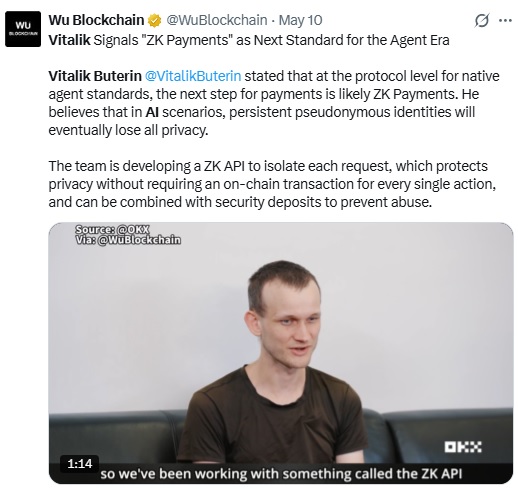
Source: X.com
You need to login in order to Like

















Leave a comment