


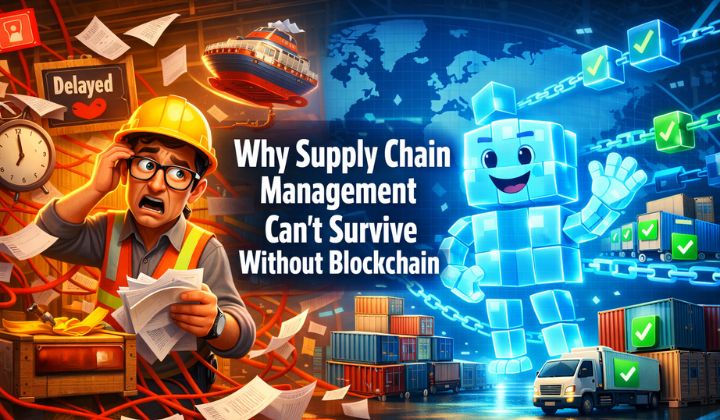
Supply chain management is an integral part of giant companies around the globe but traditional methods are seen to be far more lacking in providing solutions. This is the point at which supply chains are streamlined by blockchain, revolutionizing commercial processes.
Blockchain for supply chains enhances performance, lowers costs and optimizes efficiency also enabling real-time product tracking and preventing fraud. Let’s first examine how blockchain works.
What Is Blockchain?
A blockchain is a collection of blocks that function as a safe ledger for transactions as well as a repository for data. New transactions are grouped into a block which are validated by computers, when the network agrees the block is correct, this verified block is called finished block, which is then linked to the previous block that joins the permanent blockchain.
Secure money, property and contract transfers are made possible by the database, which is updated with every new block that is added. To put it briefly, blockchain is an internet-based software protocol. A new economy is ushered in by this technology.
Industries & Sectors Adopting Blockchain For Supply Chain Management
Blockchain technology has received a lot of attention from a variety of industries and is widely being used. In essence, the distributed database system safely and transparently records data and transactions on a decentralized computer network.
It’s a fresh approach to an old industry issue. That is primarily why different industries and sectors like healthcare, real estate, government operations, supply chains, banking & finance, law enforcement & security are relying on blockchain and enhancing blockchain adoption.
Understanding Supply Chain
Supply chain is basically the complete process of delivering the products from the production point to the end user. This process involves the entire drill from collecting the raw materials, creating the goods going through wholesalers and retailers till it reaches the customer.
In today’s world every product that you buy, be it groceries that you order from say Blinkit or Zepto or your favourite outfit bought from your preferred fashion apps like Amazon or Flipkart, goes through the complex process of supply chains. Needless to say it is complicated and cumbersome, this is where blockchain acts like a saviour.
How Blockchain Technology Streamlines Supply Chain
With its exceptional openness, security, and efficiency, blockchain technology is quickly becoming one of the most revolutionary forces that have ever changed supply chain management.
It provides an answer to a lot of the problems that conventional supply chains encounter. Blockchain can significantly increase the effectiveness, security, and reliability of supply chain operations by offering a transparent, unchangeable, and impenetrable record of transactions.
Supply chain management is a perfect fit for blockchain in many respects. It is simpler to monitor and confirm the state of items as they go through the supply chain thanks to blockchain technology, which provides a tamperproof and decentralized record of transactions.
Procurement managers, for instance, frequently follow a number of procedures while monitoring products and services. Several stakeholders are involved in these processes, typically at several locations. Transparency is a natural advantage if everyone updates a blockchain as they complete their tasks.
Traditional Methods In Supply Chain Companies & Problems Therein
The supply chain has grown more intricate, some may even say laborious. Supply chains are fraught with problems regardless of the commodity in question, be it consumer goods, food products, equipment, or digital offers. Supply chain specialists have been dealing with these problems every day using traditional methods.
- Payment between a vendor and a consumer or between a manufacturer and a supplier takes days.
- Contractual agreements necessitate the involvement of bankers and attorneys, both of which increase expenses and delays.
- Defects are difficult to eradicate since it is frequently difficult to identify the providers of products and parts.
- One major issue in the supply chain is friction. The number of go-betweens is excessive. The back and forth is excessive.
- Instead of communicating directly with one another, suppliers, providers, and clients must do so through central third-party businesses.
Alarming Repercussions Of These Complications
- Disruptions to the supply chain now cost businesses an average of $184 million a year.
- 60% of businesses don’t know anything about their tier-1 suppliers.
- Each year, the shipping sector loses $550 billion due to manual procedures and documentation errors.
- Globally, authentic businesses lose around $2.2 trillion due to counterfeit items.
The Advantages Of Blockchain For Supply Chain Management
Blockchain is contributing to streamline supply chains. Following are a few benefits that blockchain is providing in supply chain management:
Real-time Tracking: Stakeholders track the real time movement and flow of the products therefore increasing accountability.
Smart Contract: Smart contracts reduce delays and disputes and enable seamless payment processing.
Removing Intermediaries: Blockchain eliminates the need for middlemen by enabling peer-to-peer transactions directly, which lowers transaction costs and administrative burden.
Simplifying Procedures: Automating manual labor and workflows increases operational effectiveness, lowers labor expenses, and minimizes supply chain management errors.
Preventing Counterfeiting: Businesses can authenticate items and stop losses from counterfeit goods by using blockchain’s visible and unchangeable ledger, which reduces the expense of recalls and harm to a brand’s reputation.
Indian Companies Using Blockchain For Supply Chain Management: Many leading Indian companies are using blockchain and in 2026, more than 50 Indian startups will be using blockchain to improve supply chain security, efficiency, and transparency.
Tech Mahindra, Hindustan Unilever (logistics), and Hindalco (waste management) are some of the major adopters. In the logistics and supply chain industry, specialized platforms such as Vayana (trade financing) and TraceX (food safety) are also at the forefront. TRST01, NAKAD, and Lynkit are a few other noteworthy startups.
Manufacturing & Industrial: Hindalco tracks garbage from production to disposal using blockchain technology. Technology is used by Tata Steel for asset management and business financing.
Logistics & Food Traceability: For food safety and traceability, TraceX specializes in farm-to-fork tracking. Blockchain is being used by Sahyadri Farms to improve supply chain efficiency in agriculture.
FinTech & Trade Finance: Vayana is an expert in supply chain finance driven by blockchain technology. 37 banks collaborate with Primechain Technologies on blockchain projects, such as invoice discounting.
Case Studies In Logistics
1. Maersk & IBM: IBM, a technology and consulting firm, and Maersk, a major player in the Danish container shipping and logistics industry, collaborated to create TradeLens, a blockchain-enabled platform intended to streamline international supply chains, boost transparency, and cut down on paperwork. TradeLens uses IBM’s Hyperledger Fabric blockchain and automated contract execution for cargo and shipment tracking. The advantages experienced are listed below..
- Maersk has reduced paperwork as a result of this. A 90% reduction in paperwork, mostly bills of lading and customs documents, has simplified operations.
- Blockchain technology has saved the shipping industry $4 billion annually by doing away with the need for manual intervention and paper-based processes.
2. FedEx is tracking shipments with the help of Hyperledger Fabric Blockchain. Smart contracts help FedEx automate customs declarations, and shipping status notifications and cargo tracking. Following are the advantages:
- Delays were decreased at customs, thanks to improved transparency and real-time visibility.
- By using blockchain technology to automate a number of processes, costs associated with manual processing and shipment errors were decreased. |
3. Amazon uses Ethereum and AWS Blockchain for Supply Chain. Blockchain technology is used by Amazon to automate decentralized supply chain tracking, logistics processing, and payment systems.
Hurdles In Broader Usage Of Blockchain In Supply Chain Management
- The broad use of blockchain is hampered by a lack of established policies and regulatory uncertainties.
- One of the real-world implementation issues is that any firm will find it extremely difficult to transition from traditional supply chains to blockchain-based systems.
- Technical obstacles and change management, which is a process of planning, implementing, and supporting changes to ensure that changes are adopted effectively by the team during the transition period, present a number of difficulties. All of these demand that businesses give them enough thought and preparation.
- Furthermore the high energy consumption of blockchain networks’ consensus processes, particularly the proof-of-work consensus mechanism that is used to validate transactions and secure the blockchain, has drawn criticism because of its high energy and time consumption., as miners have to solve complex computational puzzles of transactions in order to add a new block to the blockchain.
- Despite their enormous potential for supply chain process automation, smart contracts are still limited in their ability to handle complex business logics and real-world situations.
What Must Be Done To Maximise Blockchain Adoption
- By contracting with reputable IT partners to handle small-scale pilot projects, many businesses can start implementing blockchain. This approach lowers risks and enables a rollout in stages.
- Training sessions and workshops should be given to the participants to emphasize the advantages of using blockchain, like total transparency, full security and complete traceability. To promote understanding and trust, blockchain should be incorporated into the less sensitive supply chain steps before going on to more important ones.
- Make use of blockchains with low energy consumption methods such as Proof-of-Stake (PoS), which allows validators to stake their cryptocurrencies in order to validate transactions and get payment. This procedure uses very little energy and is quick. For Example Walmart uses Ethereum, a PoS blockchain for food traceability.
- Businesses can encourage blockchain adoption by providing participants with operational and financial incentives. By paying for first transaction fees, lowering onboarding costs, and equitably allocating implementation costs, they should lower entry barriers.
- For blockchain to be adopted more widely, rules must be supportive and unambiguous. Blockchain use will increase more quickly and safely the more stable and transparent the regulatory environment.
Conclusion
Supply chains will not undergo a complete revolution overnight. Nonetheless, supply chains have already begun implementing blockchain in certain aspects of their business processes.
The waste and expensive delays caused by human document processing are reduced with the use of smart contracts. From there, new avenues for quicker, smarter, and safer supply chain operations have become available.
A more ethical and sustainable supply chain is promoted by blockchain, which also improves cooperation between supply chain participants.
Even if adoption issues like scalability and regulatory frameworks still exist, a cooperative approach and the adoption of a shared framework can offer a practical answer.
All things considered, blockchain has the potential to completely transform supply chain management; however, a few obstacles must be removed before it can be widely used.
It is probable that more businesses will use blockchain to increase supply chains’ effectiveness, transparency, and security as the technology develops and matures.
Stay informed with the latest trends in Web3, blockchain innovation, and cybersecurity updates at 3verseTV

You need to login in order to Like













Leave a comment