


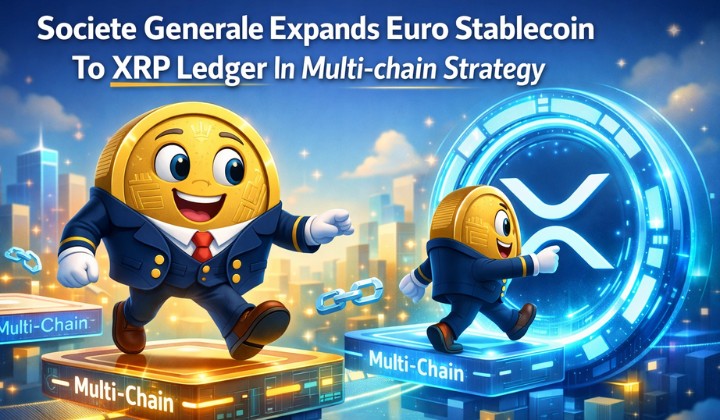
After launching its euro-denominated stablecoin, EUR CoinVertible, on Ethereum and Solana, the French banking group Societe Generale (SocGen) has now extended it to the XRP Ledger, its third blockchain deployment.
Ripple’s custody infrastructure supports the rollout, which may allow for wider integration throughout the Ripple ecosystem, including the use of the stablecoin as trading collateral in institutional markets. According to SG-FORGE, Societe Generale’s digital asset division, the action aims to increase institutional accessibility by providing multi-chain interoperability.
The fact that EUR CoinVertible is 1:1 backed by bank deposits or premium securities supports its status as a regulated digital payment system. As a result of their gradual adoption within institutional workflows, there are already about 70 million tokens in circulation.
The expansion comes after a test of SocGen’s stablecoin in tokenised bond settlement scenarios involving both fiat and digital currencies, carried out by the international financial messaging network SWIFT. The pilot showed how blockchain-based settlements may coexist with traditional financial infrastructure through interoperability standards.
The broader backdrop includes ongoing policy debates about digital currency sovereignty across Europe. Joachim Nagel, the president of the German central bank, has made the case that digital payment instruments denominated in euros, such as stablecoins and CBDCs, might increase regional autonomy from digital assets based on the dollar.
The stablecoin scene in Europe has also changed as a result of MiCA rules, which mandate that issuers get authorisation and adhere to stringent reserve and operational standards. Institutional experimentation with regulated stablecoin models has accelerated as a result of issuers pursuing compliance while others have left the region.
Institutional customers may work across various blockchain ecosystems, which is reflected in SocGen’s multi-chain strategy. The bank hopes to optimise flexibility, liquidity availability, and integration prospects across tokenised financial products by implementing its stablecoin on a variety of networks.
This expansion demonstrates how banks are no longer merely passive viewers of blockchain-based financial infrastructure, but are already actively involved in it.
You need to login in order to Like
















Leave a comment