


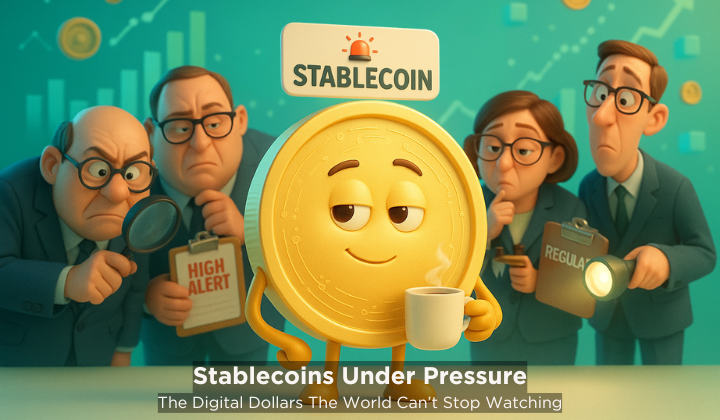
Stablecoins serve as these digital dollars meant to hold steady. They aim to stay calm even as the rest of the crypto world gets stormy. Still, they ran into fresh doubts about their real stability back in starting December.
Regulators put out new warnings around that time. S&P Global Ratings also dropped the rating on the biggest stablecoin out there.
Those events really rattled the whole market. It sits at over $233 billion in value these days. Users ended up questioning what stable even means in this setup.
What Stablecoins Are: The Digital Dollars Built for Certainty
Imagine money that never flinches.A dollar you can send instantly across borders,blockchains, and the world.
That’s the promise of stablecoins.
Stablecoins are digital tokens pegged to real-world assets , most often the U.S. dollar. They exist to do one thing: stay stable.
They bridge the old world (banks, cash, institutions) and the new world (crypto, DeFi, digital finance).
They let users stay on-chain without suffering crypto’s wild volatility and allow value to move at internet speed, without permission or delay.
For millions, they became the modern definition of “safe.”
Why Stablecoins Became So Powerful
Stablecoins grew from $1.5 million in 2016 to over $232 billion today for one simple reason: Stability is the most valuable currency in crypto.
Stablecoins provide :
- Instant profit protection, allowing users to lock in gains without leaving the blockchain.
- Frictionless global transfers, which are cheaper than banks and faster than remittances.
- Monetary escape routes, particularly in regions affected by inflation.
- DeFi liquidity, enabling lending, earning, and automated markets.
- Predictable pricing, even when crypto experiences sharp fluctuations.
They have become both a safe harbor and the backbone of the modern crypto economy. However, every powerful system eventually faces a moment when its strength is tested.
Top 5 Stablecoins of 2025
The stablecoin landscape is dominated by five giants:
- USDT (Tether) — nearly 70% market share; backed by cash, metals and other reserves
- USDC (Circle) — transparent audits; widely used by institutions
- USDS (Sky/Maker) — the evolution of DAI; yields up to 8.75%
- USDe (Ethena) — a hedged, high-yield decentralized coin; over $6 billion minted
- FDUSD (First Digital) — Asia-based, zero-fee minting, strong regulatory positioning
They power the crypto market and move billions every day. They define how value flows across digital economies.
Currently, each of these withstand a global spotlight
Stability Under Scrutiny
S&P Global Ratings downgraded Tether’s USDT to “5 (weak)”, citing:
- Increased exposure to volatile assets like bitcoin, gold and corporate bonds
- Unclear custody of reserves
- Weak transparency in asset segregation
- Potential problems with redemption capacity during stress
Despite maintaining its $1 peg, USDT’s true stability has come into question. Repetition is hypnotic.
So is doubt.
Europe Sounds the Alarm
Two days earlier, the European Central Bank warned that stablecoins could:
- Drain deposits from euro-area banks
- Undermine financial stability
- Trigger fire-sale liquidations if a major stablecoin faced a redemption run
Behind the warning lies a simple truth:
If everyone wants to cash out at once, someone must sell real assets — fast.
The Turning Point for the “Stable Dollar”
Stablecoins were created to protect users. They aim to offer safety in chaos and provide certainty when markets tremble. However, the events of November 2025 sent a different message: stability without transparency is fragile, and stability without trust is temporary. The digital dollar isn’t going away, but the world is paying closer attention
Now, the question is both captivating and urgent: how stable is your stablecoin when the world starts to shake?
You need to login in order to Like
















Leave a comment